
Buy PDF guide

Buy PDF guide — 29.99 USD

PDF — 29.99 USD

DENMARK

DENMARK

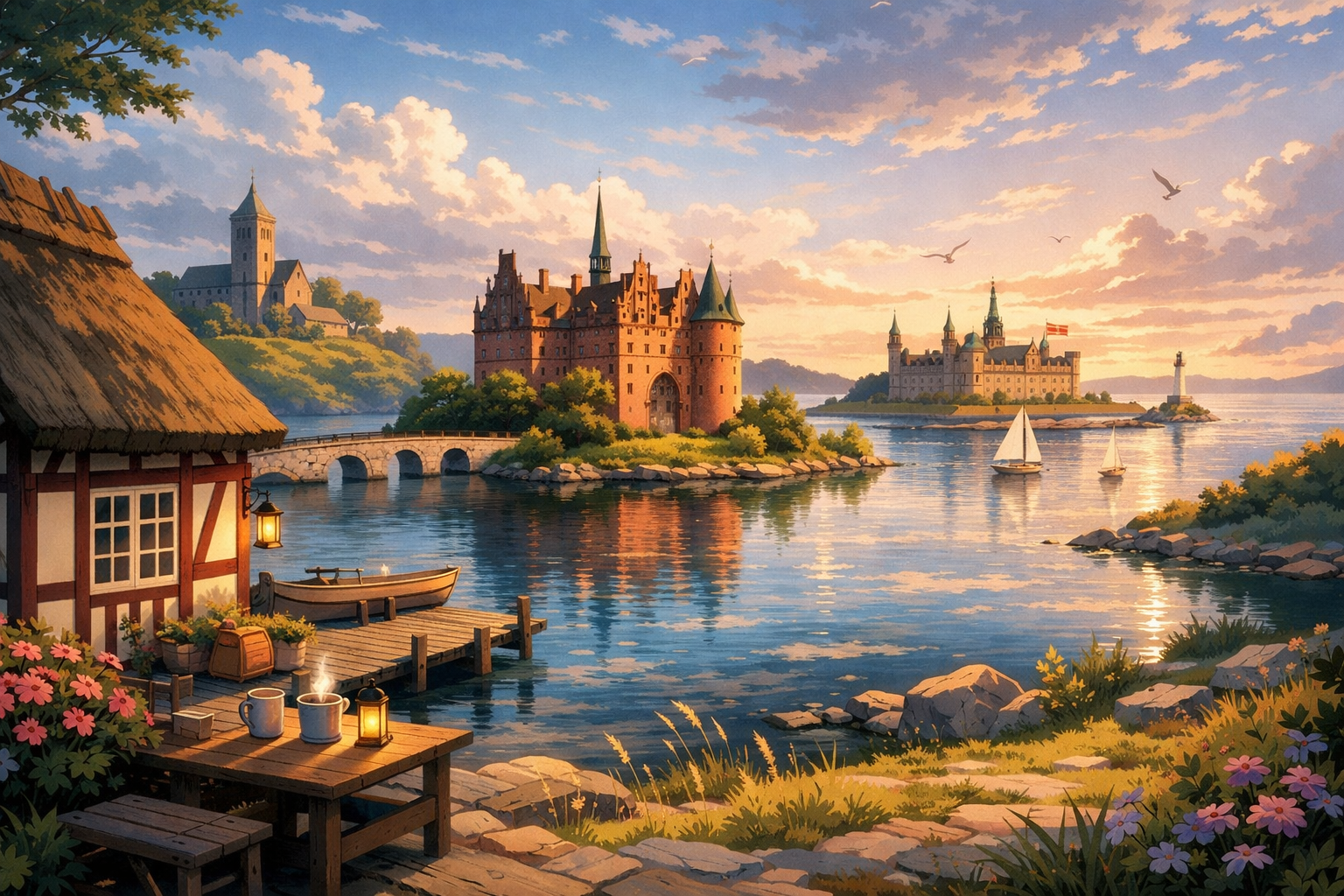
Start in stylish Copenhagen, then sweep past North Zealand’s castles and Viking-echoing Roskilde to the chalk-white cliffs of Møn, storybook Funen with Egeskov, and island-hopping Ærø via Svendborg. Carry on through culture-rich Aarhus and Aalborg to windswept Skagen where two seas meet, before looping back to Copenhagen for a final dose of hygge.

🧭 DAY-BY-DAY ROUTE

Ready-made country and city routes with daily plans, sights, transport and accommodation. Buy PDF guides for independent travel.

🧭 DAY-BY-DAY ROUTE


Day 1 — Copenhagen: Nyhavn, canals, and Strøget

  • 🚶 Nyhavn is Copenhagen’s calling card, with rows of bright 17th-century houses and the masts of old ships. From the royal square Kongens Nytorv, walk down to the waterfront: this is where “hygge” was born in its urban form—candles, wool blankets, the smell of cinnamon and coffee. Take a boat trip along the canal, peek into side alleys with antique shops, then head out onto the pedestrian Strøget—one of Europe’s longest shopping streets—where boutiques sit alongside street musicians, and historic façades alongside design stores. In the evening, return to Nyhavn when the lanterns reflect in the water, and order smørrebrød with herring and a neat shot of aquavit—for a gentle, characteristically Danish calm start to the journey.


Day 2 — Copenhagen: Rosenborg, the King’s Garden, and Amalienborg

  • 🚶 Rosenborg Castle is a stone casket of royal regalia, portraits, and elegant cabinets of Denmark’s Christian kings. Step out into the adjacent King’s Garden (Kongens Have): straight linden avenues and clipped parterres—an ideal spot for a picnic. Next is the Frederiksstaden district with Amalienborg Palace Square: four identical palaces form a star around the equestrian statue of Frederik V. Around the corner, the Marble Church with its green dome rises softly—one of the city’s most photogenic views. On the Langelinie waterfront you may see the royal guard and feel the calm, orderly capital where life flows steadily, like water in a canal.

Day 3 — North Zealand: Frederiksborg and Kronborg castles

  • 🚆 Transfer: Copenhagen → Hillerød (S-train to Hillerød, ≈ 40–45 minutes), then to Helsingør (train ≈ 30–40 minutes) and back to Copenhagen (regional Kystbanen train ≈ 45 minutes).

  • 🚶 Frederiksborg in Hillerød is the “Danish Pearl of the Renaissance” on an island in the middle of a lake: long galleries with carved ceilings, a mosaic of portraits and coronation halls, mirror-like water surfaces, and a Baroque garden with living waterfalls. After lunch, head to Kronborg in Helsingør—a fortress on a headland by the Øresund strait where Shakespeare placed Prince Hamlet: bastions with views of Sweden, underground casemates with the legendary Holger the Dane, and sea wind that brings tears of joy to romantics’ eyes.

Day 4 — Roskilde: the kings’ cathedral and Viking ships

  • 🚆 Transfer: Copenhagen → Roskilde (DSB, regional train ≈ 24–30 minutes, trains run frequently).

  • 🚶 Roskilde Cathedral is a brick Gothic giant and the burial site of Danish monarchs (a UNESCO site). Inside are white vaults, royal chapels, carvings, and centuries of silence. Walk down to the fjord to the Viking Ship Museum: five original 11th-century vessels, ancient seafaring know-how, workshops, and a harbor with reconstructions that sail in summer. The contrast between austere Gothic architecture and the smell of tar by the water is the quintessence of Zealand.

Day 5 — Møn Island: the white cliffs of Møns Klint

  • 🚆 Transfer without a car: Copenhagen → Vordingborg (train ≈ 1 hour), then bus 660R to Stege (≈ 45 minutes) and seasonal 678 to GeoCenter Møns Klint (≈ 30 minutes). Alternative: car sharing (see the “Transport” section) — about 1 h 45 min via scenic rural roads.

  • 🚶 Møns Klint are chalk cliffs up to 128 m above the turquoise Baltic Sea, where the crunch of chalk underfoot and the roar of the surf make the walk feel like meditation. Start at the GeoCenter: a brief “geo interlude” on Denmark’s glacial history, then descend the stairs to the beach and take an unhurried trek along the cliff edge. On a clear day the horizon dissolves, and the heat is softened by the cool shade of the beech groves above. Bring a thermos, some chocolate, and make a “hygge stop” on one of the scenic wooden platforms.

Day 6 — Transfer to Funen: Odense and Andersen’s fairy tales

  • 🚆 Transfer: Copenhagen → Odense (InterCity/ICL, ≈ 1 h 15 m–1 h 45 m; express trains are faster).

  • 🚶 Odense is the cozy capital of Funen, with cobblestone streets and half-timbered houses. Stop by H.C. Andersen’s House—a modern fairy-tale museum with installations where Andersen’s world comes alive through light, sound, and illusions. In the evening: the waterfront, a restaurant with local fish, and a leisurely walk through Eventyrhaven (“the Fairy Tale Garden”).

Day 7 — Egeskov: a Renaissance “water” castle and gardens

  • 🚆 Transfer: Odense → Kværndrup (Svendborg Line, ≈ 20–25 minutes), then FynBus No. 920 to the stop by Egeskov or walk ≈ 2.5 km. Return the same way.

  • 🚶 Egeskov is a rare 1554 “water” castle in the middle of a lake, preserved almost unchanged: knightly halls, collections of vintage cars and motorcycles, Treetop Walking suspension bridges, and a huge maze. The park has English lawns, green “rooms,” a rose garden, and perfect picnic spots. This is a day for unhurried pace and true Danish “hygge.”

Day 8 — Svendborg and the island of Ærø: postcards from Ærøskøbing

  • 🚆 Transfer: Odense → Svendborg (train ≈ 45–50 minutes), then ferry to Ærøskøbing (≈ 1 h 15 m). In peak season, it’s better to book ferry tickets in advance.

  • 🚶 Ærø is a watercolor island with low houses, Dutch gables, and cobbled lanes. In Ærøskøbing: pastel façades and tiny rose-filled courtyards. Rent bicycles and ride to Vesterstrand beach with its wooden bathing huts—an ideal postcard in the “slow travel” style.

Day 9 — Aarhus: the ARoS “rainbow” and the waterfront

  • 🚆 Transfer: Odense → Aarhus (InterCity, usually ≈ 1 h 37–1 h 50 m).

  • 🚶 Aarhus — the “city of smiles”: a modern waterfront with Dokk1 and the Moesgaard Forest to the south. At ARoS, head up to the enclosed circular panorama Your rainbow panorama — the city is drenched in color, and the bay view cures even chronic rushing. In the evening — the Latin Quarter with cafés and designer shops.

Day 10 — Aarhus: Den Gamle By and the Moesgaard Museum

  • 🚶 The open-air museum Den Gamle By is a walk through the “old town” made of real historic houses: confectioners’ shops, a print shop, a pharmacy, and a 1970s radio store. After lunch — Moesgaard: a hill-like museum of architecture in the forest, “bog people,” Celtic gold, and exhibits where archaeology turns into cinema. Getting there is easy: a city bus from the center goes straight to the entrance.

Day 11 — Aalborg: Lindholm Høje Vikings and the castle by the fjord

  • 🚆 Transfer: Aarhus → Aalborg (InterCity, usually ≈ 1 h 20–1 h 35 min).

  • 🚶 Start with Lindholm Høje on the north bank of the fjord — one of the most important Viking Age cemeteries with stone “ships” and an excellent museum. Back in the center, stop by Aalborghus Slot: a 16th-century half-timbered castle with a green park and ramparts — a quiet place for a walk and photos by the rose bushes.

Day 12 — Skagen and Grenen: where two seas meet

  • 🚆 Transfer: Aalborg → Skagen (train with a change in Frederikshavn, usually ≈ 2 h).

  • 🚶 At the very northern tip of Jutland, a narrow sand spit leads to Cape Grenen, where the waves of the Skagerrak and the Kattegat meet and draw a sharp line on the water. Walk along the sand (or take the seasonal Sandormen tractor), then drop into Skagens Museum — the world of the Skagen painters: radiant northern light, fishermen, and summer evenings by the sea.

Day 13 — Return to the capital: an evening at Tivoli

  • 🚆 Transfer: Skagen → Copenhagen (via Aalborg, usually total ≈ 5–6 hours by train). Plan a daytime journey with coffee breaks.

  • 🚶 In the evening — Tivoli park: strings of lights, old rides, pavilions with live music, and little restaurants. It’s easy to lose track of time here and feel again the spirit of a late-19th-century fair — carefully preserved and made cozy in a modern way.

Day 14 — Copenhagen: Christiansborg and the canals of Christianshavn

  • 🚶 The Christiansborg palace complex is where parliament meets today, and under the glass by the entrance you can see the foundations of Absalon’s medieval fortress. Climb the free viewing tower: the city opens up from the roofs of Nyhavn to the Øresund horizon. Finish the route in Christianshavn — along the canals, with a cup of coffee on a wooden pontoon, fishermen on the waterfront, and one last Danish “hygge” at the heart of it all.

Flight tickets

eSIM for travel

Buy PDF guide

Buy PDF guide — 29.99 USD

PDF — 29.99 USD