
Buy PDF guide

Buy PDF guide — 8.57 USD

PDF — 8.57 USD

Montenegro, Podgorica and Lake Skadar. An affordable trip around the capital, the wine-growing surroundings and the largest lake in the Balkans with bus transfers and a boat ride. Season: April - June, September - October.

Montenegro, Podgorica and Lake Skadar. An affordable trip around the capital, the wine-growing surroundings and the largest lake in the Balkans with bus transfers and a boat ride. Season: April - June, September - October.

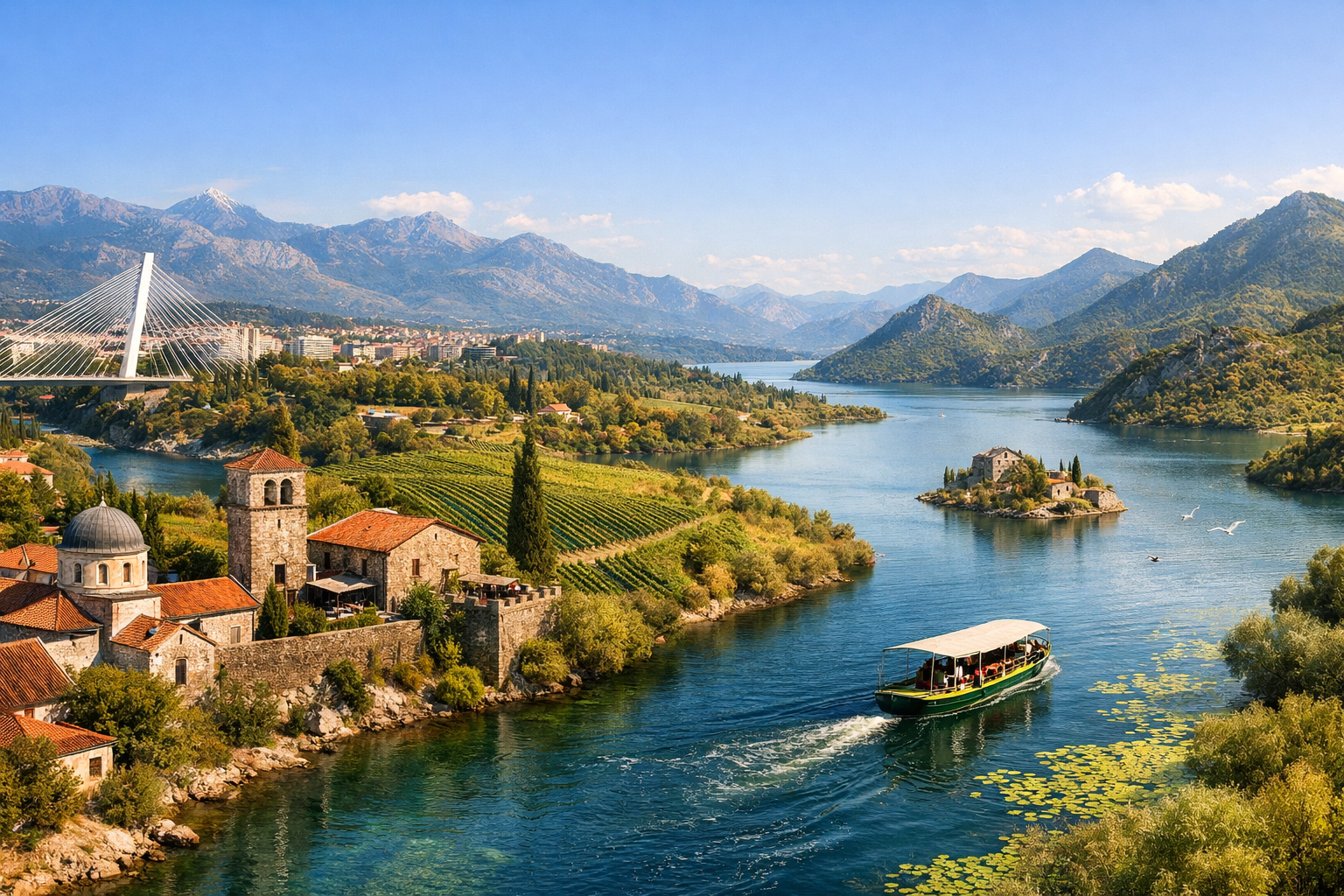
Discover Montenegro beyond the coast with an affordable escape through Podgorica, its sun-soaked wine country, and the wild beauty of Lake Skadar, the Balkans’ largest lake. Travel easily by bus from the capital to Virpazar for a scenic boat ride among reeds, mountain views, and quiet waters, then return to Podgorica refreshed.

🧭 DAY-BY-DAY ITINERARY

Ready-made country and city routes with daily plans, sights, transport and accommodation. Buy PDF guides for independent travel.

🧭 DAY-BY-DAY ITINERARY


Day 1 — Podgorica: Stara Varoš, the Clock Tower, and the embankments

  • ✈️ If you are arriving at Podgorica Airport, allow about 20–30 minutes to reach the center by taxi, and a bit more time if you go via the Aerodrom railway stop and then take a train to the main station. For a short budget itinerary, it is most convenient to check into accommodation in the center right away and keep the evening for a calm first introduction to the capital.

  • 🚶 Podgorica often strikes travelers as a “quiet city at first glance,” but that is exactly what makes it a good starting point for an affordable trip around central Montenegro. Start with Stara Varoš, the quarter where the Ottoman layer of the city’s history is felt most strongly. Narrow streets, stonework, low houses, mosques, old walls, and the uneven rhythm of the built environment create an atmosphere that feels far from a capital city and almost provincial-historic instead. It is pleasant not to rush here: walk to the Clock Tower, see how old Podgorica hides among later buildings, and feel the contrast between the ancient core and the modern part of the city.

  • 🚶 Next, it makes sense to head to the confluence of the Ribnica and Morača rivers, where the famous little stone bridge at Sastavci is located. This is one of the most photogenic spots in Podgorica: a pale stone arch, ruins of an old fortification, water beneath rocky banks, and soft green relief all around create a sense of natural quiet that is rare for a capital. It is especially beautiful here in spring: the river is full, the air is fresh, and the greenery around is dense and vivid. This is a good place for a long pause, first photos, and rest after the journey.

  • 🚶 In the evening, you can take an easy walk through the modern part of the center—stroll along pedestrian streets, have coffee on a terrace, and end the day without overloading it. Podgorica works best at an unhurried pace: not as a city of “must-see masterpieces,” but as a convenient base with lively cafés, wide boulevards, and a very easy transition from urban space to nature. For a budget itinerary, that is a big advantage: less logistical stress, more time for real impressions.


Day 2 — Podgorica: city museums, Kruševac Park, and the wine-growing surroundings

  • 🏛️ Dedicate the morning to the city’s museum side. The Museum and Galleries of Podgorica on Marka Miljanova Street is a good starting point if you want to understand how the city and the region developed: archaeological, historical, and everyday-culture collections help you see Podgorica not only as a transit capital, but also as a place with deep layers of memory. For a short itinerary, this is especially useful: in one visit, you get historical context before heading out to the lake and the wine-country landscapes.

  • 🏛️ If nature and landscapes are of greater interest, add the Natural History Museum of Montenegro. It is a compact but fitting stop before Lake Skadar: after it, the birds, marshy shores, karst forms, and rich vegetation of the region are perceived not just as a beautiful backdrop, but as part of the country’s very distinctive ecosystem. And if you are drawn to lighter and more contemporary art, you can replace part of the museum program with a walk to the Kruševac area, to the Petrović Palace and the spaces of the Museum of Contemporary Art of Montenegro.

  • 🌳 After lunch, a walk through Kruševac Park works very well. It is a green urban area with a calmer, almost resort-like atmosphere than the business center. Against the backdrop of trees and lawns, the palace complex looks unexpectedly elegant, and the district itself offers a pause between the city morning and the departure for the wine region. In the warmer months, it is especially pleasant simply to walk here without a plan, catching the slow rhythm of a Podgorica day.

  • 🍷 In the second half of the day, plan an affordable trip to the wine-growing surroundings of Podgorica. The most practical option without renting a car is a short taxi ride to one of the wine spots in the flatlands of Crmnica or in the direction of the famous wine region around the capital, where vines stretch across sunny fields and the landscape gradually opens toward the lake expanses. In April–June, it is especially fresh and green here, while in September–October the atmosphere becomes more golden and “harvest-like.” Do not overload the day with long tastings: for a 4-day itinerary, one beautiful wine stop and an early return to the city are enough.

  • ⚠️ An important practical detail: Montenegro as a whole is well suited to independent travel with normal caution, but on this itinerary it is especially worth keeping an eye on personal belongings on transport and at stations, avoiding night travel on mountain roads, and not turning onto unmarked nature trails, even if the route seems short and obvious.

Day 3 — Virpazar and Lake Skadar: bus/train, boat, and village atmosphere

  • 🚆 Transfer: Podgorica → Virpazar. For a budget trip, a bus or train on the line toward Bar will do. The journey usually takes about 30–40 minutes, but be sure to leave extra time for waiting and checking the schedule the day before, because there are not as many departures as in larger countries. If predictability matters, you can leave earlier in the morning by train or bus and return closer to the evening.

  • 🚶 Virpazar is a small village, very convenient for a day trip, on the edge of Lake Skadar, where everything revolves around water, boats, stone houses, and an unhurried rhythm. It is here that you especially clearly understand why Lake Skadar is considered one of the region’s main natural jewels. It is the largest lake in the Balkans, a vast aquatic world with reeds, bays, islets, monasteries, old fortifications, and exceptionally rich birdlife. In spring, the lake looks especially alive: soft light, birds, blossoms, green shores, and a feeling of freshness make the outing almost meditative.

  • 🛶 The main focus of the day is a boat trip from Virpazar. It is the boat that lets you see the lake not as a postcard, but from within: pass between belts of reeds, feel the silence of open water, spot birds, look at remote monastery islets or old fortification points like Grmožur. For a short itinerary, a 2–3 hour excursion is enough: it gives you scenery, a sense of scale, and relaxation without haste. After that, it is useful to leave time for a late lunch by the water.

  • 🚶 After the boat ride, walk around Virpazar itself without a packed plan. This is not a place for a long checklist of sights, but rather for atmosphere: the old stone bridge, small streets, views of the water, boat piers, and the wine and gastronomic shades of the Crmnica region. On a budget itinerary, it is often exactly these small stops that are remembered most strongly—not as a “box ticked,” but as a real sense of place.

  • 🚆 Return: Virpazar → Podgorica the same evening. Do not postpone departure until too late: that makes it easier to avoid unnecessary waiting, and the route remains comfortable and safe.

Day 4 — Podgorica: Gorica, the modern city, and departure

  • 🌿 It is best to make the last day calm and without long outings. A good option is a walk on Gorica Hill and in the Gorica forest park, which gives the capital a rare advantage: the chance to move almost immediately from city streets to shaded paths, pines, and viewpoints. This is not a mountain trek or wild nature, but a light natural finale to the itinerary, especially pleasant in spring and early autumn. Stay only on marked paths and do not plan a long forest section alone toward evening.

  • 🚶 If you want to finish the trip on a more urban note, walk to the Millennium Bridge area and through the modern quarters by the Morača. After Stara Varoš and the lakeside landscapes, another side of Podgorica is especially noticeable here: wide avenues, business buildings, the rhythm of an ordinary Balkan capital, and spacious embankments. This kind of finale ties the journey together well: the ancient layer, the wine-growing surroundings, the watery national park, and the everyday urban landscape.

  • ☕ Leave time for a calm breakfast or a late coffee before the road to the airport. For a short trip, this is more important than trying to fit in one more formal sight. Montenegro in this region reveals itself not through the number of points, but through the combination of a vast lake, wine countryside, and a very human, understated capital.

  • ✈️ It is more convenient to plan the transfer to Podgorica Airport with extra time. By taxi, the road from the center usually takes about 20–30 minutes, but it is better to allow more time in the case of an early flight, weekends, or seasonal traffic.

Flight tickets

eSIM for travel

Buy PDF guide

Buy PDF guide — 8.57 USD

PDF — 8.57 USD