
Buy PDF guide

Buy PDF guide — 10.71 USD

PDF — 10.71 USD

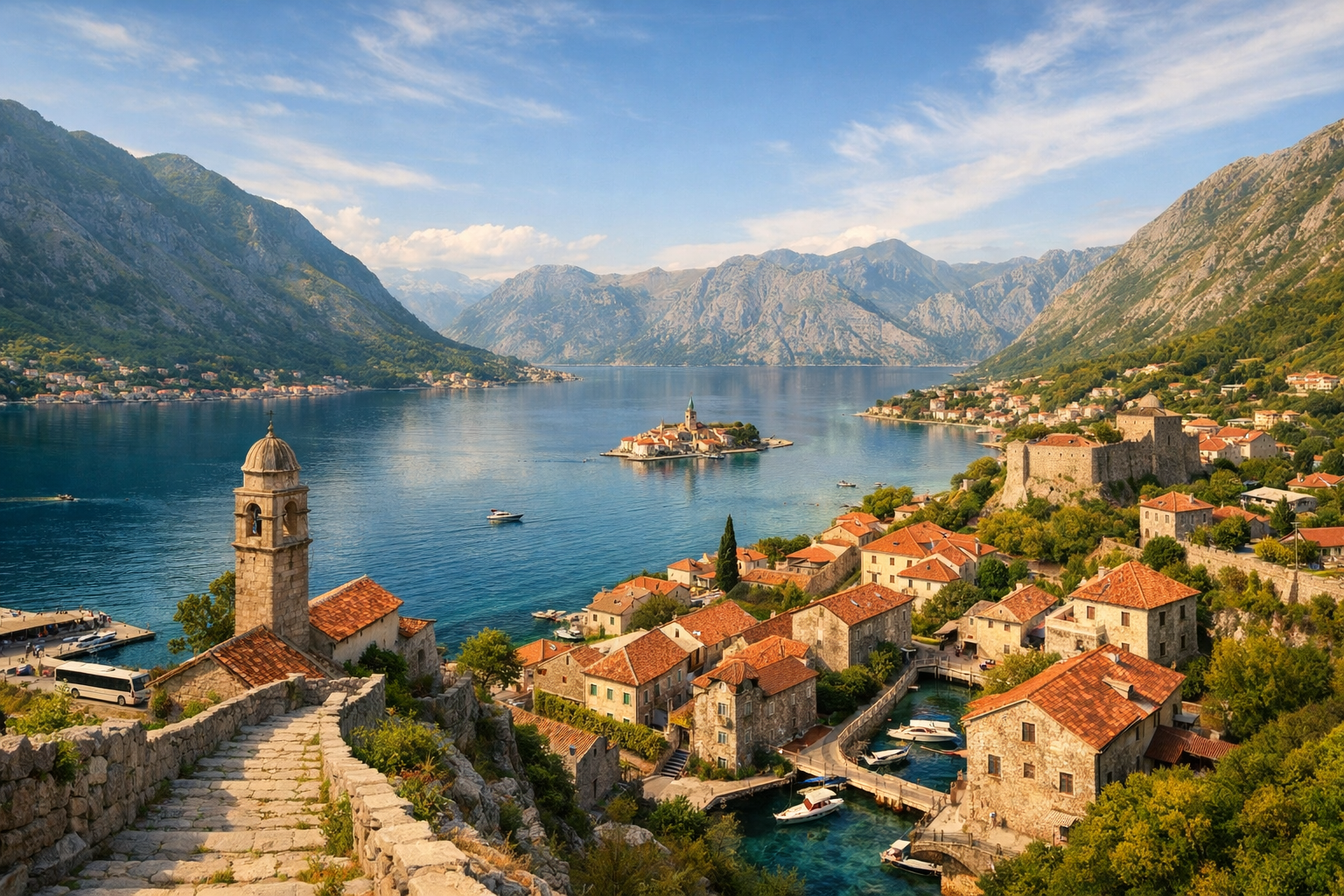
Montenegro, Bay of Kotor. A budget trip through Kotor, Perast, and Herceg Novi with walks through the old towns, climbs to the fortresses, and bus rides. Season: April - June, September - October.

Montenegro, Bay of Kotor. A budget trip through Kotor, Perast, and Herceg Novi with walks through the old towns, climbs to the fortresses, and bus rides. Season: April - June, September - October.

Discover the Bay of Kotor on a budget, wandering the stone lanes of Kotor, Perast, and Herceg Novi with the sea and mountains always close by. Climb old fortresses for sweeping views, ride local buses between historic towns, and enjoy the bay at its best in spring or early autumn.

🧭 DAY-BY-DAY ROUTE

Ready-made country and city routes with daily plans, sights, transport and accommodation. Buy PDF guides for independent travel.

🧭 DAY-BY-DAY ROUTE


Day 1 — Kotor: Old Town and an evening by the fortress walls

  • 🚶 Kotor is the ideal base for a budget trip around the Bay of Kotor: compact, atmospheric, and very walkable. The Old Town, included in the UNESCO World Heritage site together with the Natural and Culturo-Historical Region of Kotor, feels like a stone labyrinth where every turn hides arches, tiny squares, laundry lines, carved shutters, and the ringing of church bells. Start the day slowly: enter through the Sea Gate, step onto Arms Square, and then simply allow yourself to get a little lost. In Kotor, that is not a mistake but part of the experience. In a few hours, you will see how the medieval layout, Venetian facades, and the mountain amphitheater around the town come together into one of the most striking urban landscapes on the entire Adriatic coast.

  • ⛪ Be sure to stop by St. Tryphon’s Cathedral and the nearby quiet squares, where you feel the old urban texture best: worn stone underfoot, the coolness of narrow passages, and courtyards that suddenly open up. If you still have energy, add the Maritime Museum of Montenegro — it does a good job of explaining why this small town was an important maritime center for centuries. Toward evening, it is better not to try to see everything: Kotor is beautiful precisely in a slower rhythm. Sit on the waterfront or in a square with an inexpensive coffee, and watch the light fade from the fortress walls as the mountains begin to darken above the bay.

  • 💤 Practical tip of the day: after the road, do not overload your first day with climbs. For acclimatization, 4–6 hours of an unhurried walk through the Old Town and along the waterfront, with breaks for food and rest, is enough. If you are flying into Tivat, the transfer to Kotor is usually shorter and easier than from Podgorica, and by evening you can already get around only on foot without spending money on taxis.


Day 2 — Kotor: St. John’s Fortress and bay panoramas

  • 🥾 This day is devoted to the main climb of the trip — up to St. John’s Fortress (San Giovanni / St. John’s Fortress), crowning Kotor’s famous system of defensive walls. The ascent takes effort, but this is where a journey around the bay becomes something more than just a walk between beautiful towns. The walls, which rise from the town itself high into the mountains in zigzags, look almost unbelievable: it seems as if the stone line was not built but grew directly out of the rock. At the top, the view opens up for which many people come to Kotor: the red roofs of the Old Town, a bay that looks like a lake, boats like dots on the water, and the powerful gray slopes all around.

  • ⏱️ For a budget-friendly and comfortable plan, it is best to set out early in the morning, before the strong heat and large tourist crowds. For the climb itself, photo stops, breathers, and the descent, it is reasonable to allow about 2.5–4 hours depending on your pace. You need shoes with good grip: the stone steps are uneven and slippery in places, especially after rain. After coming back down, be sure to plan a long rest — lunch, shade, water, an hour without rushing. In the second half of the day, you can return to calmly exploring the streets of the Old Town that you missed on the first day, or simply walk along the waterfront to quieter neighborhoods outside the walls.

  • ⚠️ An important rule of the route: Montenegro as a whole is well suited to independent travel if you follow ordinary precautions. Keep an eye on your personal belongings in tourist areas and at bus stops, avoid night driving on mountain roads, and during climbs and walks above the town stick only to marked tourist trails and official access routes. This is especially important around the old fortifications and the slopes above the bay.

Day 3 — Perast: Baroque waterfront and the island of Gospa od Škrpjela

  • 🚌 The transfer from Kotor to Perast by local bus is one of the most pleasant and budget-friendly in the region: the road along the water usually takes about 25–35 minutes depending on the service and stops along the way. Perast feels nothing like Kotor. If Kotor is a fortress labyrinth and dramatic relief, then Perast is a long, almost theatrical line of stone palaces by the water, where everything is built not around bustle but around the view. This small Baroque town looks as if it was created for a slow pace: a narrow waterfront, bell towers, sea captains’ palaces, the quiet bay, and soft light on the facades.

  • ⛵ The main classic of the day is a short boat ride to the island of Gospa od Škrpjela, a man-made islet with a church and museum. The crossing itself takes just a few minutes, but the impression is very complete: from the water you can especially clearly see how cinematically Perast is set into the bay. Inside the island complex, the journey becomes more intimate and historical — this place is not about scale, but about legend, maritime vows, and the memory of bays, storms, and sailors’ families. After returning to shore, do not rush away: in Perast, what matters is not a checklist but the feeling of calm, when old stone palaces reflect in the water and buses and crowds remain somewhere far away.

  • 📷 Leave the second half of the day for a walk along the waterfront, taking in the urban setting, and a small museum segment. Perast opens up well without rushing over 5–7 hours including the boat, a lunch break, and coffee by the water. In the evening, return by bus to Kotor so you do not depend on expensive taxis or plan late transfers. This is especially sensible in the shoulder season, when evening services may be less frequent than in summer.

Day 4 — Herceg Novi: stairways, fortresses, and the western gate of Boka

  • 🚌 Herceg Novi is easy to visit from Kotor as a full and rewarding day trip: the bus along the bay usually takes about 1–1.5 hours, depending on the route and traffic. The town immediately gives a different mood. There is less of the enclosed fortress-basin feeling you get in Kotor, and more vertical movement: stairs, terraces, passages, bastions, viewpoints, and a long seafront line. Herceg Novi is called the town of steps and mimosa, and within the first half hour it becomes clear why: it seems scattered across the slope, yet always connected to the sea.

  • 🏰 Start in the Old Town and gradually climb toward the fortresses. Forte Mare is especially striking — the “sea fortress,” one of the town’s symbols, from which you get a good view of the entrance to the bay and the waterfront. Then you can continue higher toward Kanli Kula and the viewpoints. In Herceg Novi, architecture is perceived not as an open-air museum but as a living system of levels: you are constantly moving from shade into light, from a narrow stairway onto an open terrace, from urban fabric to views of the water and neighboring slopes. This makes the walk very photogenic, but also more physically demanding than it seems on the map.

  • 🌿 Allow at least 8–10 hours for the day including the round trip, climbs, lunch, and rest. The best pace is to walk in blocks: old center, fortress, a long pause by the sea, another climb, then a slow descent to the Šetalište promenade. For all the town’s beauty, it is better not to leave too late: a budget format works best with buses and daytime movement, without night transfers on serpentine mountain and coastal roads.

Day 5 — Kotor: museum finale, markets, quiet bay, and departure

  • 🚶 It is best to make the last day gentle and logical, without long transfers. After two outings and the climb to the fortress, Kotor feels pleasantly different already: not as the “main point,” but as a place that is easy to return to for the atmosphere. In the morning, you can wrap up everything you did not manage in the first days: the Maritime Museum of Montenegro, the Cats Museum, individual churches, quiet passages behind the cathedral, small shops, or the town market. The final day is especially good for details — door handles, coats of arms on facades, old staircases, narrow courtyards, and reflections of light in stone.

  • 🌊 If your flight or departure is not very early, give yourself one last walk outside the walls — along the bay toward quieter stretches of the waterfront. Here there is less excursion tension and more of a sense of everyday life in Boka: boats at the piers, laundry on balconies, people with coffee by the water, mountains that change shade throughout the day from silvery to graphite. This kind of ending suits a budget trip especially well: there is no need to buy new tickets or work out complex logistics, it is enough simply to spend a few more hours on foot in one of Europe’s most beautiful bays.

  • 🧳 Allow extra time for the road to the airport or bus station. In the Bay of Kotor area, traffic can slow down even on short stretches, especially in warmer months and on weekends. If you need a transfer, it is better to book it in advance, and if you are going by bus, confirm the departure the day before. The final rule remains the same: independent travel in Montenegro is quite comfortable if you keep a reasonable pace, do not overestimate your strength on climbs, and pay close attention to your belongings and travel time.

Flight tickets

eSIM for travel

Buy PDF guide

Buy PDF guide — 10.71 USD

PDF — 10.71 USD