
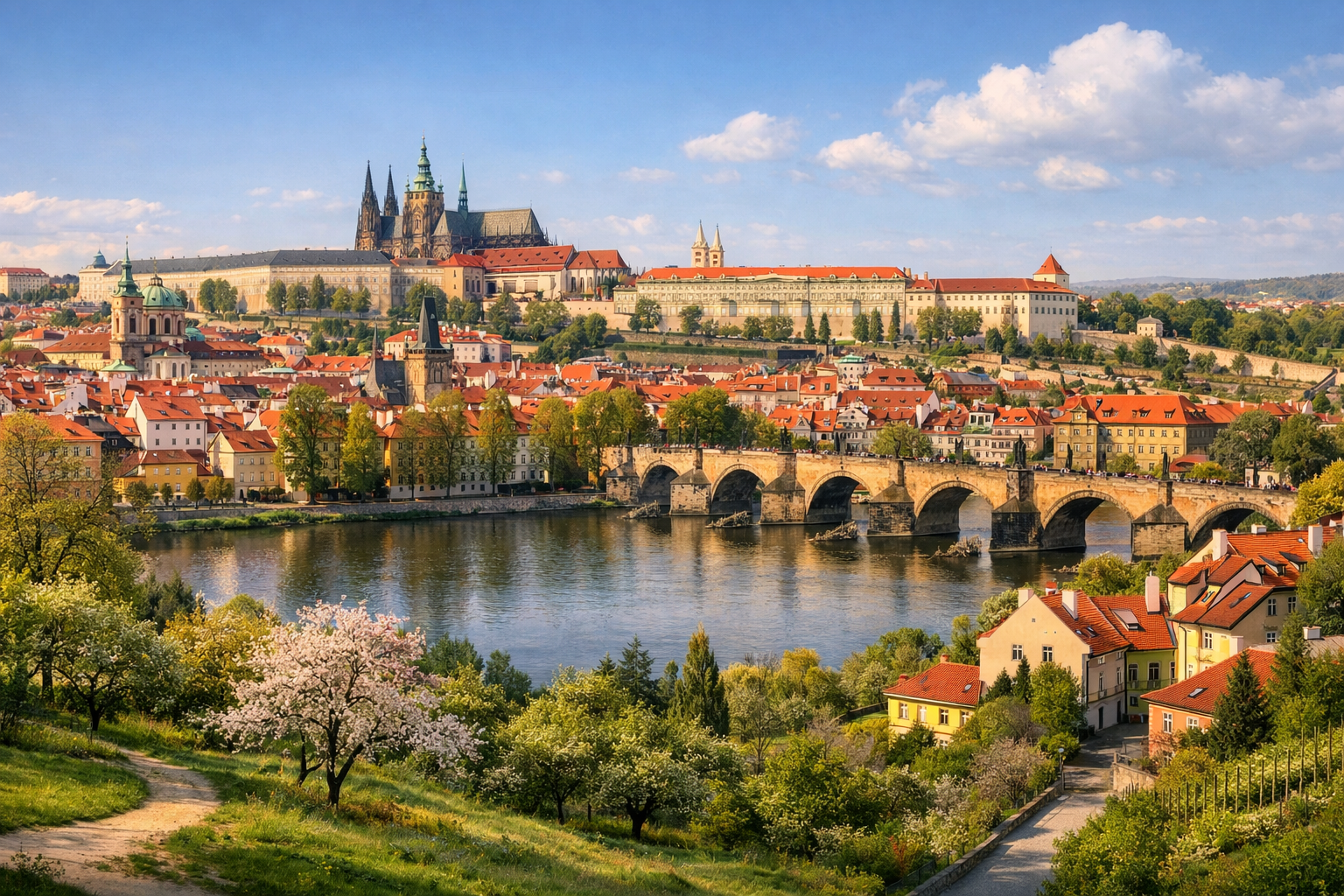
Day 1 — Prague: Staré Město, Charles Bridge, and Malá Strana
🚶 It’s best to dedicate the first day to that very image of Prague that draws first-time visitors here: stone towers, narrow streets, Gothic facades, and the soft reflections of bridges in the Vltava. Start in the Old Town, where the medieval street layout is still easy to read: houses seem pressed close together, courtyards hide behind arches, and small squares suddenly open up after tight passageways. Here, the walk is valuable not only for individual landmarks but also for the feeling of a complete historic space. Staré Město does not feel like a museum set: it is a living center where old architecture stands side by side with cafés, bookstores, and small galleries. Try to walk slowly and leave time for pauses, because it is the details — Baroque signs, carved portals, the curves of little streets — that create that unmistakable Prague atmosphere.
🚶 Then head to Charles Bridge — one of the city’s most recognizable landmarks and the most important symbol of old Prague. Its construction began in 1357 under Charles IV and was completed in the early 15th century, and to this day the bridge is seen not simply as a crossing over the river, but as a ceremonial stone stage between two historic worlds — the Old Town and Malá Strana. The best strategy here is simple: don’t rush across it in a few minutes, but walk slowly, taking in the towers, sculptures, and views along the embankments. On one side, the roofs of the Old Town open up; on the other, the hills, domes, and silhouette of Prague Castle. It is crowded during the day, so it is especially pleasant to come either in the morning, when the bridge is just waking up, or closer to evening, when the stone turns golden and the water beneath begins to reflect the city more softly and deeply.
🚶 After the bridge, it makes perfect sense to continue the day in Malá Strana — one of the most beautiful and at the same time more intimate districts of central Prague. Here, Baroque Prague feels especially vivid: palaces, gardens, stairways, little squares, and quiet streets create the sense of a city that lives not only for tourist photos, but also for unhurried everyday life. The district is ideal for an affordable introduction to Prague, because the main pleasure here is simply walking, climbing to small viewpoints, peeking into courtyards, and resting on a bench overlooking tiled roofs. If you still have energy, make your way to Kampa Island: this is a more relaxed part of the day, where after a dense historical route it feels good to slow down by the water, look at the old mill buildings, and feel the noise of the central streets gradually dissolve.
🚶 Time-wise, this day fits realistically without rushing: 5–7 hours of pure walking with stops for coffee, lunch, and rest. Walking segments between the key points are short — usually 10–20 minutes — but in central Prague, cobblestones, stairs, photo stops, and crowds at the most famous spots slow you down. That is why it is better to plan the route not as a race through a checklist of places, but as a smooth introduction to the city. In the evening, you can finish your walk around Malostranská or take a tram back to your hotel. For a first meeting with Prague, this is one of the most harmonious scenarios: beautiful, full, and without expensive transfers.