
Buy PDF guide

Buy PDF guide — 10.71 USD

PDF — 10.71 USD

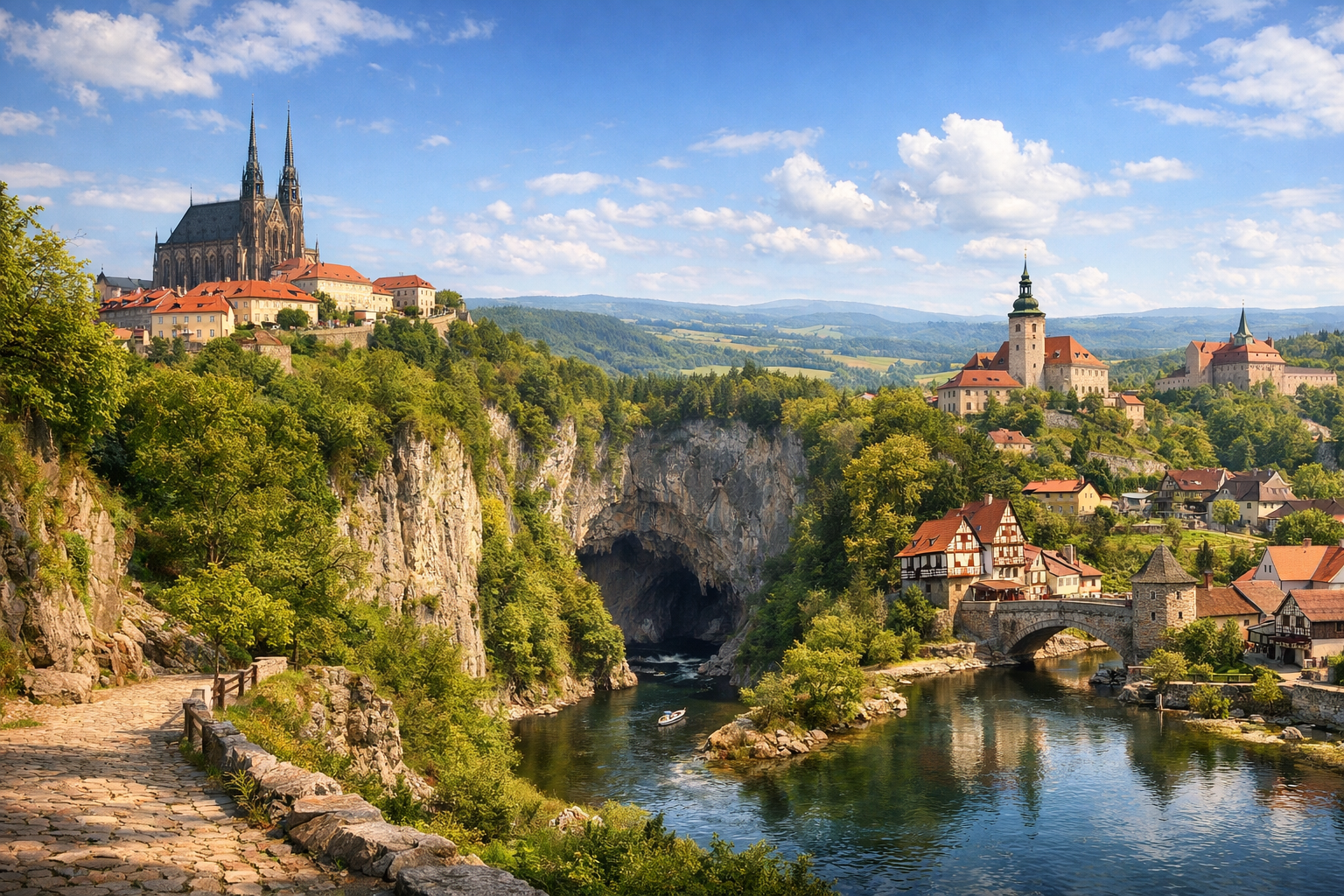
Czech Republic, Brno and the Moravian Karst. A budget itinerary through the capital of Moravia, caves, the Macocha Gorge, and small historic towns of the region. Season: April — October.

Czech Republic, Brno and the Moravian Karst. A budget itinerary through the capital of Moravia, caves, the Macocha Gorge, and small historic towns of the region. Season: April — October.

Discover the Czech Republic beyond Prague with a budget-friendly journey through Brno and the Moravian Karst. Wander Brno’s lively streets, descend into dramatic caves and the Macocha Gorge, then slow down in the historic charm of Slavkov u Brna and sunlit Mikulov.

🧭 DAY-BY-DAY ITINERARY

Ready-made country and city routes with daily plans, sights, transport and accommodation. Buy PDF guides for independent travel.

🧭 DAY-BY-DAY ITINERARY


Day 1 — Brno: historic center, Špilberk and evening Moravia

  • 🚶 Brno is the second-largest city of Czechia and at the same time a place with an amazingly convenient human scale: it is easy to explore on foot, quick to get around by tram, and the main sights are not spread over dozens of kilometers as in major metropolises. For a budget trip, it is almost an ideal base: you can stay near the station or the center, head out in the morning to markets, churches, and old squares, and just a few minutes later find yourself by fortress walls or at a panoramic viewpoint. Start the day with a walk through the heart of Old Brno: from the main station to Zelný trh square, past old facades, cafés, and city arcades. Here you can feel that very “Central European” mix of Gothic, Baroque, functionalism, and a light university energy, thanks to which Brno feels not like an open-air museum, but like a living city where history naturally coexists with modern everyday life.

  • 🚶 Then head up to Špilberk Castle — once a royal fortress, later a grim prison of the Habsburg Empire, and today one of the city’s main viewpoints. The climb is worth the effort: from the terraces and slopes you get wide views of red rooftops, church spires, and the green hills of South Moravia. The route through the park is enjoyable in itself: shady paths, bastion walls, and the feeling that the city is gradually unfolding beneath your feet create a very cinematic opening to the trip. After that, return to the center and leave time for the Cathedral of Saints Peter and Paul on Petrov Hill, the arcades around the market, and an unhurried dinner in the old town area. For the first day, it is better not to overload the plan: after the journey, it is useful to set aside 1–1.5 hours of quiet rest at the hotel before an evening walk.

  • 💡 Day logistics: if you arrive at Brno Airport, it is convenient to get to the center by public transport. From the airport, line 21 goes to Hlavní nádraží in about 22 minutes, line 77 to Úzká in about 26 minutes, and at night line N89 in about 20 minutes. If your arrival is late or you have luggage, it makes sense to take a taxi via an app and go straight to the hotel.


Day 2 — Brno: Villa Tugendhat, Lužánky and a museum day

  • 🚶 Dedicate the second day to the side of Brno that makes it not only cozy, but truly culturally important for Europe. The main star is Villa Tugendhat, a masterpiece of modernist architecture by Ludwig Mies van der Rohe and the only monument of modern architecture in Czechia on the UNESCO list. Even if you have already seen photos of its glass wall and famous interiors, the villa makes a much stronger impression in person: it is not just beautiful, it almost physically changes your sense of space. The house seems to dissolve the boundary between interior and garden, between luxury and strict simplicity, between rational geometry and an almost meditative lightness. It is best to book tickets in advance, and to treat the visit not as a “box to tick,” but as a full architectural experience.

  • 🚶 After the villa, it is nice to continue the day on foot through Lužánky Park — Brno’s oldest public park, a green pause between intense cultural stops. From here, it is convenient either to head to the Mendel Museum, connected with the history of genetics and the Augustinian abbey, or to the Moravian Museum in Dietrichstein Palace on Zelný trh square if you want more on the region’s history. An alternative for those who like technology and industrial heritage is the Technical Museum in Brno, which is easier to reach by public transport. This day is especially good because it shows Brno as layered: not only as a city of cathedrals and fortresses, but also as a place where major ideas of modernism, science, and Central European intellectual culture were born.

  • 🚋 It is best to plan movements during the day around trams and walking. Brno has a developed network of trams, buses, and trolleybuses, and the center is compact. It is convenient to reach Villa Tugendhat from the center by a short tram ride followed by a walk, and between central museums it is often easier to walk 10–20 minutes than to make transfers.

Day 3 — Moravian Karst: Punkva Caves, the Macocha gorge and natural drama

  • 🚆 Today is the main nature day of the route and probably the most spectacular trip out of Brno. In the morning, head toward the Moravian Karst, one of the best-known karst regions in Central Europe. A realistic budget scenario is to take a train from Brno to Blansko, then a local bus to Skalní mlýn, and then walk or take the tourist road train to the Punkva Caves. The journey from Brno to the karst area usually takes about 1–1.5 hours depending on the train + bus connection and waiting time. It is important to leave early because this place is popular, and in season advance booking is especially recommended for the Punkva Caves.

  • 🚶 The Punkva Caves are one of those rare cases when a natural attraction truly lives up to expectations. The route passes through large underground halls and galleries with stalactites and stalagmites, and the climax is reaching the bottom of the famous Macocha Abyss. This karst chasm, 138.7 meters deep, creates an almost theatrical effect: the dark vertical rock walls, cold damp air, and the sharp contrast between the light above and the twilight below make it feel as if you are looking into a crack between worlds. After the dry part of the tour comes a boat ride along the underground Punkva River — a short but very memorable part of the visit that makes the day feel not just like a walk, but like a small adventure.

  • 🚶 After the caves, be sure to climb or ride up to the upper viewing platforms of Macocha. From above, the abyss looks completely different: no longer like an intimate underground space, but like a grand natural amphitheater hidden in a forested landscape. If you still have energy, you can walk part of the marked trails around the karst, but it is better to keep the route moderate: the tour, climbs, transport waits, and lunch take up a significant part of the day. Plan to return to Brno by evening and leave at least an hour for quiet rest after arrival.

Day 4 — Slavkov u Brna and surroundings: the small-scale history of South Moravia

  • 🚆 After the natural drama of the karst, it is nice to change the rhythm and head to the small historic town of Slavkov u Brna, known internationally as Austerlitz. It is easy to get here from Brno by regional train or bus, and the trip itself usually takes about 25–40 minutes depending on the service. This is a realistic and undemanding day trip: no long transfers, just a calm outing into the Moravian countryside, where behind Baroque facades and park alleys lies the memory of major European events.

  • 🚶 The main highlight is Slavkov Castle – Austerlitz, with its ceremonial interiors and large park. Unlike the severe Špilberk, the atmosphere here is completely different: bright halls, palace symmetry, garden axes, and that aristocratic lightness that feels especially pleasant after an active day in the caves. Even if you do not dive deeply into military history, the place is interesting as a well-preserved example of Moravian palace culture. And if the Napoleonic era appeals to you, the trip takes on extra meaning: the surroundings of Slavkov have long been part of Europe’s historical memory thanks to the Battle of Austerlitz.

  • 🚶 Spend the rest of the day without rushing: a walk in the park, coffee in the town center, a short rest on a bench in the shade of trees, and return to Brno by evening. This kind of day is important for the balance of the route: it does not overload you, gives a change of scale from a big city to a small historic center, and leaves enough energy for the final trip to Mikulov. If you want the most budget-friendly option, you can limit yourself to a walk around the town and park without a complicated program and simply enjoy the pace of provincial South Moravia.

Day 5 — Mikulov: castle, Holy Hill and the wine-country silhouette of the region

  • 🚆 Dedicate the final day to Mikulov — one of the most beautiful small towns in South Moravia. It is easy to get here from Brno by train or bus; on average, the journey takes about 50 minutes to 1 hour 15 minutes depending on the connection. Mikulov immediately offers a different scenic and emotional tone: if Brno is the urban capital of the region, here South Moravia opens up in a more intimate, almost postcard-like form. Pale facades, the castle hill, wine motifs, and the limestone elevations of Pálava create a very photogenic and at the same time warm atmosphere.

  • 🚶 Start with Mikulov Castle, home to the Regional Museum in Mikulov. The castle beautifully dominates the town and helps you see how trade, aristocratic history, wine culture, and the borderland position have shaped this corner of Czechia for centuries. Then walk through the historic square and head down to the Dietrichstein Tomb — a place with strong Baroque expressiveness and important family memory for the region. In Mikulov, the multilayered nature of history is especially tangible: Christian pilgrimage, aristocratic heritage, traces of the Jewish community, and the gentle South Moravian rhythm of life all exist side by side here.

  • 🚶 As a farewell, climb Holy Hill. It is not a difficult ascent, but a very rewarding one, and it finishes the route in the best possible way: with a panorama of Mikulov’s red roofs, vineyards, the pale limestone shapes of Pálava, and the distant lines of the South Moravian landscape. Up here, it is especially nice to sum up the whole trip: in five days, you will have seen the capital of Moravia, modernist architecture, an underground karst world, small historic towns, and one of the most picturesque corners of the region. In the evening, return to Brno or, if logistics allow, continue your journey further through Czechia.

Flight tickets

eSIM for travel

Buy PDF guide

Buy PDF guide — 10.71 USD

PDF — 10.71 USD