
Buy PDF guide

Buy PDF guide — 29.99 USD

PDF — 29.99 USD

BUCHAREST

BUCHAREST

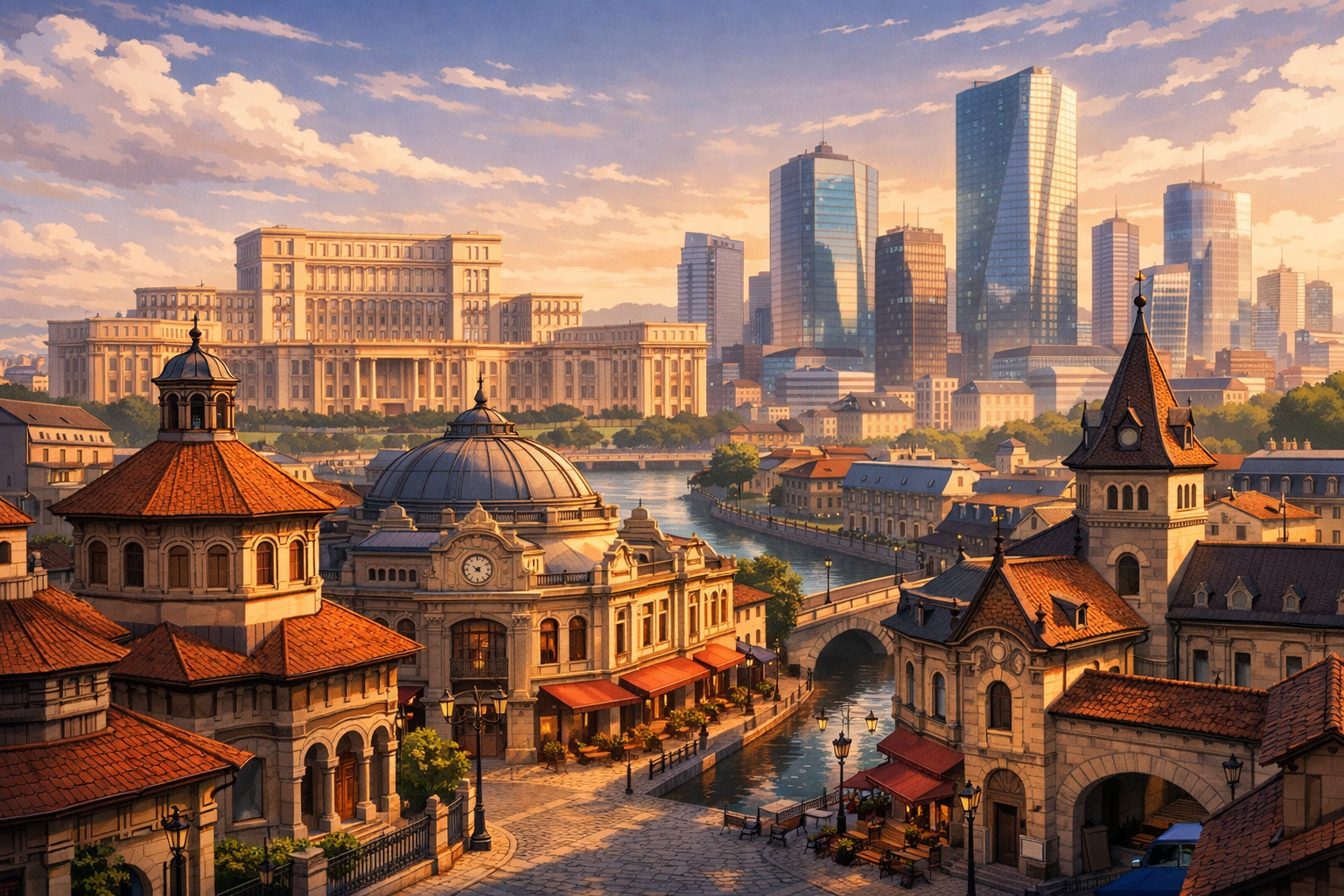
Bucharest blends stately boulevards with bohemian corners, from the cobbled bars of Old Town (Lipscani) to the Belle Époque façades along Calea Victoriei. Wander past Cotroceni’s leafy villas to Aviatorilor’s Herăstrău Park, then dive back into the buzzing center of Sector 5 for late-night cafés and contemporary culture.

🧭 DAY-BY-DAY ITINERARY

Ready-made country and city routes with daily plans, sights, transport and accommodation. Buy PDF guides for independent travel.

🧭 DAY-BY-DAY ITINERARY


Day 1 — Bucharest: Old Town (Centrul Vechi, Lipscani)

  • 🚶 Start with the most cinematic part of Bucharest — the Lipscani quarters. Narrow streets, neoclassical and neo-Renaissance façades, arcades, courtyards, old signs of craftsmen’s shops — here the city immediately gives you a sense of scale and layers. Step into the Stavropoleos Monastery Church (Strada Stavropoleos, 4): a miniature Brâncovenesc-style masterpiece with stone carving and painted porches. Nearby is the Macca–Vilacrosse Passage with its warm yellow glass dome and cafés under the arches. Walk to Hanul lui Manuc — a historic caravanserai with an inner courtyard — and to the ruins of the Old Princely Court (Curtea Veche): medieval Bucharest took shape here. In the evening, take an unhurried loop along Strada Lipscani and Strada Smârdan: shop windows, street musicians, atmospheric bistros.


Day 2 — Calea Victoriei: from “Little Paris” to museum classics

  • 🚶 Calea Victoriei is the city’s ceremonial axis. Start at Revolution Square: on the left is the former Royal Palace (today the National Museum of Art of Romania), opposite is the Romanian Athenaeum with its elegant colonnade and round hall. By day: one major museum (we recommend the National Museum of Art) and a walk along Calea Victoriei to the Majorescu Passage and the Cantacuzino building (George Enescu Palace). The façades alternate between neoclassicism, Art Deco, and early modernism; the shopfronts of bookstores and cafés add a “capital-city” rhythm. Finish at the Museum of Art Collections at 111 Calea Victoriei — private collections show how artists and collectors “assembled” Bucharest’s taste in the 20th century.

Day 3 — Urban-planning modernism: the Palace of Parliament and Izvor

  • 🚶 Bucharest’s “big modernism” is the gigantic Centrul Civic ensemble, whose culmination is the Palace of Parliament. Walk from Izvor Park to the palace’s north side and to the entrance of the MNAC contemporary art museum in the E4 wing: the contrast between the “megastructure” and contemporary art explains the city’s 20th–21st centuries perfectly. Look at the broad avenues, symmetries, and “superhuman scale” — a legacy of 1980s urban-planning ideas. After the museum, go up to the palace’s viewing terraces (per tour schedule) or loop to Unirii Boulevard and the fountains — at dusk, the perspective lines are especially striking.

Day 4 — Cotroceni: mansions, gardens, and a museum-residence

  • 🚶 Cotroceni is an intimate, green neighborhood with early-20th-century villas where it’s easy to see a more “everyday” Bucharest. Stroll along the quiet streets, noticing stucco details, wrought-iron fences, and the mansions’ little “corner turrets.” Plan a visit to the National Museum of Cotroceni (in the historic wing of the presidential palace) — interior ensembles, wardrobes, ballrooms, and a church within the complex. On the way back, have coffee on cozy Cotroceni Road/Doctor Staicovici — small bakeries and specialty coffee shops are great here.

Day 5 — Aviatorilor and Herăstrău: a big park and the Village Museum

  • 🚶 The north is air and water: do a loop around King Michael I Park (formerly Herăstrău), with lake views, runners, and cyclists. Inside is the “Dimitrie Gusti” National Village Museum: open-air houses, churches, and farm buildings from across the country — an excellent “field” course in Romanian housing typologies. Around the perimeter: Art Deco stadiums, the Triumphal Arch, boulevards leading to Charles de Gaulle Square. A great day for a picnic, unhurried photography, and a “breather” from the dense architecture of the center.

Day 6 — The museum cluster near Victory Square

  • 🚶 Within a 10–15 minute walk from Piața Victoriei are three “pillars” at once: the Romanian Peasant Museum (traditional culture and everyday design), the “Grigore Antipa” National Museum of Natural History (an amazing showcase of nature and classic museum display), and buildings of the National Museum of Art (branches). An ideal day of “one or two museums in depth + a walk” — to keep a balance between information and air. In the evening, dinner in Dorobanți/Floreasca: modern gastronomy and lively terraces.

Day 7 — The waterline and gardens: Cișmigiu → Universitate

  • 🚶 Cișmigiu Gardens are the oldest city park, with shady alleys, a lake, little “islands” of quiet, and classic benches. It’s about the “Little Paris” atmosphere, when you just want to walk, look around, and take short pauses by the water. Then head toward University Square — bookstores, cafés, poster-filled shop windows — and end the day in one of the historic passages (Macca–Vilacrosse) with a late coffee.

Day 8 — Jewish and Armenian heritage: quiet quarters

  • 🚶 Away from the noisy axes are neighborhoods where Bucharest reveals itself through courtyards, synagogues, Armenian houses, and the craft-like lines of the streets. Walk along Strada Sfânta Vineri and Strada Vasile Adamache, and peek into small shops and antique stores. This is a day of “small discoveries”: door details, signs, wrought-iron balconies, and a couple of non-obvious cafés with local pastries.

Day 9 — The modern city: glass glaze, business clusters, and small squares

  • 🚶 Explore Bucharest’s “new horizon”: from Piața Victoriei to the office clusters of Pipera/Floreasca — glass, reflections, art-filled lobbies, new plazas. Along the way: public art and pocket squares where the office rhythm mixes with urban pauses. Perfect for those who like to see how a city changes “here and now.”

Day 10 — Southern parks: Carol I and Tineretului

  • 🚶 In the south there are two large parks with different characters. Carol I has an axial layout, the Tomb of the Unknown Soldier monument, alleys and classic vistas. Tineretului is more “family-oriented”: running paths, a lake, children’s areas, cafés. This day is about restoring balance and long walks without point-by-point discipline.

Day 11 — National history and “seeing Romania inside the city”

  • 🚶 Drop by the National Museum of Romanian History on Calea Victoriei: a “compressed” course on the country — from prehistoric artifacts to royal regalia. Afterward, promenade along the same axis: bank façades, the post office palace, old shop windows. In the evening, return to your favorite Old Town quarter for dinner.

Day 12 — Art Day: MNAC or MNAR branches

  • 🚶 Choose one major art stop: MNAC (contemporary art inside a megastructure) — or branches of the National Museum of Art (for example, the Museum of Art Collections). The algorithm is simple: 2–3 hours for the exhibition, then an easy walk with coffee and a pastry (try Romanian-style cozonac/baklava) and an unhurried evening.

Day 13 — Bucharest “for yourself”: markets, bookstores, vintage

  • 🚶 Skip the “must-see” spots and assemble the city from details: Obor Market (fruit, cheeses, spices), Cărturești bookstores, posters and vinyl, small workshops on the second lines of the streets. This day often becomes the warmest in memory—when you’re already “tuned in” to the city’s wavelength.

Day 14 — Finale: a lap of respect through the center and sunset

  • 🚶 A short final loop: Revolution Square → Calea Victoriei → the Dâmbovița riverside → your favorite spot in the Old Town. Sunset, a late dinner, and that very walk “with no goal,” when the city has already become yours.

Flight tickets

eSIM for travel

Buy PDF guide

Buy PDF guide — 29.99 USD

PDF — 29.99 USD