
Buy PDF guide

Buy PDF guide — 29.99 USD

PDF — 29.99 USD

BUDAPEST

BUDAPEST

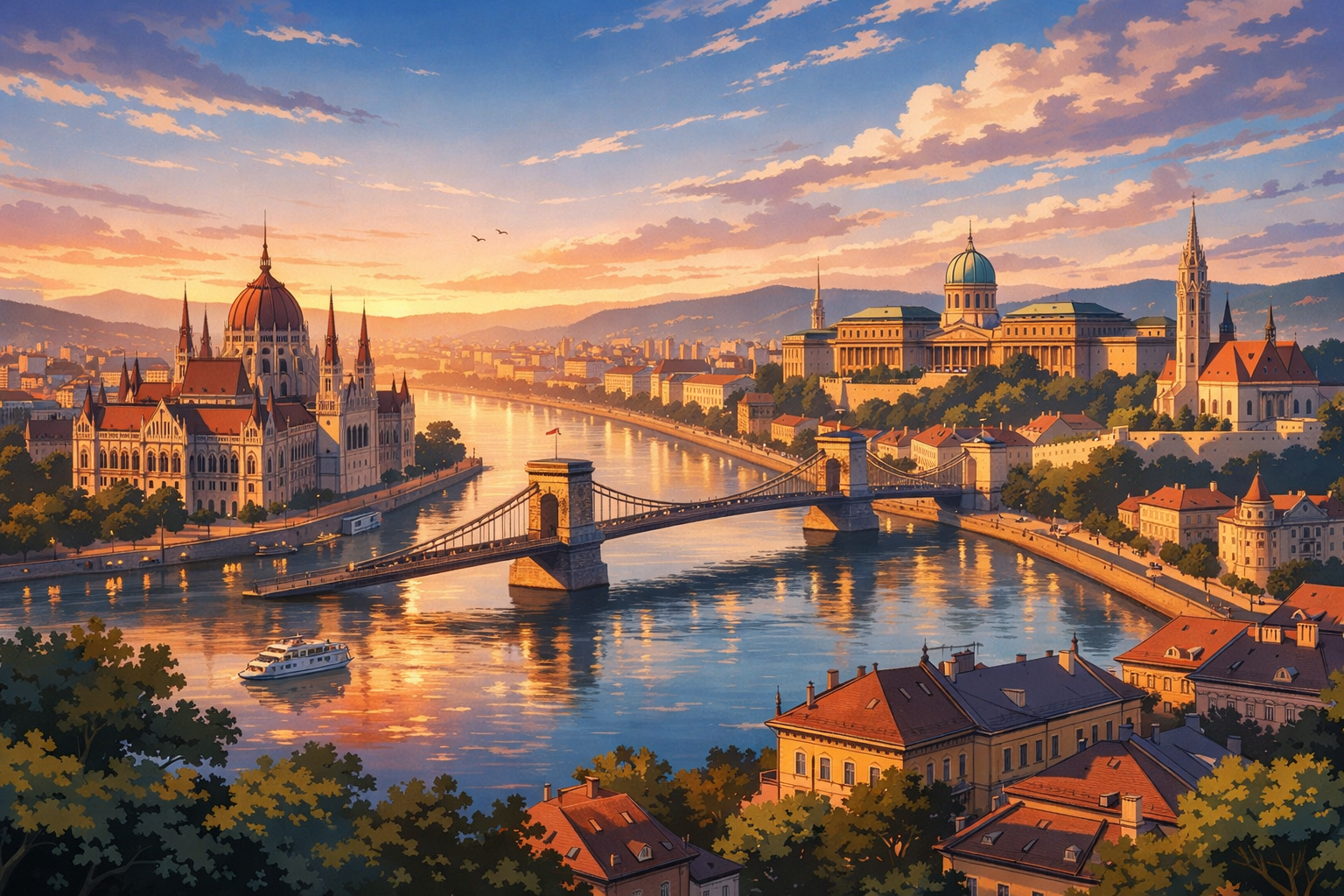
Budapest sweeps you from stately Lipótváros and café-lined Belváros along Andrássy into the buzzing Jewish Quarter, up to storybook Castle Hill and leafy Városliget, then down to the Danube promenades of Ferencváros. Trace Roman echoes in Óbuda’s Aquincum and finish in the Buda Hills at Normafa, where the city glitters below.

🧭 DAY-BY-DAY ITINERARY

Ready-made country and city routes with daily plans, sights, transport and accommodation. Buy PDF guides for independent travel.

🧭 DAY-BY-DAY ITINERARY


Day 1 — Danube axis: Parliament → Chain Bridge → Castle Hill

  • 🚶 Start your morning at the Parliament building (Országház) on Kossuth Square: neo-Gothic, sharp spires, and bronze guards reflected in the waters of the Danube. Walk along the Danube Promenade to the Széchenyi Chain Bridge—the city’s first permanent bridge. The walk across (≈ 15–20 min) offers the best view: tram no. 2 glides along the water, and the Buda panorama looks like a postcard. Head up to Castle Hill either by funicular (2–3 min) or on foot via the switchback path (≈ 15–20 min). At the top: the Palace complex, bastions, multi-level courtyards, and views of the “parliament crown” on the Pest side. Plan 1–1.5 hours to take it in from the Fisherman’s Bastion terraces and around Matthias Church: sunset here gathers the whole city into a single panorama.


Day 2 — Belváros and Lipótváros: the “classic” center and the basilica

  • 🚶 Immerse yourself in central Pest. From Vörösmarty Square, turn onto Váci Street—shop windows, pastry shops, coffee with a kindly “Viennese note.” At midday: St. Stephen’s Basilica—go up to the dome (elevator + a few steps; 360° panorama) and take in the checkerboard street grid below. Then head to Liberty Square with its mix of architectural eras and postwar layers. In the evening, return to the embankment between the Chain Bridge and Liberty Bridge: golden hour on the Danube is a must. Walks between points are 5–20 minutes; if you’re tired, take short hops on tram no. 2.

Day 3 — Andrássy and the Jewish Quarter: city rhythms and elegant details

  • 🚶 Andrássy Avenue is the “Hungarian Champs-Élysées”: mansions, theaters, and display windows. The avenue’s sections change pace—from businesslike to residential. Stop by the Opera House and wander into courtyards with mosaics and wrought-iron staircases. After lunch: the Jewish Quarter (District VII): here graffiti sits alongside synagogues, best visited with respectful timing and an unhurried pace. Finish with ruin bars (for example, in atmospheric courtyards), but don’t rush: this isn’t a “nighttime attraction,” it’s a slice of local urban life. A walking day: 12–15k steps, with coffee breaks every 60–90 minutes.

Day 4 — Városliget (City Park): museums, terraces, and baths

  • 🚶 The yellow M1 metro line is a “museum on rails” in itself. Ride to Széchenyi fürdő/Városliget (≈ 10–15 min from the center), walk to Heroes’ Square and into the park: the lake, little bridges, Vajdahunyad Castle. If you’re interested—visit the Museum of Fine Arts or the Agricultural Museum inside the “castle” walls. If you want a thermal block today, choose the Széchenyi Baths: best in the afternoon (fewer tour groups); plan 2–3 hours with a “thermal circuit”: warm pool → hot pool → steam/sauna → cool down → rest.

Day 5 — Deeper into Castle Hill: museums, palace passages, and “stone air”

  • 🚶 Return to Buda, but into its “inner layer.” The hill’s museums offer different shades of history—from national painting to the capital’s life within fortress walls. Between blocks: palace arcades, the quiet streets of Dísz and Úri, unexpected views toward Pest’s spires. Don’t try to “check off” every exhibition: one museum in depth + a long walk across the terrain is the ideal balance. Getting there from the center: bus/funicular/on foot; allow 20–30 minutes for the ascent including photo stops.

Day 6 — Ferencváros and the southern embankments: markets, Müpa, and Liberty Bridge

  • 🚶 Morning—Great Market Hall: displays of paprika, sausages, cheeses, pastries. Cross Liberty Bridge—green ironwork and a viewpoint toward Gellért Hill. Then keep south along the embankment to the Müpa/ National Theatre cultural quarter: modern forms and a big “window” onto the Danube. Return to the center by tram no. 2 or M3 (≈ 15–25 min). The day’s tempo: “flavors + water + architecture.”

Day 7 — A water day: Rudas and views from Gellért

  • 🚶 The historic Turkish Rudas Baths under the Gellért slope are perfect for an unhurried thermal ritual (2–3 hours). Afterward, climb to the viewpoints on Gellért-hegy (≈ 25–35 min on foot from the base): the Danube bridges and the “parliament line” are spread out before you. The day’s principle: lots of “doing nothing” between scenes of water and city.

Day 8 — Óbuda and Aquincum: Roman Budapest

  • 🚶 North of the center is the third “proto-capital”: Óbuda. The HÉV H5 gets you there quickly; in Aquincum—ruins, mosaics, and the street grid of a Roman camp. The contrast with the Danube postcard is striking: “Rome next door.” Travel time from the center by public transport: 30–40 minutes; inside the park there’s lots of open sky and wind—bring water/a cap in season.

Day 9 — Margaret Island and Újlipótváros: a green island and “Hungarian modernism”

  • 🚶 Margaret Island is a long green island with a running loop, gardens, and monastery ruins. It’s an “urban sanatorium”: come in the morning or at sunset, have a picnic. Afterward—Újlipótváros: cafés, bookshops, Art Deco/modernism in the facades. A day without rushing and without a “must-do program.”

Day 10 — Andrássy, galleries, and “light-well courtyards”: hunting for details

  • 🚶 Head back to Andrássy and the side streets: this is where Budapest’s “lacework” is hidden—majolica, wrought-iron grilles, Art Nouveau, and Art Deco. Add one or two intimate contemporary art galleries. Between stops—coffee and pastries in historic confectioneries. It’s best to build the route in “threads”: from display window to display window, with short tram dashes.

Day 11 — “Heavy” themes: the House of Terror and the underground hospital

  • 🚶 A day for 20th-century history. Morning—the House of Terror on Andrássy (an exhibition about Nazism and Communism in Hungary). After a break—the Hospital in the Rock nuclear bunker under Castle Hill: authentic corridors, equipment, sound scenes. It’s emotionally tough—keep the evening light: dinner and a calm riverside walk.

Day 12 — Városliget without museums: the zoo, the lake, long shadows

  • 🚶 Return to the park, but without any “indoor halls”: the zoo (the oldest pavilions in Europe), the boating lake, and the avenues. This is a “day of living spaces”: fewer walls, more leaves and water. Depending on the weather — a final hour at the Széchenyi Baths or just time on a terrace with a view of Heroes’ Square.

Day 13 — The southern arc: Unicum, markets, and music on the Danube

  • 🚶 Head down to District IX: visit the House of Unicum — factory-and-family stories and a tasting (if that’s in your plans). Walk along the Danubius Promenade, drop into local markets and courtyards. In the evening — a river cruise (seasonal) or a tram “loop” along the water at sunset.

Day 14 — Finale: favorite views, one last loop along the embankment

  • 🚶 Put together your personal Budapest: your favorite bridge, a viewpoint of Parliament, a courtyard where it felt calm. A short walk, dinner with a view of the Danube, and a farewell look at the lights of the Chain Bridge. This city values an unhurried finale — leave room for nostalgia.

Flight tickets

eSIM for travel

Buy PDF guide

Buy PDF guide — 29.99 USD

PDF — 29.99 USD