
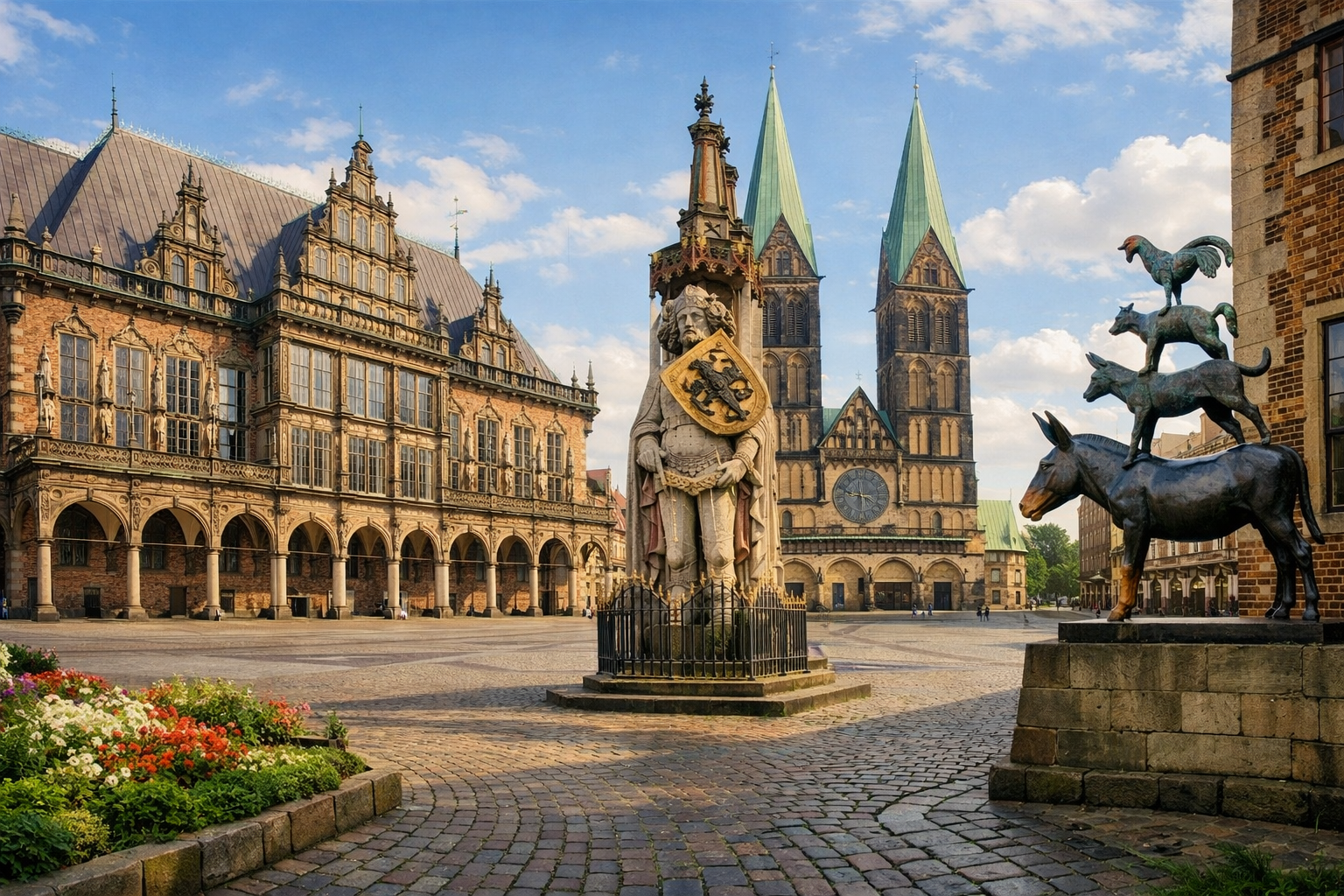
Day 1 — Bremen: Market Square, Town Hall, Roland, and the Bremen Town Musicians
🚆 Arrival in Bremen is convenient to plan via Bremen Airport or the main station, Bremen Hauptbahnhof. From the airport, you can realistically reach the center in about 10–15 minutes on tram line 6 to the Domsheide area, and from there walk a few more minutes; from the main station to the old town, the journey takes about 10 minutes by tram or around 15–20 minutes at an easy walking pace. This short transfer makes Bremen an almost ideal city for a full but not exhausting two-day itinerary.
🚶 Start your trip in the heart of the city — Marktplatz, the historic Market Square, where Bremen immediately reveals itself in all its strength, beauty, and symbolism. Here, the city’s main images come together almost seamlessly: the magnificent Bremen Town Hall, the Roland statue, and the famous Bremen Town Musicians. This space does not feel like just an open square with monuments — rather, it is like a stage on which the centuries-old story of a free Hanseatic city is performed. Historic facades, stone paving, spires, flagpoles, and a dense historical atmosphere create the feeling that you have stepped into a Northern European fairy tale, where urban freedom, mercantile wealth, and civic pride have taken architectural form.
🚶 Bremen Town Hall is one of the most outstanding civic buildings in Germany and a rare monument perceived not only as a beautiful building, but also as a symbol of the city’s independence. Its historic core dates back to the early 15th century, and later the facade received lavish decoration in the Weser Renaissance style. As a result, before you stands not just an administrative building, but almost a stone manifesto of urban self-government, dignity, and prosperity. The facade is especially impressive, rich in decorative sculpture, figures, ornaments, and the rhythm of its windows: you can study it for a long time, finding new details each time. If you go inside on a guided tour, the impression only deepens: the halls of the Town Hall look solemn and ceremonial, yet still preserve a genuine sense of living history rather than a museum set.
🚶 Right in front of the Town Hall stands Roland — Bremen’s main stone guardian and the symbol of its freedoms. This medieval statue, installed in 1404, looks like a knight silently yet confidently protecting the city’s rights. In Bremen, Roland is not seen as a secondary monument, but almost as a political sign, the embodiment of independence, market rights, and urban self-awareness. Together with the Town Hall, it forms one of the strongest and most coherent historical ensembles in Northern Europe. That is why this duo is included on the UNESCO World Heritage List. Even if you are far from architectural history, it is easy to feel near Roland that this place speaks of something greater than mere antiquity: of a city’s right to be itself.
🚶 Then head to the sculpture of the Bremen Town Musicians on the western side of the Town Hall. In reality, it is more compact than many expect from photographs, but that is exactly what makes meeting it especially charming. The donkey, dog, cat, and rooster, standing on top of one another, seem to gather around themselves everything childlike, fairy-tale, and warm in Bremen’s image. The sculpture was created in the 20th century based on the Brothers Grimm tale, yet it feels completely organic as part of the old town. People come here not only for photos: for many, it is an almost ritual moment — to touch the donkey’s legs for good luck, smile, pause, and feel how serious and dignified Bremen suddenly shows its kind, ironic, and deeply human side.
🚶 After the city’s main symbols, it is worth taking a slow walk along Böttcherstraße — a short but incredibly expressive street that looks like a theatrical passage between brick expressionism, decorative fantasy, and merchant romance. Here Bremen changes its tone: after the official grandeur of the Market Square comes a more intimate, artistic, and almost scenographic city. This narrow street with red-brick facades, arches, inner courtyards, and workshops is ideal for an unhurried stroll, a short coffee break, and the feeling that your route is not turning into a race from one point to another.
💤 Allow at least 1.5–2 hours for rest and lunch. Almost the entire first day’s route is walkable within the old center: the distances between the key points are small, usually from 3 to 10 minutes on foot. This means the day can be spent comfortably, without rushing, with real stops for photos, coffee, souvenirs, and simply watching the square at different times of day. In the evening, it is nice to head to the Schlachte waterfront: from Marktplatz it is about a 10–12 minute walk. There Bremen becomes more relaxed — with the river, a promenade, restaurants, and beautiful evening light.