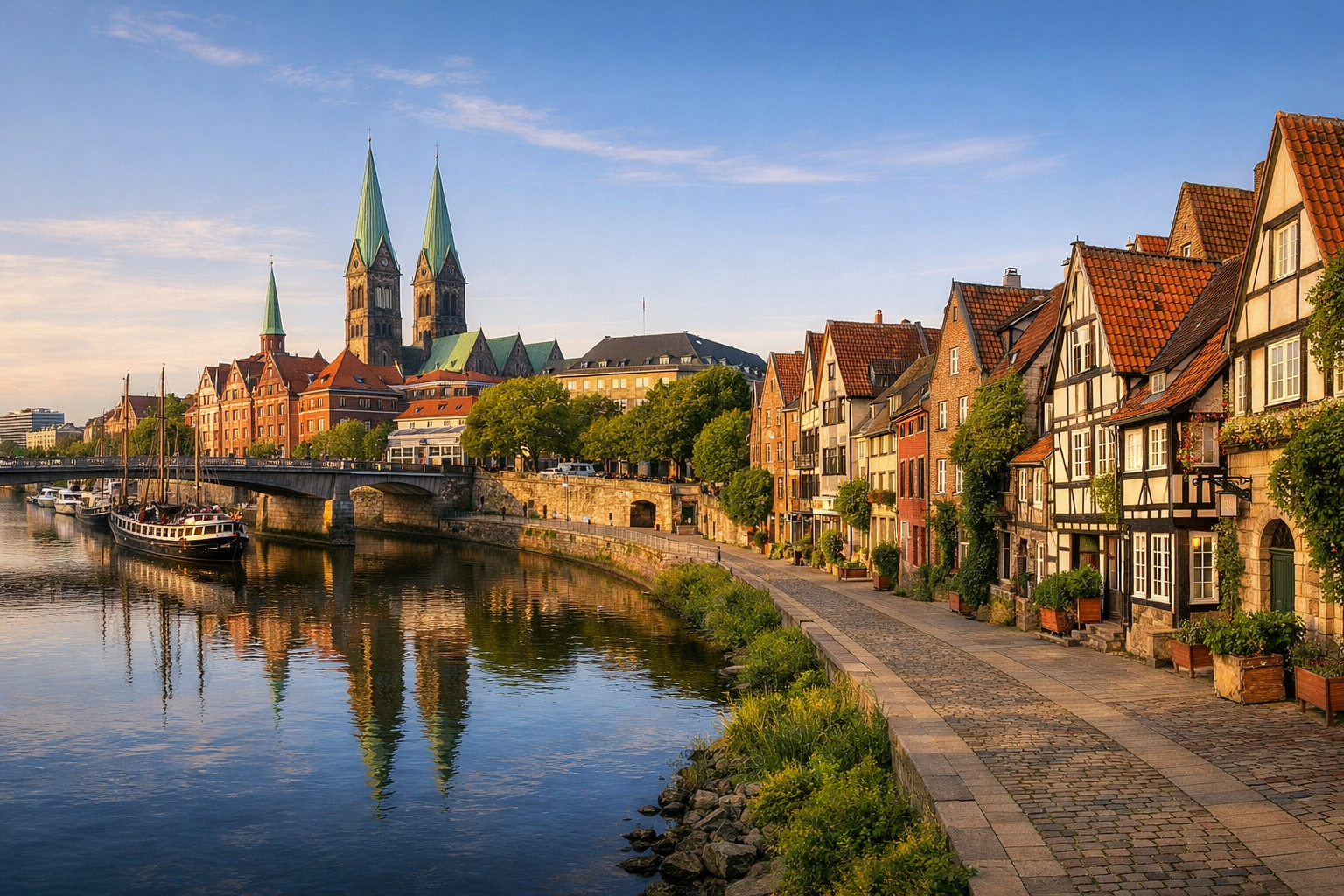
Bremen Bremen Schlachte Embankment and the old Schnoor Quarter

Bremen Bremen Schlachte Embankment and the old Schnoor Quarter

Bremen blends riverside charm with storybook streets. Stroll the lively Schlachte embankment, then wander into the old Schnoor quarter, where narrow lanes and historic houses create one of the city’s most enchanting corners.

🧭 DAY-BY-DAY ROUTE

Ready-made country and city routes with daily plans, sights, transport and accommodation. Buy PDF guides for independent travel.

🧭 DAY-BY-DAY ROUTE


Day 1 — Bremen: Schlachte, Marktplatz, and an evening in the old town

  • 🚆 If you are flying into Bremen Airport, plan for a very easy and short transfer to the center: tram no. 6 goes directly from the terminal toward the city center, usually taking about 10–12 minutes to Domsheide, after which it is only a few more minutes on foot to Schnoor or Marktplatz. From the main station, the old town is also close: you can walk to the central historic quarters in about 13–15 minutes, or get there even faster by tram. This is ideal for the first day: without long transfers, you find yourself almost immediately in the very heart of Bremen.

  • 🚶 Start your route at Marktplatz and the neighboring streets of the old town, then gently make your way down to the Schlachte embankment. Bremen’s historic center is very compact, so it is especially pleasant to build the day not around transport, but around the rhythm of walking. From Market Square to Schlachte is only a few minutes on foot. Along the way, it is easy to add Böttcherstraße, St. Peter’s Cathedral, and the famous Bremen Town Musicians sculpture to the route without turning the day into a race. This combination gives the right first impression of the city: Bremen reveals itself not through flashy attractions, but through a blend of merchant history, water, brick, bell towers, narrow passages, and an unexpectedly cozy urban atmosphere.

  • 🚶 The Schlachte embankment is one of those places where Bremen shows its maritime and trading character especially beautifully. Today it is a long promenade along the Weser with restaurants, terraces, piers, and open views of the water, but once this was an important city port. The very name goes back to the Middle Ages and is connected with the fortification of the riverbank, and the historical memory of the Hanseatic era is felt here not as museum scenery, but as a natural backdrop to city life. During the day, Schlachte is perfect for a relaxed walk with coffee and river views, and by evening it becomes especially atmospheric: soft lights come on, reflections spread across the water, the murmur of the terraces can be heard, and the space feels both lively and very relaxed. It is a great place to have dinner at an unhurried pace, take a pause after the journey, and feel that Bremen is not only historic, but also a very human-scale city.

  • 💤 After a walk along Schlachte, it is worth allowing at least 1–1.5 hours for a calm dinner and rest, without trying to fit too much into the evening. Bremen’s center works best in a short format: a little walking, a little history, a little water, and a good evening rhythm. If you still have energy, you can walk along the river once more or return to the illuminated lanes of the old town — the distances are small, and this is one of those rare cases when a second evening walk really does not feel tiring.


Day 2 — Bremen: the Schnoor quarter, museums near the center, and a farewell walk

  • 🚶 Dedicate the second day to Schnoor — the oldest and perhaps the most photogenic quarter of Bremen. From Marktplatz, it is literally just a few minutes’ walk, so it makes sense to come early, while the narrow alleys have not yet filled with the daytime flow of visitors. Schnoor is a labyrinth of tiny streets and 15th–16th century houses, where the buildings really do stand almost “like beads on a string,” which is how the quarter got its name. Here you especially feel the scale of an old North German city: not ceremonial and monumental, but intimate, artisanal, and highly tactile. The stone underfoot, small signs, workshop windows, inner courtyards, turns that suddenly lead to tiny squares — all this makes a walk through Schnoor not just sightseeing, but a small journey into the medieval fabric of the city.

  • 🚶 The main pleasure of Schnoor is not to “tick it off,” but to walk slowly and let the quarter unfold in layers. There are art shops, craft stores, little cafés, theater and museum spots, and also that rare effect for the center of a big city where time noticeably slows down. It is especially interesting to stop by Bremer Geschichtenhaus — an unusual museum space where the history of Bremen is presented through living scenes and characters from past centuries, not only through display cases and labels. Even if you limit yourself to an exterior look and a short visit, the quarter still leaves a very complete impression: Schnoor does not pretend to be a “postcard” — it really is alive, with real doors, windows, workshops, and an urban rhythm.

  • 🚶 After Schnoor, it is convenient to continue the day along the cultural arc of the center. Within walking distance are Kunsthalle Bremen, Gerhard-Marcks-Haus, and across the river — Weserburg Museum für moderne Kunst. If you do not want to overload the day, choose one major museum and one walking stop. It makes sense to allow about 1.5–2 hours for Kunsthalle or Übersee-Museum, about an hour for a short visit to Gerhard-Marcks-Haus, plus time for coffee and walking between places. Bremen is especially good precisely because a museum day here does not require complicated logistics: between the main central points, 10–20 minutes on foot is often enough, so you can alternate dense indoor spaces with air, streets, and rest.

  • 🚶 The best way to end the trip is by returning to the water or taking one final loop through the old town. You can head back to Schlachte to see the Weser in a different mood, or stay in the Schnoor and Marktplatz area if you want to soak up the atmosphere of facades, old signs, and quiet alleys once more. It is good to allow 45–60 minutes for a farewell walk without a strict goal. Bremen is one of those cities where the warmest impressions often arise not at the main landmark, but between them — in the transition from square to river, from cathedral to narrow lane, from museum hall to evening light on the pavement.

Flight tickets

eSIM for travel