
Buy PDF guide

Buy PDF guide — 8.57 USD

PDF — 8.57 USD

BRANDENBURG - Nature tour through the national parks of Brandenburg

BRANDENBURG - Nature tour through the national parks of Brandenburg

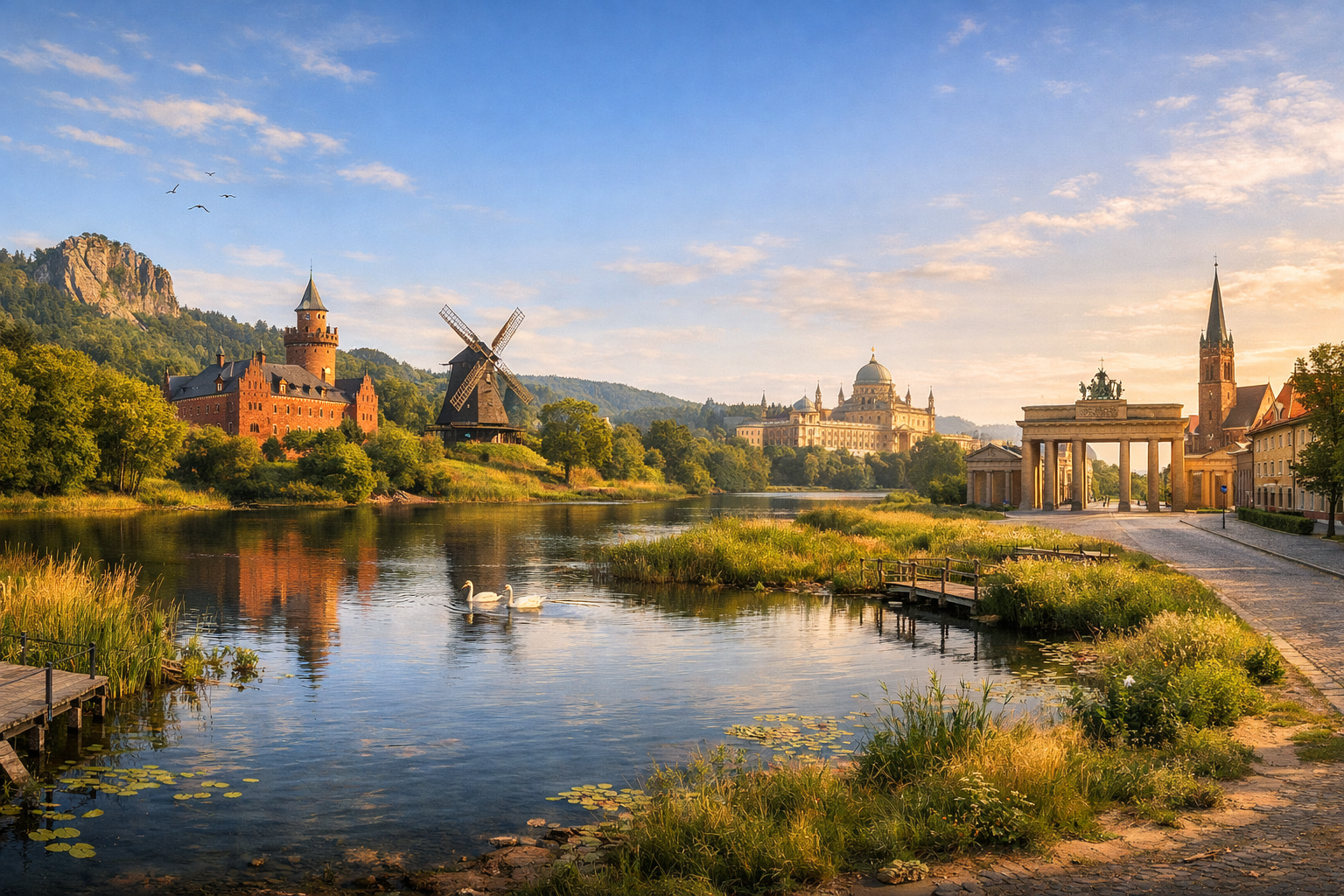
Discover Brandenburg on a nature-filled journey from elegant Potsdam to the quiet waterways of the Spreewald. Continue through the deep forests of Schorfheide-Chorin and end amid the wide floodplains and birdlife of the Lower Oder Valley.

🧭 DAY-BY-DAY ROUTE

Ready-made country and city routes with daily plans, sights, transport and accommodation. Buy PDF guides for independent travel.

🧭 DAY-BY-DAY ROUTE


Day 1 — Potsdam: a gentle start after arrival and waterside parks

  • 🚆 Transfer: BER Airport → Potsdam by regional train RB22 or via central Berlin with a transfer. A realistic travel time is usually around 50–80 minutes depending on the flight and connection. After landing, allow another 20–30 minutes for baggage claim and getting to the station under the terminal.

  • 🚶 Potsdam is an ideal first base for a nature route through Brandenburg: the city offers a gentle acclimatization after the journey, does not overwhelm you with pace, and immediately introduces the region’s signature landscape — water, old parks, quiet avenues, and big skies. It’s best not to try to cover everything on the first day: after check-in, leave yourself a calm route along the embankments and gardens around Neuer Garten or along Heiliger See. Potsdam is wonderful because nature and history do not compete here: among palaces, lawns, and old trees, it is easy to feel that distinctly northern German rhythm where the walk matters more than ticking off a list. In the evening it is especially beautiful to stroll toward the water, when facades turn golden, the paths grow emptier, and the park seems to slowly dissolve into silence. This kind of start helps you avoid burning out at the beginning of the trip and preserves your energy for the following days with longer outings to the national park and biosphere reserves.

  • 🌿 If you still have energy, add a short walk through Neuer Garten and the area around Heiliger See: this is a place not about attractions, but about breathing, perspective, and light. Here you can feel especially well why Brandenburg is so loved for its combination of cultural landscape and the natural softness of nature: paths disappear between old trees, the water opens up in broad mirrors and then hides behind greenery, and the air feels surprisingly fresh even close to the city. For the first evening, 1.5–2 hours of unhurried walking and an early dinner are enough to go to bed without overload and be ready for an early departure to Spreewald the next day.


Day 2 — Spreewald: boats, canals, and waterside villages

  • 🚆 Transfer: Potsdam → Lübben or Lübbenau/Spreewald by regional trains. With a transfer, allow about 1h 30m–2h each way. If you want more flexibility with timing, renting a car or using car-sharing for the day makes this day noticeably more convenient, but the route is still quite realistic by train.

  • 🚶 Spreewald is one of the most atmospheric natural places in Brandenburg, and its magic reveals itself not from a viewpoint but in the movement through the landscape itself. This is a world of slow canals, wooden footbridges, meadows, alder groves, shaded branches of the Spree, and villages where water has for centuries been not an obstacle but a street. The best way to get to know the region is either by boat trip or by combining a short walking route with a ride on a traditional flat-bottom boat. Around Lehde and Lübbenau, the scenery is especially cinematic: narrow canals reflect the sky and treetops, the banks are overgrown with reeds and grasses, and the old houses with flower gardens seem almost toy-like. You don’t want to rush here — on the contrary, the whole value of the place lies in slowing down and letting your eye get used to the details: ripples on the water, occasional splashes, the smell of damp wood, the shadow of walkways, quiet moorings by the houses. This is not “wild” nature in the Alpine sense, but a subtle, centuries-old union of people and a marshy world, which is precisely why Spreewald feels so alive and human.

  • 🏡 It is worth setting aside time for the village of Lehde and the open-air museum Freilandmuseum Lehde: this is where the character of the region is read especially clearly. Old farmyards, outbuildings, gardens, and canals show how everyday life took shape in a world where the boat was as ordinary a means of transport as a cart or a bicycle. After the museum, it’s good to leave yourself a pause for a walk without a strict plan — go down to the water, sit on a bench, try the local cuisine, and simply enjoy the silence. For the whole day, it is reasonable to allow 8–10 hours including the round trip, so the outing does not turn into a marathon. It is better not to plan your return to Potsdam too late: 2 hours of travel after a full nature day feels noticeably easier if you do not push yourself to exhaustion.

Day 3 — Schorfheide-Chorin: ancient forests, lakes, and the silence of northern Brandenburg

  • 🚆 Transfer: Potsdam → Chorin / Joachimsthal / Angermünde depending on the chosen entry point into the Schorfheide-Chorin Biosphere Reserve. By public transport with transfers, the journey usually takes about 1h 45m–2h 30m each way. A car is especially convenient for this day because it lets you combine forest trails, lake views, and the monastery complex without an unnecessary race for connections.

  • 🚶 The Schorfheide-Chorin Biosphere Reserve is already a different Brandenburg: more spacious, more northern, more silent. There is no feeling of a suburban walk here; on the contrary, the landscape becomes deeper and more serious. Vast forest massifs, hilly glacial terrain, lakes, old beech stands, and long roads between villages create a sense of real distance from the city, even though you are still comparatively close to Berlin. One of the region’s strongest natural highlights is the area around the Grumsin beech forest, the only UNESCO World Natural Heritage site in Brandenburg. This is not a place for a dramatic “wow” shot, but for a very pure, almost meditative experience of the forest: soft light between the trunks, deep greenery, silence in which you hear only footsteps, birds, and wind. In landscapes like these, your inner rhythm shifts especially well: the walk stops being an activity and becomes a state of being.

  • ⛪ If you build the day around Chorin, add Kloster Chorin and the walking areas around it. This is a rare combination of architectural austerity and natural softness: the red brick of the old Cistercian complex, the clearings, water, and forest are perceived here as a single whole. It is best not to overload the route: 2–3 key points, one main walk of 2–4 hours, and a long lunch break. In northern Brandenburg, distances can be deceptive: everything seems close on the map, but constant short drives and transfers quickly eat up your energy. That is why the quality of the day matters more than the number of locations. In the evening, either return to Potsdam or stay overnight in Chorin/the surrounding area — both options are realistic, but for a calmer pace, an overnight stay in the northern part of the region is especially pleasant.

Day 4 — Unteres Odertal National Park: floodplains, birds, and a grand finale

  • 🚆 Transfer: from the Chorin / Angermünde area or from Potsdam to Schwedt/Oder and then onward to the Criewen area, where the national park and its visitor center are located. If starting from northern Brandenburg, the journey usually takes about 45–90 minutes; from Potsdam the trip is substantially longer and can take 2h 30m–3h 30m with transfers. That is why the logistics of this day work best either with an overnight stay in Chorin the night before or with an early departure by car.

  • 🚶 Unteres Odertal National Park is the main natural chord of the whole trip and one of the most distinctive places in Brandenburg. It is the only floodplain national park in Germany, and its beauty is built not on mountains or dramatic cliffs, but on the immense breathing space of a river valley. Here you feel space, water, seasonality, and the life of migratory birds especially strongly. The landscape feels both open and subtle at the same time: broad meadows and polders, branches of the Oder, dikes, wet lowlands, quiet canals, and endless sky create a sense of borderland, almost northern European freedom. On a clear day, the views from the dikes are incredibly crisp and far-reaching, and in cool or windy weather the park becomes even more expressive — slightly austere, but very honest. This is a place for those who love not “entertainment in nature” but a true observant walk: to look into the distance, notice the movement of light, read the landscape, listen to birds, and understand how a large river ecosystem lives.

  • 🦅 It is best to start at the Nationalparkzentrum in Criewen to pick up maps, understand the current route conditions, and choose a manageable walk. After that, it makes sense to follow one of the sections along the dikes or viewing trails without overloading the program: even 2–3 hours in this area leave a strong impression. Here it is especially important to have time for pauses — sit on a bench, stop by the water, look through binoculars, wait out the wind, and slowly make your way to the next point. If your trip falls during migration periods, the impression becomes even more powerful: the park is known for its rich birdlife, and even a person with no ornithological experience can easily feel that they are in a truly living, major natural corridor. For the finale, it is best to allow time for an early dinner in Schwedt and a calm departure: after a day like this, what you want is not bustle but silence, so that the trip ends in exactly the state for which people usually come to Brandenburg — a clear head, lungs full of fresh air, and the feeling of a vast open space.

Flight tickets

eSIM for travel

Buy PDF guide

Buy PDF guide — 8.57 USD

PDF — 8.57 USD