
Buy PDF guide

Buy PDF guide — 4.28 USD

PDF — 4.28 USD

BRANDENBURG - Potsdam Sanssouci palaces and parks

BRANDENBURG - Potsdam Sanssouci palaces and parks

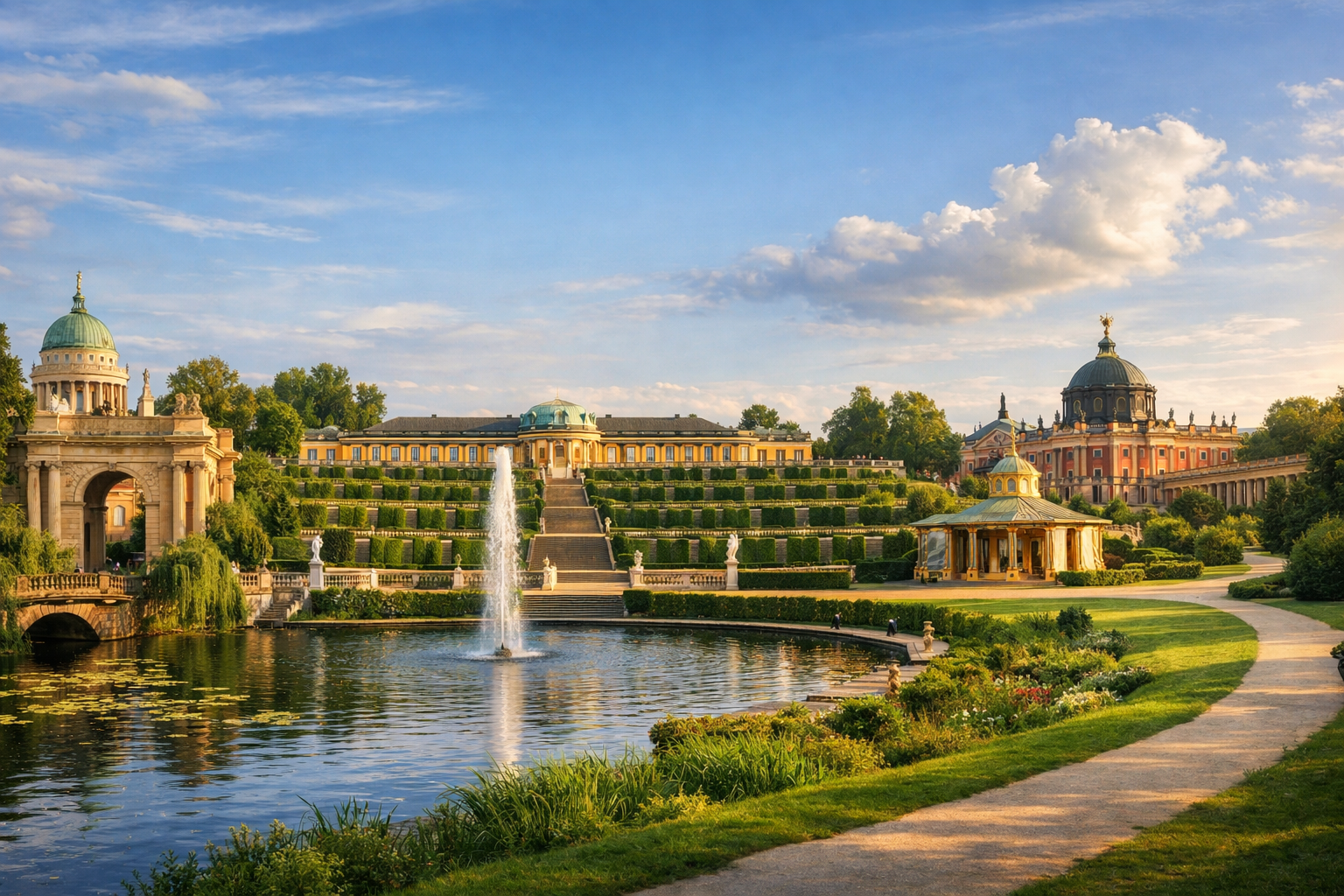
Brandenburg invites you into a landscape of grand palaces, sweeping parks, and quiet lakeside beauty. In Potsdam, Sanssouci and its elegant gardens offer a glimpse of royal splendor just beyond Berlin.

🧭 DAY-BY-DAY ROUTE

Ready-made country and city routes with daily plans, sights, transport and accommodation. Buy PDF guides for independent travel.

🧭 DAY-BY-DAY ROUTE


Day 1 — Potsdam: Sanssouci Park, Sanssouci Palace, Picture Gallery, New Palace

  • 🚆 Transfer: Berlin Hbf → Potsdam Hbf by regional train RE1 — about 25–30 minutes. From Potsdam central station, it is convenient to reach the Sanssouci area entrances by tram or bus, and then it is best to continue on foot: the park itself is huge, but this walking pace is exactly what lets you feel its scale, the perspectives of the avenues, and the changing palace scenes.

  • 🚶 Start the morning with Sanssouci Palace — the most poetic and intimate of the Prussian royal palaces. Unlike ceremonial residences, it was conceived as Frederick the Great’s personal retreat, a place for rest, philosophical conversations, and almost intimate luxury. The palace lies on a vineyard terrace, and that image alone makes it completely special: the light facade, semicircular lines, gilded details, staircases, and green tiers create the impression that the architecture here grew directly out of the garden. Inside, Sanssouci does not impress through heaviness — it captivates with refinement, the rhythm of rococo, and the feeling of private royal life in which art, music, and landscape were part of everyday existence. It is reasonable to allow about 45–60 minutes for the interiors, and at least another half hour for the approach, photos, and an unhurried look at the terraces. It is important to plan entry by time slot: for Sanssouci, this is especially relevant.

  • 🚶 After the palace, it is worth taking a slow walk along the central avenues of Sanssouci Park. This is not just a park, but a whole landscape theater of squares, shaded paths, pavilions, sculptures, and distant vistas. It is often perceived as a “garden by the palace,” but in reality it is a complete world where the walk itself becomes the main impression. There is a lot of greenery and open views between the route points, so the transitions here are not tiring, but work as gentle pauses between interiors. From Sanssouci Palace to the Picture Gallery and further along the main routes, allow 10–20 minutes for each walk, but with stops for views and photos this easily turns into a full slow journey.

  • 🚶 The Sanssouci Picture Gallery is one of those places that often becomes a pleasant surprise even for experienced travelers. From the outside it is relatively restrained, but inside it opens up like a true jeweled case of the 18th century: marble, gilded frames, solemn brilliance, and a dense hanging of paintings create the atmosphere of an old princely museum, where art was shown not as a neutral collection but as a demonstration of taste, power, and cultural ambition. Here you can especially feel Frederick the Great’s love for European painting, and the space itself does not look like a modern white cube, but rather like a luxurious historical setting for meeting paintings. It is comfortable to set aside 30–45 minutes for the gallery.

  • 🍽️ It is best to plan lunch in the middle of the day around the historic mill or near the park exits closer to Luisenplatz / Brandenburger Straße. This helps keep the pace and avoid wasting extra time on longer transfers. Allow 60–90 minutes for lunch and a short rest: the park is large, and such a break really improves the experience of the second half of the day.

  • 🚶 In the second half of the day, move toward the New Palace — the impressive finale of the park’s main axis. If Sanssouci is refined royal seclusion, then the New Palace is demonstratively the opposite in character. This is architecture of representation, power, and state splendor: the enormous scale, dome, extended facades, and almost theatrical solemnity immediately make it clear that this is a residence created not for privacy but for impression. The walk from the central part of the park to the New Palace takes about 30–40 minutes at a calm pace, but this transition is especially good because the palace gradually “grows” in the perspective of the avenue like the final set of a huge park performance.

  • 🚶 The New Palace is worth exploring without rushing. Inside, it unfolds as a ceremonial machine of the Prussian court: halls, staircases, decorative programs, and the scale of the interiors emphasize that this is one of Potsdam’s most representative royal buildings. There is no intimate lyricism of Sanssouci here — instead, grandeur, rhythm, and the feeling of an official monarchical stage take over. It is reasonable to allow 60–90 minutes for the interiors, and after the visit leave at least 20–30 minutes for the exterior, photos, and a short rest before the return trip.

  • 🚋 It is convenient to plan the return to the hotel by public transport from the stop near the New Palace or via a short ride to Potsdam Hbf / the center. In the evening, you can stroll along Brandenburger Straße, Luisenplatz, or the Old Market: after a monumental day in the park, urban Potsdam feels especially cozy, compact, and lively.


Day 2 — Potsdam: Charlottenhof, Alexandrowka, Museum Barberini, and the tropical Biosphäre

  • 🚶 The second day is best made more varied in mood: first the romantic and almost Italian side of Potsdam, then an unusual Russian trace in the city’s history, and toward evening a strong museum focus and a comfortable finish in a covered green environment. This rhythm balances the first day well, which was centered on the Sanssouci axis and large palace forms.

  • 🚶 Start the morning with Charlottenhof Palace and the surrounding park landscape. This is one of Potsdam’s most elegant and underrated places: it has less official heaviness and more of the ideal of a calm, educated, almost Mediterranean life. Charlottenhof is often called “Prussian Arcadia,” and that is a very accurate impression: the palace does not overwhelm with scale, but charms with clarity of line, noble simplicity, and dialogue with the landscape. It is especially pleasant to walk here in the morning, when the garden vistas are still quiet and the light falls softly on facades and paths. It is worth allowing about 1.5–2 hours for the walk and this part of the route.

  • 🚶 If time and opening hours allow, after Charlottenhof it makes sense to continue to the Orangery Palace area for an exterior look at the complex. It is important to keep in mind that the Orangery Palace itself may currently be partially or fully closed due to restoration work, so this part is best understood primarily as a walking and visual stop. Even without the interiors, the place makes a strong impression: long facades, Renaissance motifs, terraces, and viewpoints create an almost Italian scenography in the middle of Brandenburg. Allow 30–45 minutes for the exterior and the walks between points.

  • 🚕 Next, it is convenient to transfer or take public transport to Alexandrowka. From the Sanssouci area, the journey to the Russian colony usually takes about 15–25 minutes depending on your starting point and connections. Alexandrowka is a surprising historical episode of Potsdam that sharply changes the optics of the trip: after Prussian palaces, you find yourself among wooden houses with a Russian roofline silhouette, gardens, and an almost village-like quietness. This place does not look like a stage set; it feels like a living cultural layer where politics, the memory of 19th-century alliances, and an architectural exoticism rare for Germany are intertwined. The Alexandrowka Museum helps reveal the concrete history behind this idyllic picture, and a walk through the colony itself gives you a chance to catch your breath and see a completely different Potsdam — not ceremonial, but intimate and very human.

  • 🍽️ After Alexandrowka, it is convenient to pause for lunch in central Potsdam or closer to the Old Market. Allow 75–90 minutes for the trip and lunch: this will let you move on to the museum part of the day without rushing.

  • 🏛️ In the second half of the day, head to Museum Barberini on Alter Markt. This is one of the strongest cultural highlights of modern Potsdam: a baroque urban scene with a reconstructed palace facade is combined here with a museum program of international level. Even if you have already visited many European museums, Barberini stands out precisely because of the contrast: after gardens, avenues, and historic residences, you enter a space where Potsdam speaks the language of exhibitions, curatorial ideas, and great art. The Alter Markt area itself also deserves attention: it is an urban stage set with domes, a square, and the feeling of a restored historic center. Allow at least 1.5–2 hours for the museum and the square.

  • 🌿 If you want a softer ending to the day, after the museum head to the Potsdam Biosphäre. It is easy to get here from the center by tram in about 15–20 minutes. The Biosphäre is especially good as an evening or late-afternoon finale: after palaces and the museum, you find yourself in a warm tropical space where the air is humid, palms and dense greenery surround you, and the mood becomes almost vacation-like. This place does not compete with Sanssouci and does not try to be another historic monument — on the contrary, it gives your body and eyes a rest. It makes sense to allow 60–90 minutes for the visit.

  • 🚆 End of the route: from the Biosphäre or central Potsdam, it is easy to return to Potsdam Hbf and then take the RE1 train back to Berlin. If you are heading to BER airport, you can use the regional train RB22 or the direct BER2 bus; on average, the journey from Potsdam to the airport takes about 60 minutes, but before departure you should definitely check current services and possible timetable changes.

Flight tickets

eSIM for travel

Buy PDF guide

Buy PDF guide — 4.28 USD

PDF — 4.28 USD