
Day 1 — Brandenburg an der Havel: Cathedral Island, old urban fabric, and archaeology
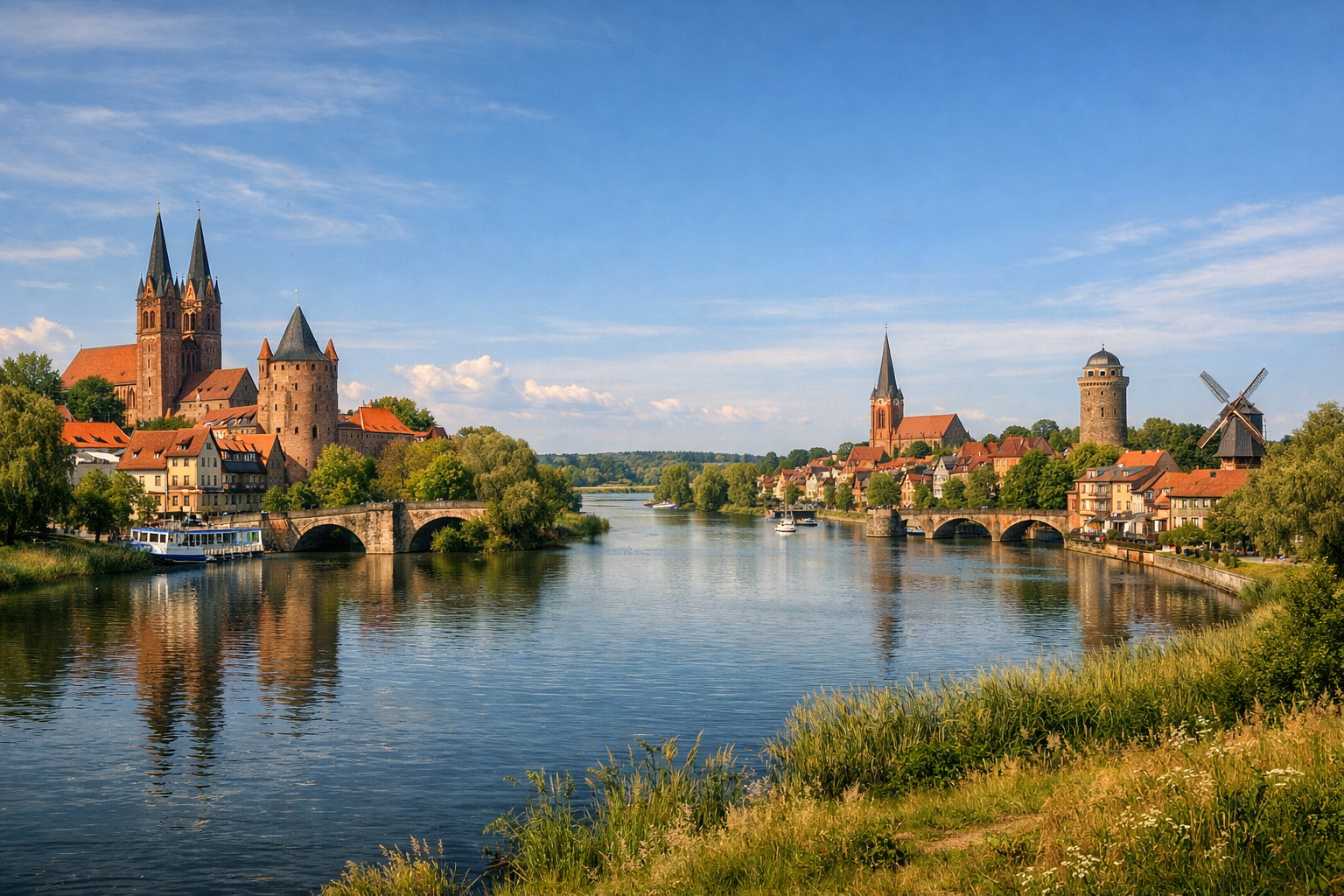
🚶 Brandenburg an der Havel is one of those German towns where history is felt not as a museum backdrop but as a living environment: here, water is not just scenery but part of the city’s logic, and the old quarters grew around islands, bridges, and church silhouettes. The town is especially well suited to a calm two-day route because it does not demand haste: instead of an endless race through sights, you get the rare pleasure of walking streets lined with Brick Gothic architecture, reaching quiet embankments along the Havel, watching towers and gables reflected in the water, and gradually assembling an image of medieval Brandenburg. The historic core is made up of several parts — Cathedral Island, the Altstadt, and the Neustadt — and that is exactly why a walk here feels layered: beyond one bridge opens the church ensemble of early Brandenburg, beyond another — market squares, town halls, stone towers, and the cozy rhythm of a small old town.
🚶 Start the day on Cathedral Island with Brandenburg Cathedral of St. Peter and St. Paul. This is not just the city’s main church, but the place from which the region’s early history can literally be read. The cathedral stands on an island between Lake Beetzsee and the Havel, and the ensemble itself, with its cloister and adjoining buildings, still forms the oldest and most noble silhouette of the city. The architecture carries a deep historical layer: its foundation goes back to the 12th century, and the building was later rebuilt in the Gothic spirit, so this is an especially beautiful place to observe how the strict medieval mass of brick connects with the more elegant details of later eras. Inside, not only the church itself matters, but also the museum space attached to the cathedral: this place does not shout about its significance, but reveals itself gradually — through old tombstones, sacred objects, the organ tradition, and the atmosphere of North German sacred architecture. Even if you are usually indifferent to church interiors, it is worth lingering here: the cathedral works like a time machine and at the same time as a viewpoint for understanding the whole city.
🚶 After the cathedral, stroll around Cathedral Island and return via the bridges to the old quarters of the Altstadt. It is especially pleasant here to walk without a rigid plan: to look at the water, old facades, quiet courtyards, and the rare-for-Germany feeling of a “city between river branches.” Brandenburg an der Havel lacks the aggressive tourist bustle of larger centers, and that is exactly what makes the walk especially valuable. The Altstädtischer Markt with its historic buildings, stone towers, narrow streets, small squares, and views of the embankments creates a mood of unhurried discovery. This city reveals itself not in a single postcard panorama but in a sequence of beautiful fragments: now a red-brick wall and spire, then boats by the water, then an old house, then a quiet street leading toward a square. It is worth allowing at least 2–3 hours for this section, with breaks for coffee and photos, because the main charm of Brandenburg lies precisely in the rhythm of slow walking.
🏛️ In the second half of the day, it makes sense to move on to the Brandenburg State Archaeological Museum in the former St. Paul’s Monastery, Neustädtische Heidestraße 28, 14776 Brandenburg an der Havel. It is easy to reach on foot from the center in about 10–15 minutes, and from the main station the walk takes around 8 minutes. The space itself is already impressive: the museum is housed in a former Dominican monastery, so the visit gives you two layers of impressions at once — the archaeological exhibition and a powerful architectural setting. It is a great place for the second half of the day, when you want not only to walk but also to calmly “assemble” the historical context of the region. The exhibitions help you see how Brandenburg developed from early settlements through the Slavic and Christian periods to later urban culture. A visit here balances the morning walk well: after the open space of islands and markets, you find yourself inside a focused, thoughtful narrative about a land where history is literally extracted from layers of soil.
🏛️ If you still have energy, add the Brandenburg an der Havel City Museum, Frey-Haus, Ritterstraße 96, 14770 Brandenburg an der Havel. This is a good complement to the cathedral and the archaeological museum because it shows not so much antiquity as urban everyday life and local identity. The Baroque Frey-Haus is itself worth attention, and inside the stories connected with more recent urban history and local traditions are especially interesting. It is convenient to fit this visit in toward evening if you want to end the day not in a rush, but in a more intimate way.
☕ Leave the evening for a calm walk along the embankments and through the historic center. In Brandenburg an der Havel, there is no need to turn the evening into a mandatory program: it is far better simply to stroll along the water, watch the brick towers and city lights reflected in the Havel, and give the town time to “finish speaking.” It is precisely at dusk that its character is felt most clearly — not ceremonial and not noisy, but noble, watery, and old-European. It is best to spend the night in Brandenburg an der Havel so that the next day you can head to Rathenow without early stress.