
Buy PDF guide

Buy PDF guide — 6.43 USD

PDF — 6.43 USD

Boston - the history of the USA and Ivy League universities

Boston - the history of the USA and Ivy League universities

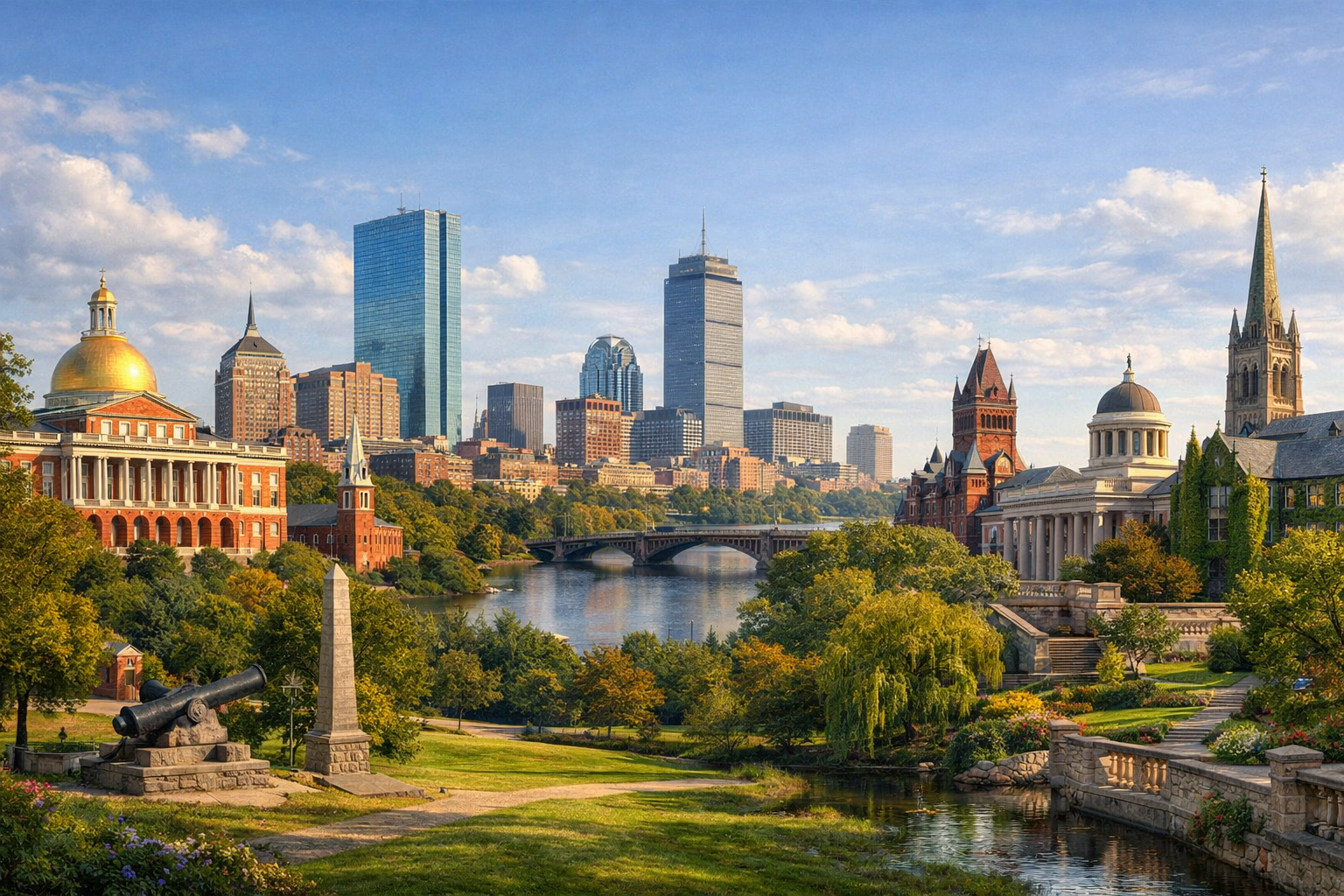
Walk through the birthplace of American history in Boston, where the Freedom Trail winds past red-brick landmarks into the elegant streets of Beacon Hill and Back Bay. Just across the river, Cambridge adds a brilliant academic edge with Harvard, MIT, and museum-filled campuses that make the city feel both timeless and alive.

🧭 DAY-BY-DAY ITINERARY

Ready-made country and city routes with daily plans, sights, transport and accommodation. Buy PDF guides for independent travel.

🧭 DAY-BY-DAY ITINERARY


Day 1 — Boston: Freedom Trail, revolutionary US history, and the waterfront

  • 🚶 The first day is best devoted to the historic core of Boston — a city where American history is felt not like a schoolbook paragraph, but as a living urban fabric. Start in the morning in the Boston Common area and the Visitor Center at the beginning of the Freedom Trail: the famous red line on the sidewalk helps you walk almost without a map and gradually “assemble” the story of the American Revolution. A realistic pace for the day is this: 20–30 minutes for Boston Common and a quick route setup, then 15–20 minutes on foot to the Massachusetts State House and Beacon Hill, after which continue to Granary Burying Ground, King’s Chapel, Old South Meeting House, and Old State House. Allow 15–25 minutes for each key stop, and about 2.5–3 hours total for the whole stretch from the Common to Faneuil Hall at a comfortable pace with photos and short breaks. This is not a “whirlwind monument dash,” but a walk through places where taxes, rights, representation, and the very idea of a new republic were discussed.

  • 🍽️ After midday, it is convenient to take a break in the Faneuil Hall / Quincy Market area: this is a logical rest point for about 45–60 minutes. From here, the route naturally continues into the North End — Boston’s oldest residential neighborhood, where narrow streets, brick facades, and an almost European density of urban space unexpectedly heighten the sense of historical depth. Here you will find the Paul Revere House and Old North Church; the walks between them are short, usually 8–12 minutes on foot. If you still have energy, it makes sense to continue toward Charlestown Navy Yard and USS Constitution, but this is already a longer section: from the North End to the Navy Yard, allow about 25–35 minutes on foot one way, or shorten the trip by public transport or taxi. In total, the first day’s route easily takes 7–8 hours including museums, coffee stops, lunch, and a relaxed evening by the water near Long Wharf. The finale by the harbor is especially successful: after a history-filled walk, Boston suddenly reveals itself as a maritime city from which commercial, political, and university New England once grew.


Day 2 — Boston: Beacon Hill, Back Bay, Fenway museums, and cultural America of the 19th–20th centuries

  • 🚶 The second day is best planned as a more “visual” and cultural one, without excessive focus only on the revolutionary theme. Start with a morning walk through Beacon Hill and across the Public Garden: this area shows a different Boston — not rallying and portside, but elegant, literary, almost intimate. Between Boston Common, the Public Garden, and the streets of Beacon Hill, it is pleasant to walk unhurriedly for 1.5–2 hours, enjoying the brick houses, gas lamps, and the tidy rhythm of the old city. Then head to the Fenway / Avenue of the Arts area. By Green Line subway or taxi from the center, it usually takes about 20–30 minutes; from Back Bay, the trip is even shorter. The main focus of the day is the Museum of Fine Arts and the Isabella Stewart Gardner Museum, located next to each other, which makes the program very convenient.

  • 🏛️ At the Museum of Fine Arts, do not try to cover everything: it is a large world-class museum, and it is sensible to set aside 2–3 hours for it, choosing American art, European painting, or ancient collections according to your interests. After a short coffee break or late lunch, walk to the Isabella Stewart Gardner Museum — the walk between them takes about 8–12 minutes. Here the atmosphere changes: instead of an encyclopedic museum, you are met by an almost personal artistic world, assembled like a palace of memory with an inner courtyard, garden, silence, and a very distinctive sense of space. It is worth allowing 1.5–2 hours for the Gardner Museum, otherwise it will pass by too quickly. In the evening, you can return to Back Bay and end the day at the Boston Public Library and Copley Square: from the museum district to Copley, it is about 15–20 minutes by transport. This day provides an important contrast to the first: Boston turns out to be not only the city of the founding of the United States, but also a place where American tastes, institutions, libraries, museums, and the very idea of cultural prestige were formed.

Day 3 — Cambridge: Harvard, Harvard Square, museum collections, and MIT

  • 🎓 The third day is devoted to university America — that very intellectual version of New England for which many people come to Boston. In the morning, head to Cambridge, ideally to Harvard Square: from downtown Boston, the ride on the Red Line usually takes about 15–25 minutes, plus 5–10 minutes to exit and get oriented on site. Start with a walk around Harvard Yard and the surrounding streets. Even without a deep dive into university history, the area makes a strong impression: red brick, restrained architecture, bookstores, courtyards, and the feeling that the American academic elite has been reproduced here for decades. For the walk around Harvard Square and the Yard itself, it is reasonable to allow 1–1.5 hours, and then choose one of the museums in the Harvard cluster. A good half-day combination is Harvard Art Museums plus the Harvard Museum of Natural History or the Peabody Museum of Archaeology & Ethnology. Walks between them in Cambridge are relatively short: 10–20 minutes on foot.

  • 🔬 After lunch, move to Kendall Square and MIT — by subway from Harvard Square this is usually about 10–15 minutes, plus another 5–15 minutes on foot between individual points on campus. Here the mood is completely different: if Harvard is associated with tradition and symbolic capital, MIT feels like a territory of ideas, technology, engineering, and the modern urban future. The MIT Museum in Kendall Square is the best way to see this layer not only through campus buildings, but also through real projects, experiments, and the language of science. Allow 1.5–2 hours for the museum. If you still have energy, take an evening walk along the Charles River: the views of Boston from the Cambridge side are especially beautiful at sunset and make a graceful conclusion to the three-day route. This kind of finale works almost perfectly: you begin the journey with the history of the founding of the United States, and end it in places where the country’s intellectual and technological future is being shaped today.

Flight tickets

eSIM for travel

Buy PDF guide

Buy PDF guide — 6.43 USD

PDF — 6.43 USD