
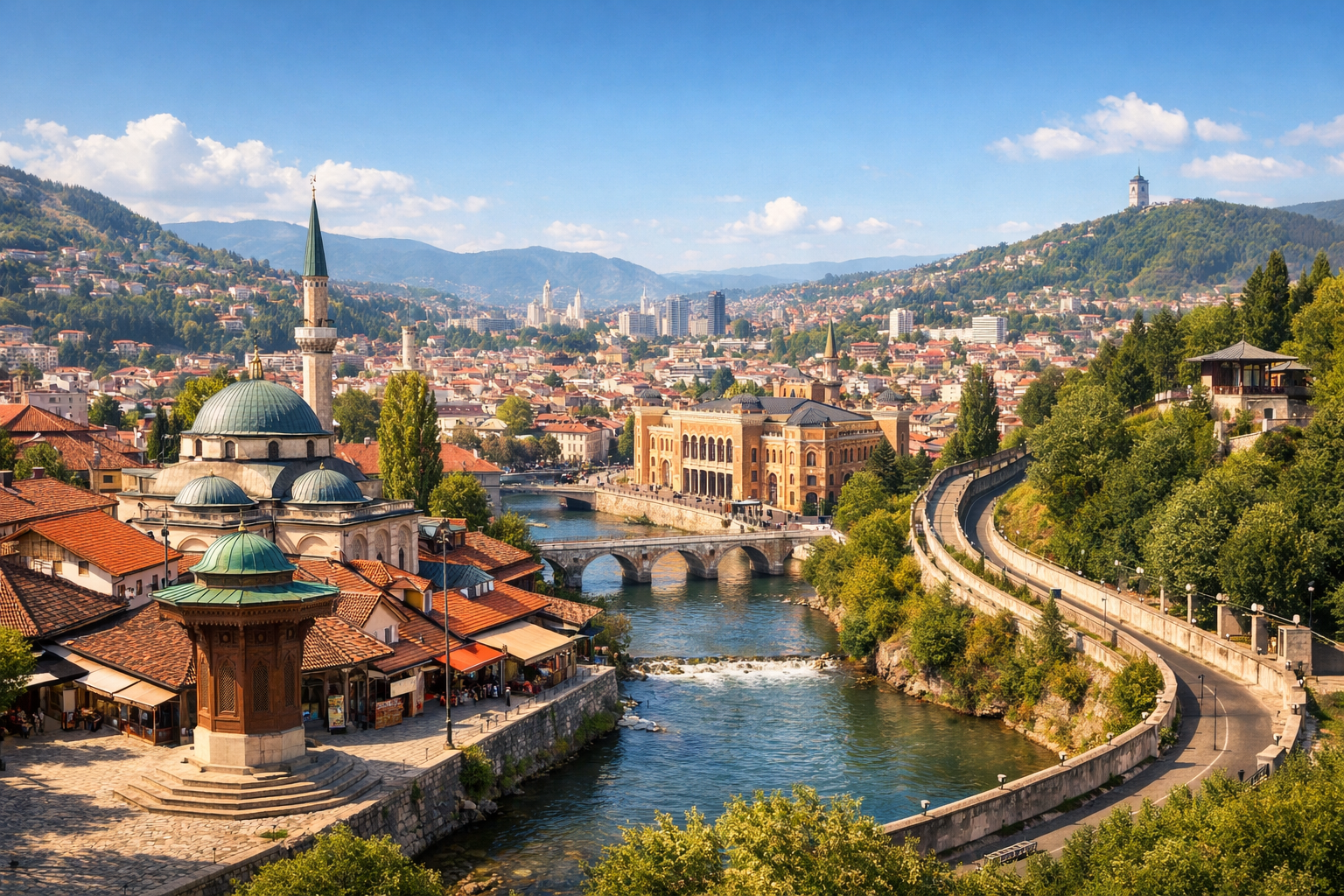
Day 1 — Sarajevo: historic center, Baščaršija, and traces of empires
🚶 Start your introduction to Sarajevo in Baščaršija — the old Ottoman heart of the city, where narrow streets, copper workshops, the smell of Bosnian coffee, and the clatter of dishes create the feeling of a living open-air museum. This is not just a tourist quarter, but the historical core that grew around caravan routes, craft courtyards, and markets. Here you can especially feel a layering rare for Europe: within a short walk you encounter mosques, Catholic and Orthodox churches, traces of the Sephardic community, Austro-Hungarian facades, and very modern urban rhythms. Walk to Sebilj Square, peek into the alleys with coppersmiths’ shops, head out to Sarači Street, and give yourself time simply to observe — Sarajevo reveals itself best not through rushing, but through attention to detail.
🚶 Then head to the Latin Bridge and the Sarajevo 1878–1918 Museum, located right by the place where the assassination of Franz Ferdinand in 1914 became the starting point of a global catastrophe. The bridge itself is small and outwardly quite modest, but the historical density of this place is enormous: here it becomes especially clear how a local episode can change the course of all Europe. On the way, it is worth walking along the Miljacka and noticing the shift in the urban landscape: from the Ottoman fabric of the old town to the straighter, stricter lines of the Habsburg era. After the museum, it is a good idea to pause for a late lunch or coffee, because the first day is best kept light and walkable without overload.
🚶 In the second half of the day, it is worth visiting Brusa Bezistan — a covered market-museum in the old part of the city. Once it was a place for trading fabrics and expensive goods, and today the space helps you imagine Sarajevo as an important crossroads of the Ottoman Empire. The exhibition is usually easy to take in: it is a good format for the first day, when you want to combine architecture, history, and rest in the shade. After that, you can walk to Vijećnica, the famous city hall with its striking pseudo-Moorish appearance, and linger by the riverside at sunset.
🚶 In the evening, walk up to the Yellow Fortress. The climb takes about 20–30 minutes from the old town and requires no special training, but it is better to go in comfortable shoes and without rushing. From above, one of the best panoramas of Sarajevo opens up: minarets, domes, tiled roofs, the long city valley, and the ring of green hills around it. It is the perfect place to feel the scale of Sarajevo — a city that seems compact on the map, but in real life unfolds as a complex amphitheater of history and terrain.