
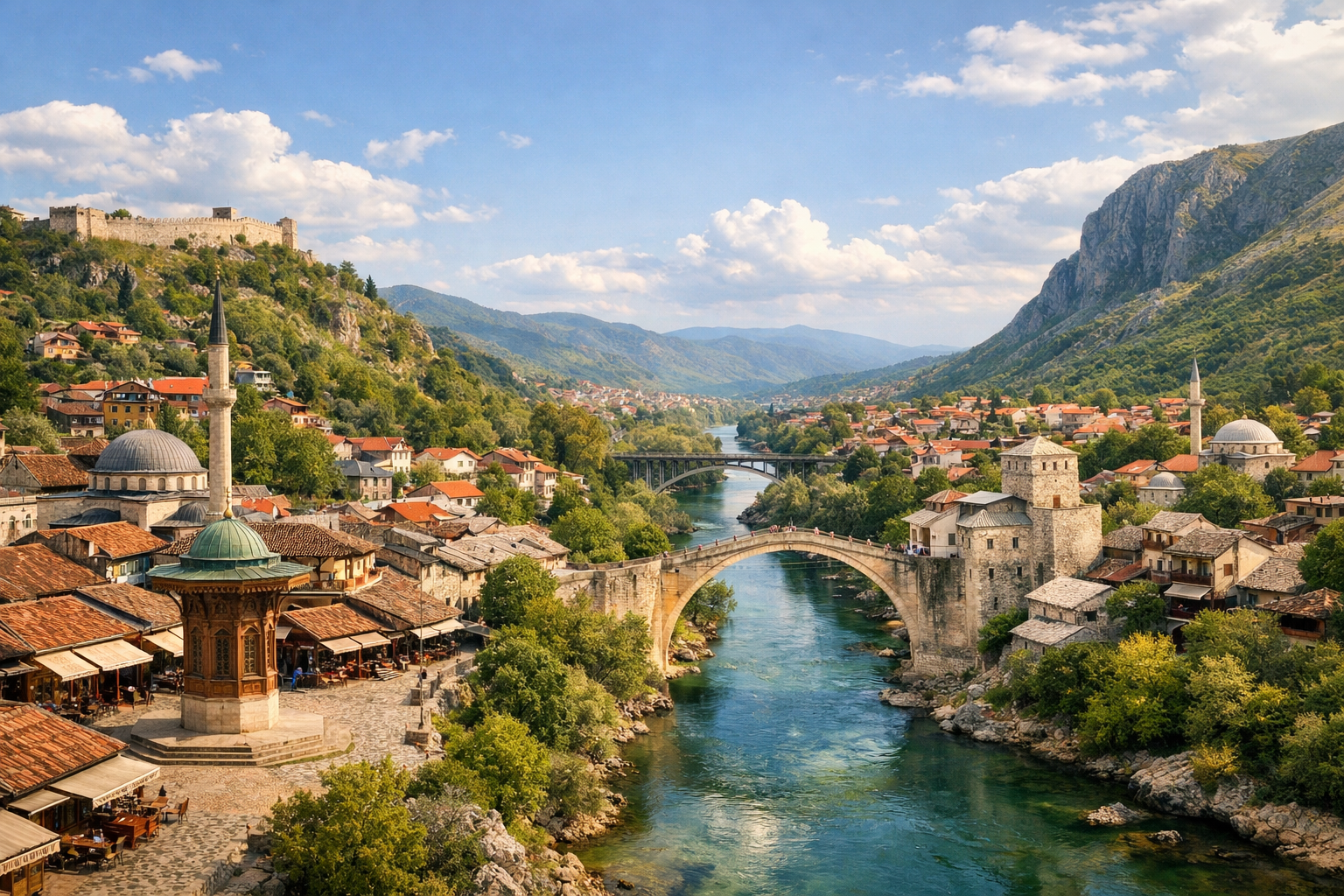
Day 1 — Sarajevo: Baščaršija, Sebilj, and the city's eastern heart
🚶 Start your trip with Baščaršija — the old Ottoman core of Sarajevo, where the city reveals itself not as an open-air museum but as a living eastern-Balkan maze. Narrow cobbled alleys, copper shops, the smell of freshly brewed Bosnian coffee, and the unhurried rhythm of artisan streets create the very atmosphere people come here from all over the world to experience. In the center of the quarter stands the famous wooden Sebilj fountain — a symbol of Sarajevo — and around it spread old market rows, mosques, caravanserai spaces, and small bakeries with burek and sirnica. This is one of the best places to feel how the Ottoman Empire, the Balkans, and later Austro-Hungarian influence intertwined in a single urban landscape.
🚶 After the main square, walk to Kujundžiluk Street and the neighboring artisan lanes: workshops still operate here, selling traditional džezvas, trays, engraved sets, and simple but very beautiful household items. Then stop by the Gazi Husrev-beg complex with its mosque, bezistan, and historic surroundings: this is one of Sarajevo’s key cultural layers, and one reason the city is often called a meeting point of East and West. For lunch, it’s best to go for simple and affordable local classics — ćevapi, pljeskavica, börek, čorba, or dolma in old town eateries, where the food is usually hearty, straightforward, and free of unnecessary tourist pretension.
💤 Keep the evening light: a relaxed walk to the Latin Bridge and the Miljacka embankment, a short stop for coffee with Turkish delight, and an early rest after the road. For the first day, this is ideal: Sarajevo’s historic center is compact, does not require too much walking, and the route gives you a gentle introduction to the country without overload.