
Buy PDF guide

Buy PDF guide — 6.43 USD

PDF — 6.43 USD

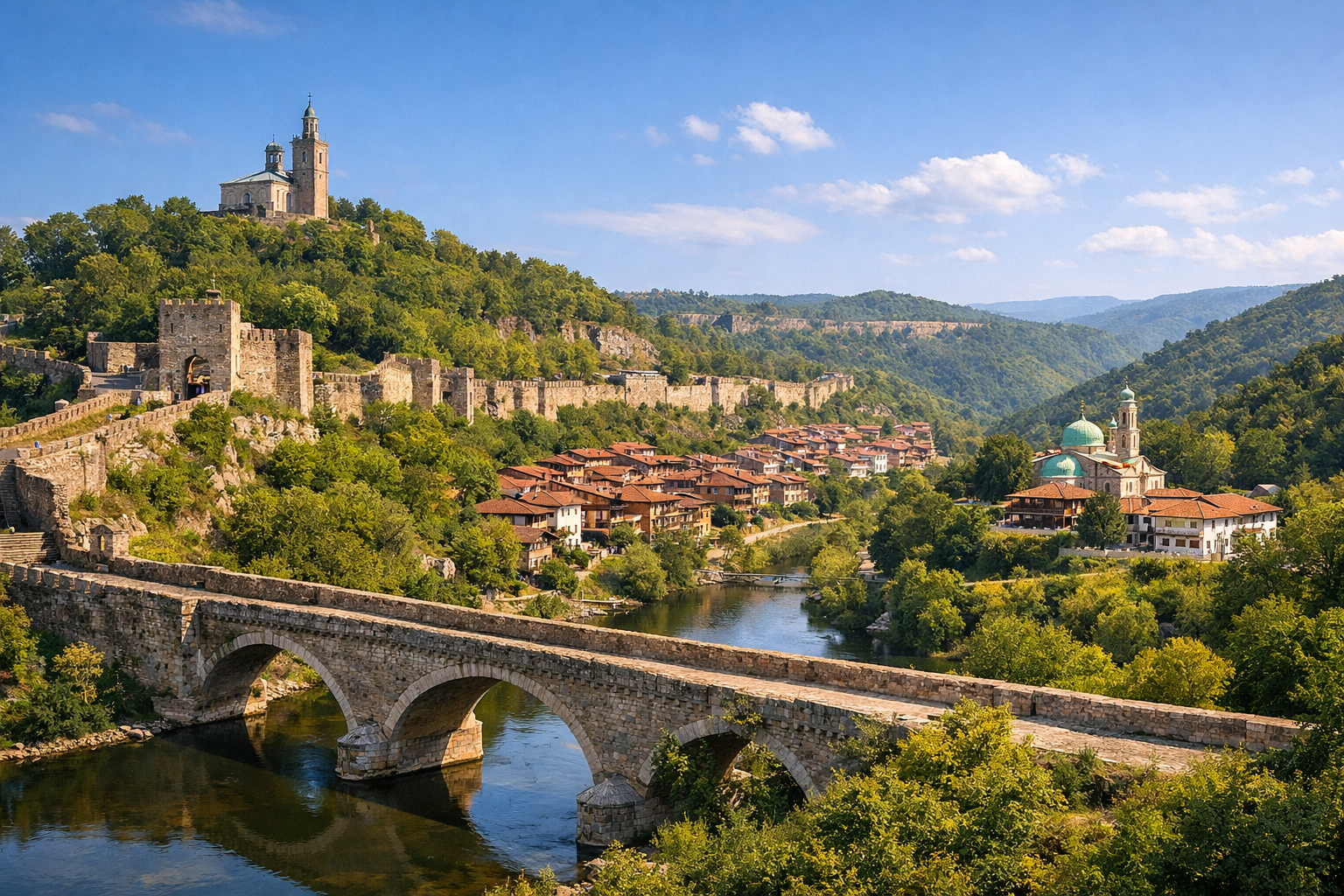
Bulgaria, Veliko Tarnovo. A budget trip to the medieval capital with a visit to the Tsarevets Fortress, old streets, and monasteries in the surrounding area. Season: April - October.

Bulgaria, Veliko Tarnovo. A budget trip to the medieval capital with a visit to the Tsarevets Fortress, old streets, and monasteries in the surrounding area. Season: April - October.

Discover Veliko Tarnovo, Bulgaria’s medieval capital, where the hilltop Tsarevets Fortress rises above winding old streets and dramatic river views. From spring to autumn, it’s an ideal budget escape, with the historic village of Arbanasi and peaceful monasteries nearby adding even more charm to the journey.

🧭 DAY-BY-DAY ITINERARY

Ready-made country and city routes with daily plans, sights, transport and accommodation. Buy PDF guides for independent travel.

🧭 DAY-BY-DAY ITINERARY


Day 1 — Veliko Tarnovo: Tsarevets, the Old Town, and Samovodska Charshia

  • 🚆 It is convenient to plan your arrival in Veliko Tarnovo via the city’s South Bus Station, where intercity buses arrive, including routes from Sofia and Sofia Airport. From the station to the central part of the city, you should usually allow about 10–15 minutes by taxi or 20–30 minutes by city bus including waiting time. For a budget trip, it makes sense to choose accommodation in the old part of town or near the center so that most walks can be done on foot and without extra expense.

  • 🏰 Start your route with Tsarevets Fortress — the main symbol of the old Bulgarian capital and a place where the scale of the Second Bulgarian Empire is felt especially clearly. This hill is not just a beautiful viewpoint, but the former heart of medieval Tarnovo, where the most important state and church matters were decided. The road to the entrance has a gentle incline, so it is better to come in the morning while it is not too hot. In the April–September season the fortress stays open longer, while in October the hours are slightly shorter, so a daytime visit is especially convenient. Inside, it is worth allowing at least 2–3 hours: for the gates, the lines of the walls, the remains of the palace complex, panoramas of the bends of the Yantra, and the climb to the Patriarchal Church at the top. The atmosphere here is powerful and almost cinematic: wind moves across the stone, the city swirls below on the slopes, and the ruins create a rare feeling of contact with living history rather than just museum scenery.

  • ⛪ After Tsarevets, head down to the Church of the Holy Forty Martyrs — one of the most significant churches in Bulgarian history. It is here that you especially strongly feel that Veliko Tarnovo was not only a fortress and political center, but also the spiritual core of the country. The church is associated with Tsar Ivan Asen II, the victory of 1230, and a whole series of major monuments of Bulgarian statehood. It is best to visit without rushing: the value here is not in its scale, but in the historical density of the place, in the inscriptions, burials, and the sense of rare authenticity. It is not far to walk here from Tsarevets, but because of the terrain and steps, it is better to save some energy and water.

  • 🚶 Then return to the historic center and devote the second half of the day to a walk through the old streets, especially General Gurko Street and the adjoining Varusha quarters. This is one of the most beautiful parts of Veliko Tarnovo: houses hang over the slopes, facades seem to grow out of the stone, and each turn opens new views of the river, the hills, and the tiled roofs. It is especially pleasant here not to hurry anywhere — to pause at viewpoints, look into quiet lanes, and watch how the old town literally clings to the ledges of the mountain. For a budget trip, this is an ideal format for the day: the strongest impressions come precisely from walking, not from expensive activities.

  • 🛍️ Toward evening, head to Samovodska Charshia — a historic торгово-ремесленная street that preserves the spirit of the Bulgarian National Revival. It is pleasant here to look at workshops, small shops, traditional sweets, ceramics, and goods made by local artisans. This is not a huge museum complex, but a living urban fabric where tourist interest combines with the authentic atmosphere of the old town. For dinner, you can choose a simple Bulgarian restaurant in the center and end the day with a sunset walk to a viewpoint. On a clear evening, Veliko Tarnovo is especially beautiful: illuminated slopes, old houses, and the silhouette of Tsarevets turn the city into one of the most expressive historical panoramas in the Balkans.


Day 2 — Veliko Tarnovo and Arbanasi: museums, panoramas, and architecture

  • 🏛️ Start the morning at the Veliko Tarnovo Archaeological Museum, located near Saedinenie Square. This is a very successful continuation of yesterday’s introduction to Tsarevets, because the museum helps bring together all the eras of the region: from prehistoric finds and antiquity to the splendor of medieval Tarnovo. The exhibition emphasizes the period when the city was the capital of Bulgaria, and thanks to this, yesterday’s ruins begin to be perceived more fully: as part of a great political, artistic, and religious world. Usually 1–1.5 hours is enough for the museum if you do not read every display in detail.

  • 🏛️ Then it makes sense to stop by the Museum of the Bulgarian Revival and Constituent Assembly. This place already carries the traveler from medieval Bulgaria into the 19th century and the era of the formation of the modern Bulgarian state. The building itself, the former konak built by Kolyu Ficheto, is already worth attention, and inside the contrast between church art, the ideas of national awakening, and political history is especially interesting. This transition from royal Tarnovo to the Bulgarian Revival makes the route much deeper than an ordinary postcard walk.

  • 🚌 After lunch, head to Arbanasi — a historic village on the plateau above Veliko Tarnovo. For the journey one way, it is reasonable to allow about 15–20 minutes by taxi or about 20–30 minutes by local transport including waiting time. Arbanasi is excellent for a half-day trip: it is a compact, atmospheric place with stone fences, heavy gates, old houses, and churches hidden behind almost fortress-like walls. Here you find a different Bulgaria — not as dramatic as Tsarevets, but more intimate, mercantile, and quiet.

  • 🏠 The main point in Arbanasi is the Konstantsalieva House, one of the most expressive house-museums in the region. This fortified house lets you see the life of a prosperous family and feel how privacy, wealth, and architectural practicality were combined in Arbanasi. High stone walls, interior spaces, utility rooms, and living quarters clearly show what comfortable life looked like in a Bulgarian settlement that once prospered on trade routes. The visit does not take too much time, but it complements the whole route very well.

  • ⛪ If you still have energy, add the Church of the Nativity in Arbanasi — a famous monument with rich paintings and an almost hidden outward simplicity. From the outside, such churches often seem restrained, but inside a completely different world opens up: filled with painting, dense symbolism, and a sense of ancient concentration. In the evening, return to Veliko Tarnovo. It is best to leave at least 2–3 calm hours for the walk back, dinner, and rest so the route does not turn into a race and keeps exactly that unhurried, budget format for which this region is especially good.

Day 3 — Surroundings of Veliko Tarnovo: monasteries and final views

  • ⛰️ Devote the third day to the surroundings and monasteries, which give the trip a more contemplative and spiritual character. The best budget option is to choose 1–2 nearby points rather than trying to cover too much. The most convenient scenario is an early departure to the Transfiguration Monastery, located about 7 km from Veliko Tarnovo. For the road, people usually allow about 15–20 minutes by taxi each way; a hike here is possible only for prepared travelers and in good weather, since the terrain of the region is hilly and part of the route requires attentiveness. If you walk through natural areas, it is important to stay only on marked trails.

  • 🕍 The Transfiguration Monastery is one of those places where landscape and architecture work together. It is set on a slope among greenery and rocks, so even the approach itself makes an impression. There is no city bustle here, but there is a space of silence, white walls, a courtyard, a valley view, and a sense of seclusion that is often lacking in popular tourist places. It is a good contrast to the powerful fortress emotions of the first day: if Tsarevets speaks of power and history, then the monastery speaks of inner composure and calm.

  • ⛪ If you have transport and the desire, you can add Kilifarevo Monastery south of the city. But for a short three-day route, it is better to treat it as an option if you left early and do not want to overload the day. The road there and back takes noticeable time, and the whole point of this trip is not the number of checkmarks, but to feel the rhythm of the old capital and its surroundings. If you choose only one out-of-town point, the Transfiguration Monastery is usually the most practical and logical option.

  • 🌄 After returning to Veliko Tarnovo, leave the second half of the day for final panoramas and a calm walk without a strict plan. You can once again head to the viewpoints of the old town, choose a café with a view of the hills and the Yantra, buy some local sweets or handmade souvenirs as a keepsake. It is in this kind of unhurried final walk that the city reveals itself best: not as a set of sites, but as a living landscape made up of rocks, bridges, streets, and history.

  • 🛡️ For independent travel, Bulgaria is generally well suited if you follow normal precautions: keep an eye on personal belongings in public transport and tourist places, use official taxis, and when walking in natural areas and on hills, stay only on marked trails. Before heading to the bus station, it is better to leave at least 30–40 minutes of extra time, especially if you are leaving by intercity bus or heading toward the airport.

Flight tickets

eSIM for travel

Buy PDF guide

Buy PDF guide — 6.43 USD

PDF — 6.43 USD