
Buy PDF guide

Buy PDF guide — 12.85 USD

PDF — 12.85 USD

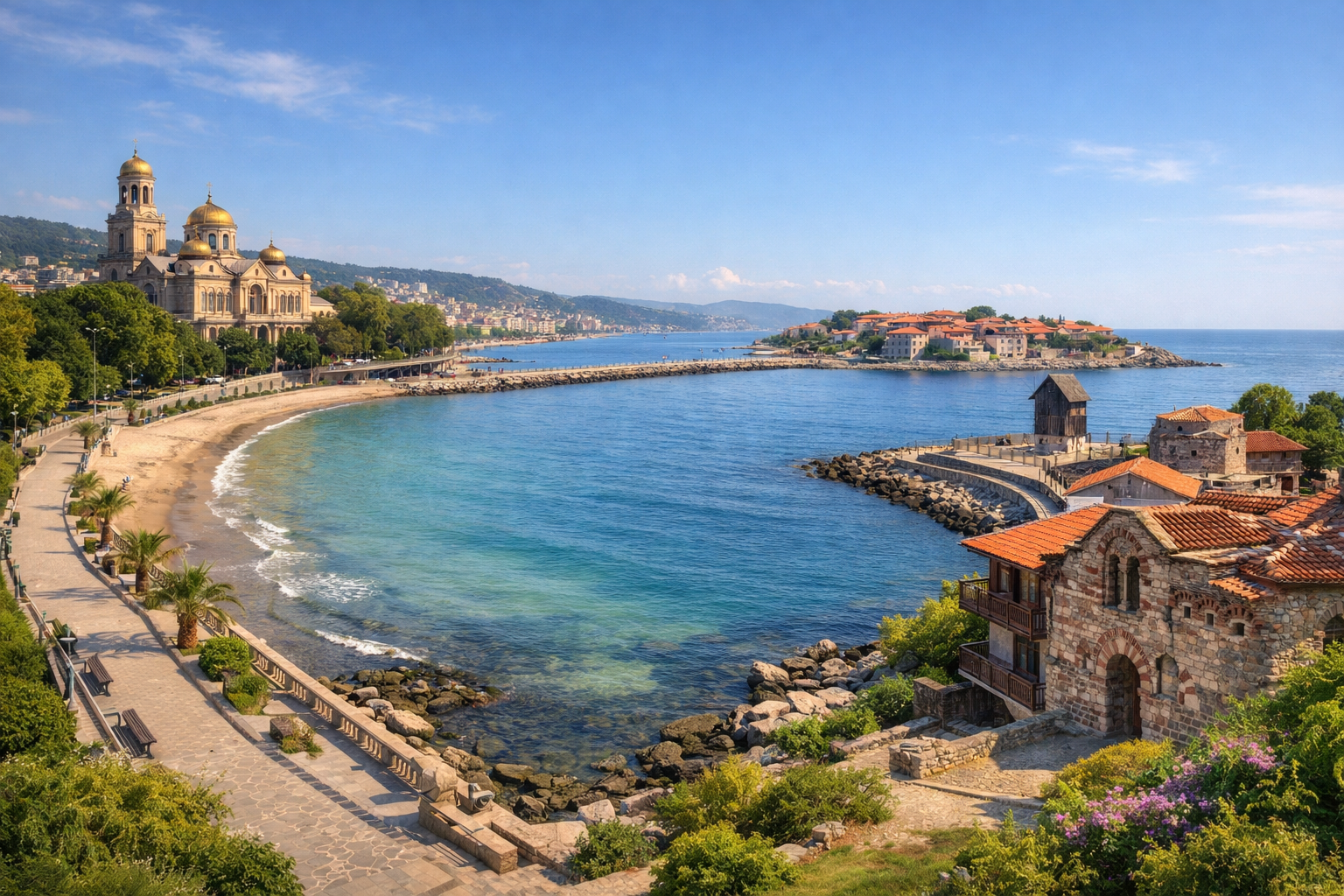
Bulgaria, Varna and Nessebar. Affordable vacation on the Black Sea with walks around Varna, ancient Nessebar, and city beaches; accommodation in a hostel or private room. Season: May - June, September.

Bulgaria, Varna and Nessebar. Affordable vacation on the Black Sea with walks around Varna, ancient Nessebar, and city beaches; accommodation in a hostel or private room. Season: May - June, September.

Discover Bulgaria’s Black Sea coast with an affordable escape that blends relaxed city beaches, seaside walks in Varna, and the timeless charm of ancient Nessebar. Best in May–June or September, this trip is perfect for staying in a hostel or private room while enjoying sunny days, fresh sea air, and a rich coastal atmosphere.

🧭 DAY-BY-DAY ITINERARY

Ready-made country and city routes with daily plans, sights, transport and accommodation. Buy PDF guides for independent travel.

🧭 DAY-BY-DAY ITINERARY


Day 1 — Varna: arrival, city center, and the Sea Garden

  • 🚆 If you arrive at Varna Airport, the most budget-friendly way to get into the city is bus 409: it runs from the stop by Terminal 2 to the Central Bus Station and the cathedral area in about 15–20 minutes. If you are staying in the center, allow another 10–15 minutes on foot or a short ride in an official taxi. After the journey, it’s best not to overload the day: leave time for check-in, a shower, and a little rest.

  • 🚶 Your first introduction to Varna is best started in the central part of the city, gradually leading the walk toward the Sea Garden. Varna feels not like a resort “conveyor belt,” but like a living Black Sea city: late-19th- and early-20th-century buildings stand alongside wide boulevards, cafés with outdoor tables, and a sea breeze that constantly reminds you the sea is literally around the corner. Around the cathedral and the pedestrian streets, it is easy to settle into the local rhythm, buy water, change small money for transport, and simply look around without rushing.

  • 🌿 The Sea Garden is Varna’s main space for long walks and one of the most pleasant urban parks on the entire Bulgarian coast. It is not just a green strip by the sea, but a whole world of alleys, viewpoints, stairways down to the beaches, shady corners, and panoramas where the light is constantly changing. During the day, families and students stroll here peacefully, and by evening the park becomes almost cinematic: the sun lies over the water, the promenade begins to glow with soft lights, and the city itself feels more southern and relaxed than it does in daytime. For the first evening, this is the ideal route without complicated logistics or extra spending.

  • 🏖️ If you still have energy, head down to one of the city beaches by the Sea Garden. In May, June, and September, beach time here is usually less about spending a whole day on a sun lounger and more about short stops by the water, walks along the shoreline, takeaway coffee, and the feeling of fresh sea air without the peak summer noise. In the evening, it’s better to plan your return to the hostel or private room before you become too tired: the start of the route should be gentle and adaptive.


Day 2 — Varna: Archaeological Museum, Roman Thermae, and city beach

  • 🏛️ Dedicate the morning to the Varna Archaeological Museum on Maria Luiza Boulevard. It is one of the country’s most important museum sites, and it is here that you especially understand that Varna is not only a resort, but also a place of very ancient history. The collection connects ancient Odessos, Thracian heritage, early coastal settlements, and the famous finds from the Varna Necropolis. Even those who are usually indifferent to archaeology often remember the museum because of its sense of deep time: behind the façade of a seaside city, a cultural layer stretching back thousands of years suddenly opens up.

  • 🚶 After the museum, it makes sense to take a lunch break and then walk to the Roman Thermae on San Stefano Street. This archaeological site works especially well together with the museum: first you see the objects, history, and context, and then you find yourself among the real massive ruins of an ancient public complex. The scale of the thermae is striking — especially if you imagine that this was once the center of city life, where people met, relaxed, and discussed business. Stone, warm air, open sky above the ancient walls, and the proximity of the sea create an almost Mediterranean mood here.

  • 🏖️ Leave the second half of the day for the lighter part of the route — the beach and relaxation. After the museum and history block, it is especially pleasant to return to the sea: sit on the sand, walk barefoot by the water, or simply take a long break in the shade. Varna’s city beaches are convenient because they do not require a separate expedition: they are easy to reach on foot from the center and the Sea Garden, which means you can adjust the day flexibly according to how you feel and the weather.

  • 🌆 In the evening, you can walk the central streets again or head up to the upper part of the Sea Garden for a sunset stroll. This makes for a very balanced day: history and culture in the morning, sea and rest in the afternoon, and calm city life without haste in the evening. For a budget route, this is especially valuable because it does not require expensive transfers and fills the trip with several layers of impressions at once.

Day 3 — Varna: Aladzha Monastery and an evening by the sea

  • 🚆 Today it is worth making a short trip beyond the center — to Aladzha Monastery, located in a natural area north of Varna, near the Golden Sands district. Allow about 40–60 minutes each way, including the city bus and a short walk, or an official taxi. This is a convenient half-day outing: not too far, but enough to noticeably change the mood of the route.

  • ⛰️ Aladzha Monastery is one of the most atmospheric places around Varna. It is a medieval rock monastery carved directly into a limestone massif among greenery, and in person it makes a much stronger impression than in photographs. Here, the contrast between the noisy coast and the almost monastic silence of the forest is especially tangible: the air becomes cooler, the sounds more muted, and the landscape itself seems to hide traces of former spiritual life in the rock. The place does not require heroic trekking, but for the walk it is better to choose comfortable shoes and stay only on marked trails.

  • 🌲 After visiting the monastery, do not rush back right away: leave time for a slow walk through the green area around it. May, June, and September are especially good for such outings because there is no suffocating heat, and nature is still fresh or already softly turning golden after summer. This day adds an important contrast to the route: not only sea and city, but also a small nature-and-history episode that makes the holiday feel richer.

  • 🌊 After returning to Varna, finish the day by the sea without a fixed program. You can simply walk along the promenade, have a coffee or lemonade around the Sea Garden, go down to the water for half an hour, and watch how the color of the Black Sea changes toward evening. After a trip out of town, it is especially pleasant to feel Varna’s city rhythm again — not hectic, but rather stroll-friendly and very well suited to a budget holiday.

Day 4 — Nessebar: transfer and the ancient peninsula

  • 🚆 In the morning, the most convenient way to travel from Varna to Nessebar is by bus along the coast. Realistically, allow about 2–2.5 hours on the way, including boarding, waiting, and arriving near the bus station, after which there will be a short walk to your accommodation or to Old Nessebar. It is better not to leave too late, so the day does not fall apart into transport and check-in.

  • 🏛️ Old Nessebar is one of those places where the tourist image is completely justified by reality. The ancient town on a narrow rocky peninsula really does look like a living set from several eras at once: antiquity, Byzantium, medieval churches, wooden houses of the Bulgarian Revival, stone streets, and open sea on all sides. Nessebar is not a place you want to “rush through” as a checklist of sights — its value lies precisely in wandering slowly, when every turn reveals a new apse, a small square, an old façade, or a view of the water.

  • 🏛️ Start with the Nessebar Archaeological Museum on Mesambria Street, at the entrance to the old part of town. It helps you see the peninsula not as a pretty postcard, but as a place with a continuous history — from the Thracian period and Greek Mesambria to the Roman and medieval stages. After the museum, a walk around the peninsula itself becomes much more meaningful: ruins, churches, and city walls are no longer perceived as just a background for photos, but as fragments of a large historical organism.

  • 🌅 In the evening, a walk along the edge of the peninsula, by the fortress remains and the water, is especially beautiful. The light in Nessebar at sunset is incredibly soft: the stone grows warmer, the sea grows darker, and the narrow streets become quieter after the daytime flow of excursion groups. This is the best time to feel the city’s true character — not a noisy resort one, but ancient, slightly theatrical, and very beautiful.

Day 5 — Nessebar: churches, sea views, and beach time

  • 🚶 It is best to spend the second day in Nessebar without rushing and without major transfers. In the morning, walk past the main church monuments of the Old Town: especially striking are the Church of Christ Pantocrator with its rich decorative brick pattern, and the ruins of Saint Sophia Basilica, which stand almost like an open stone skeleton of a vanished era. In Nessebar, not only the individual sites matter, but also the very density of history in a small space: in just a few hours, you can pass through antiquity, medieval religious architecture, and seaside urban life.

  • 📸 Leave time during the day for a free walk without a strict checklist. Old Nessebar is wonderful because short routes work so well here: walk from one side of the peninsula to the other, stop by a ceramics shop, peek into a shady courtyard, go out to the sea, return again to the lanes — and repeat this several times, noticing something new each time. Outside peak season, the town is easier to truly feel: fewer crowds, more air, and the real rhythm of the place is easier to hear.

  • 🏖️ After the historical part, devote a few hours to the city beach or walk toward the newer part of Nessebar and the coast by Sunny Beach. In this route, the beach does not compete with the cultural program, but complements it: after stone streets and old churches, it is especially pleasant to find yourself by the open sea, lie down on the sand, or simply sit by the water without obligations. May, June, and September often offer exactly the kind of holiday many people like more than the July heat: you can walk longer without getting tired and enjoy the sea without excessive noise.

  • 🌃 In the evening, take a final walk through Old Nessebar. When the daytime groups leave, the peninsula becomes almost intimate: footsteps can be heard on the stone, the sea hits the shore from both sides, and the façades of the old houses look almost museum-like in the warm light. It is a great moment for an unhurried dinner and the feeling that the route has truly given not only rest, but also a beautiful historical experience.

Day 6 — Return to Varna: an easy finale by the sea

  • 🚆 It is best to plan the return to Varna in the morning or closer to noon, so you still have time to spend the final hours without rush. Again, it is reasonable to allow about 2–2.5 hours for the bus and local transfer. If your flight or onward journey from Varna is on the same day, add extra time for boarding, traffic, and picking up your luggage calmly.

  • 🌊 The final day should not be overloaded with sightseeing. It is much nicer to leave it for a short walk through your favorite part of Varna: stroll through the Sea Garden once more, go down to the beach, have a coffee by the sea, or buy some small local products for the road. Such a gentle ending is especially good for a short six-day route: the trip ends not in a rush, but with a feeling of completion and rest.

  • 🧳 If there is enough time, you can stop by the Varna Aquarium or simply sit among the greenery of the Sea Garden before the road. For budget travel, Varna is especially convenient as a final base: the center, park, sea, and transport infrastructure are close enough to each other that even the last few hours can be used beautifully and without extra expense.

  • ✅ Bulgaria is generally well suited to independent travel if you follow ordinary safety precautions. Throughout the route, it is useful to keep an eye on your personal belongings on public transport and in tourist areas, use official taxis, and during walks in natural areas and hilly sections stay only on marked trails. In this format, Varna and Nessebar offer exactly the kind of holiday you want to repeat: affordable, filled with sea, walks, and history.

Flight tickets

eSIM for travel

Buy PDF guide

Buy PDF guide — 12.85 USD

PDF — 12.85 USD