
Buy PDF guide

Buy PDF guide — 8.57 USD

PDF — 8.57 USD

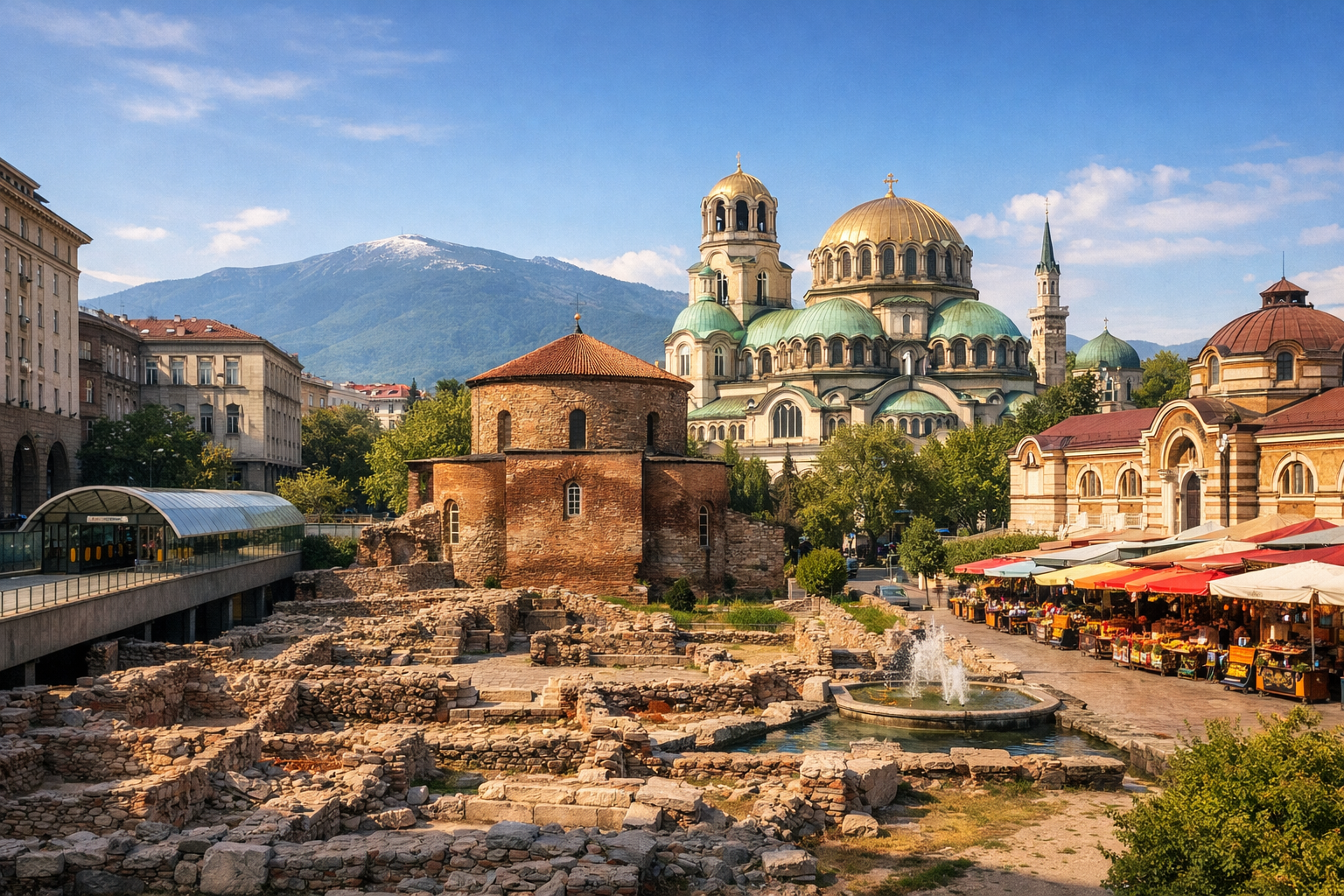
Bulgaria, Sofia. A budget city tour of ancient ruins, Orthodox churches, markets, mineral springs, and Mount Vitosha using the metro and buses. Season: April - October.

Bulgaria, Sofia. A budget city tour of ancient ruins, Orthodox churches, markets, mineral springs, and Mount Vitosha using the metro and buses. Season: April - October.

Discover Sofia from ancient Serdika ruins to golden-domed Orthodox churches, lively markets, and the city’s steaming mineral springs. From April to October, it’s an easy and affordable escape, with metro lines and buses carrying you from the historic center all the way to the trails of Mount Vitosha.

🧭 DAY-BY-DAY ITINERARY

Ready-made country and city routes with daily plans, sights, transport and accommodation. Buy PDF guides for independent travel.

🧭 DAY-BY-DAY ITINERARY


Day 1 — Sofia: ancient Serdica, the rotunda, and mineral springs

  • 🚇 If you are flying into Sofia, the most convenient budget-friendly start to the route is the metro from the airport. Sofia Airport station is at Terminal 2; it is easy to ride line M4 toward the city center. To the Serdika hub, travelers usually allow about 30–35 minutes including waiting time for the train and exiting the station, and from there you can walk to almost all the main sights of the day. This is one of those rare European capital routes where the airport line brings the traveler almost naturally straight to ancient ruins.

  • 🚶 Start your introduction to Sofia with the ancient Serdica complex around Serdika station and Independence Square. Here the modern city literally stands on top of the Roman one: under glass and along open sections you can see fragments of streets, residential quarters, early Christian buildings, and fortification elements of the former city of Ulpia Serdica. This is not a museum in isolation, but a living urban fabric where the metro, administrative buildings, and ancient stones coexist in a single frame. What is especially impressive is the feeling of layered history: you go down through a passageway as if entering an ordinary transport hub, and find yourself in a space where it is easy to imagine the noise of a Roman provincial capital, trade, baths, church processions, and the continuous history of a city by hot springs.

  • 🚶 Then walk to the Rotunda of Saint George, the oldest preserved building in Sofia, hidden in an inner courtyard among later administrative and hotel blocks. This 4th-century red-brick rotunda makes a strong impression precisely through the contrast in scale: from the outside it feels intimate, almost quiet, but in historical importance it is one of the key places in the Bulgarian capital. Here you can sense the transition from the ancient world to the Christian one, from an imperial quarter to a medieval city. Inside and around it, you feel especially clearly that Sofia does not so much display ruins to tourists as continue living on top of them, without hiding its own antiquity.

  • 🚶 After that, head to the former Central Mineral Bath, which today houses the Regional History Museum Sofia, while the famous mineral springs flow in the square nearby. This is a very important place for understanding the character of the city: Serdica developed thanks to the hot springs, and Sofia still retains its reputation as a city of water, steam, and healing baths. The former bath building itself is bright and decorative, with architecture typical of the early 20th century, and near the fountains you can see locals with bottles and canisters. This is a particularly pleasant point in the route to slow down: visit the museum, then step out to the water, sit in the square, watch the rhythm of ordinary city life, and feel that the mineral theme in Sofia is not a tourist backdrop but a genuine part of everyday life.

  • 🚶 To end the day, it makes sense to walk through the Central Market Hall and the neighboring streets of the old center. Even if food is not your main focus, the market helps you see a more grounded, everyday Sofia: less ceremonial, more urban temperament. Within walking distance are also Banya Bashi, the Sofia Synagogue, and the streets around the Women’s Market, so the first day becomes very rich in cultural layers: Roman Serdica, Orthodox and early Christian history, Ottoman heritage, market life, mineral water, and everyday Sofia. For this route, with a museum stop and some rest, it is convenient to allow almost a full day, around 7–9 hours without rushing.


Day 2 — Sofia: Orthodox shrines, cathedral squares, and the city center

  • 🚶 Dedicate the second day to Orthodox Sofia, because the city reveals itself most fully and emotionally through its churches. Start with Alexander Nevsky Cathedral, one of the main symbols of Bulgaria. Its enormous volume, gilded domes, and the solemn square around it create a feeling of almost imperial scale, yet the cathedral does not feel cold: in the morning, soft light falls on the stone and copper, and the whole composition seems remarkably calm. Even if you have already visited large Orthodox cathedrals in Eastern Europe, what is striking in Sofia is the combination of monumentality and open urban space, where the church is not hidden away but reigns over the square.

  • 🚶 Very close by stands the Basilica of Saint Sofia, which gave the city its name. This place works differently from the grand Alexander Nevsky Cathedral: there is less spectacular shine here, but a much stronger sense of the depth of time. The church is connected to the early Christian history of the Balkans and is perceived as the architectural root of the city’s entire identity. It is precisely in the pairing of these two points — the monumental memorial cathedral and the older, austere basilica — that the history of Bulgaria is clearly readable as a country where Orthodoxy is not only a religion but also a cultural foundation of memory, language, education, and urban symbolism.

  • 🚶 After that, you can continue to Saint Nedelya Church and the area around Vitosha Boulevard. This part of the route is convenient because it lets you combine religious architecture with a relaxed city walk. Along the way there are classic squares, administrative facades, cafés, and convenient places for lunch. Vitosha Boulevard works well as a pause between churches: here you can slow down, have a coffee, look at the mountain on the horizon, and feel how Sofia combines capital-city status with a fairly gentle, almost provincial unhurried rhythm. This is especially pleasant in the season from April to October, when street life becomes a noticeable part of the city experience.

  • 🏛️ If you want to add a museum without overloading the day, it is convenient to visit the National Archaeological Museum in the second half of the day. It complements your impressions of the ruins of Serdica very well because it provides material context: stone steles, ancient finds, and artifacts from the Thracian, Roman, and medieval periods. After walking among the open remains of the ancient city, the museum helps bring the history together into a more coherent picture.

  • 🚶 It is worth ending the day with another calm walk through the evening center. In Sofia, you do not need to keep moving long distances all the time: many of the city’s strongest places are within reasonable walking distance of one another, and if you get tired, the metro and trams quickly bring you back to your hotel. For the whole day with churches, a museum, lunch, and rest, it is comfortable to allow 8–9 hours. It is a full but realistic city day without long transfers or rush.

Day 3 — Sofia: markets, synagogue, baths, and everyday life in the capital

  • 🚶 It makes sense to make the third day more grounded and atmospheric: fewer ceremonial facades, more markets, craftsmanship, and everyday city life. Start with the Central Market Hall and the area around Maria Luiza Boulevard, then walk toward the Women’s Market. This is one of the best ways to see Sofia beyond the postcard image. If the first days showed you Roman Serdica and Orthodox symbols, here the commercial, mixed, urban character of the capital comes forward — with vegetable rows, spices, street bustle, conversations, the smell of pastries, and the feeling of a real Balkan city.

  • 🚶 The Women’s Market is especially interesting because it remains a living place rather than just a tourist stage set. It is pleasant to wander here slowly, looking at fruit, cheese, honey, seasonal produce, and small shops. In the warm season the route works especially well: in April and May the market feels fresher and greener, in summer noisy and bright, and in September and October rich with vegetables, grapes, and autumn flavors. This is a good day for inexpensive snacks, buying small local products, and watching how old trading habits, the many voices of the Balkans, and modern city life mix together in Sofia.

  • 🚶 Nearby, the Sofia Synagogue is a must-see — one of the most notable Jewish religious buildings in the region. It fits this day especially well thanks to its location near the markets and the historic center. Together with Banya Bashi and the Orthodox churches from the previous days, it helps you understand Sofia as a city of religious and cultural intersection. Even if your visit is only from the outside or a brief one, this area leaves a strong impression as a compact knot of different traditions.

  • ♨️ After the market, return to the theme of mineral water — but now without the museum focus, instead as a city habit. Around the former Central Bath, it is especially pleasant simply to linger, watch people coming for warm mineral water, and feel that Sofia quite literally lives around its springs. You can take a quiet pause on a bench, and then walk through the Largo, the underpasses of Serdika, or along the boulevard back to your hotel. This is a day without hurry, with the chance to sit a lot, eat, watch, and not try to “see everything.”

  • 🚇 For getting around on this day, walking stretches and 1–2 short trips by metro or tram are usually enough. But remember the practical side: Bulgaria as a whole is suitable for independent travel if you follow normal precautions; on public transport, in markets, and in tourist areas it is better to keep an eye on your belongings, avoid carrying your phone and wallet in easily accessible pockets, and use only official taxis if needed. For this route, with breaks, the market, the synagogue, and rest, it is comfortable to allow 6–8 hours.

Day 4 — Sofia and Vitosha: Boyana, mountain air, and panoramas above the city

  • 🚇🚌 Dedicate the fourth day to Vitosha Mountain — it is the ideal finale to a short Sofia route because here the capital reveals itself not only as a historic city, but also as a place at the foot of a real mountain. In the morning it is convenient to take the metro to the southern districts and then transfer to a bus toward Boyana or farther up to the higher points of Vitosha. For an independent budget route, the usual convenient combinations are metro + bus 64 to Boyana Church, or metro/city transport + bus 66 to the Aleko area. Travel time should be planned realistically: from the center to Boyana it is usually about 45–60 minutes with a transfer, and to the higher mountain points about 60–90 minutes depending on transport waiting times.

  • ⛪ Start with Boyana Church — one of the main monuments of medieval Bulgaria and a UNESCO site. Its modest size is deceptive: this is not a giant cathedral, but a precious sanctuary hidden at the foot of the mountain in the greenery of an old neighborhood. It is precisely this intimacy that makes it special. After the monumental churches of the center, Boyana Church feels almost intimate: here what matters is not scale and domes, but the sense of ancient spiritual silence, rare paintings, and the remarkable preservation of the place. Combined with mountain air and the calmer development of the Boyana district, this is one of the most beautiful and subtle points of the whole trip.

  • 🌲 After Boyana, continue the day on Vitosha. If you want an easier scenario, you can limit yourself to a walk on the lower trails and viewpoints nearby, and if the weather is clear and you have the energy, go higher by bus to the Aleko area, where convenient walking routes begin and good panoramas open over the Sofia Basin. From April to October this is an especially rewarding day: in spring the mountain slopes are fresh and cool, in summer people escape the city heat here, and in early autumn the air becomes clearer and the views of the capital look especially sharp.

  • 🥾 It is very important to keep the route safe and realistic: walk only on marked trails, check the weather before heading out, and do not plan a long trek if you are wearing ordinary city shoes. Vitosha is accessible, but it is no longer a city park — it is a real mountain. For a short trip, it is wiser to choose a simple format: travel to a point, take a 1.5–3 hour walk, rest, take photos, have a snack, and return to the city before evening.

  • 🚇 After returning to the center, end the tour with a calm dinner on Vitosha Boulevard or in the Serdika area. This kind of finale works very well compositionally: in four days you will have seen Sofia as an ancient city by hot springs, as an Orthodox capital, as a market and living urban environment, and then as a rare European capital from which you can reach a real mountain by public transport in a single day. For the whole day with the journey, Boyana, Vitosha, and some reserve time for rest, it is best to allow 8–10 hours.

Flight tickets

eSIM for travel

Buy PDF guide

Buy PDF guide — 8.57 USD

PDF — 8.57 USD