
Buy PDF guide

Buy PDF guide — 8.57 USD

PDF — 8.57 USD

Bulgaria, Plovdiv. An inexpensive trip through the Old Town, the Roman Theatre, the creative Kapana district, and nearby wine regions. Season: April - October.

Bulgaria, Plovdiv. An inexpensive trip through the Old Town, the Roman Theatre, the creative Kapana district, and nearby wine regions. Season: April - October.

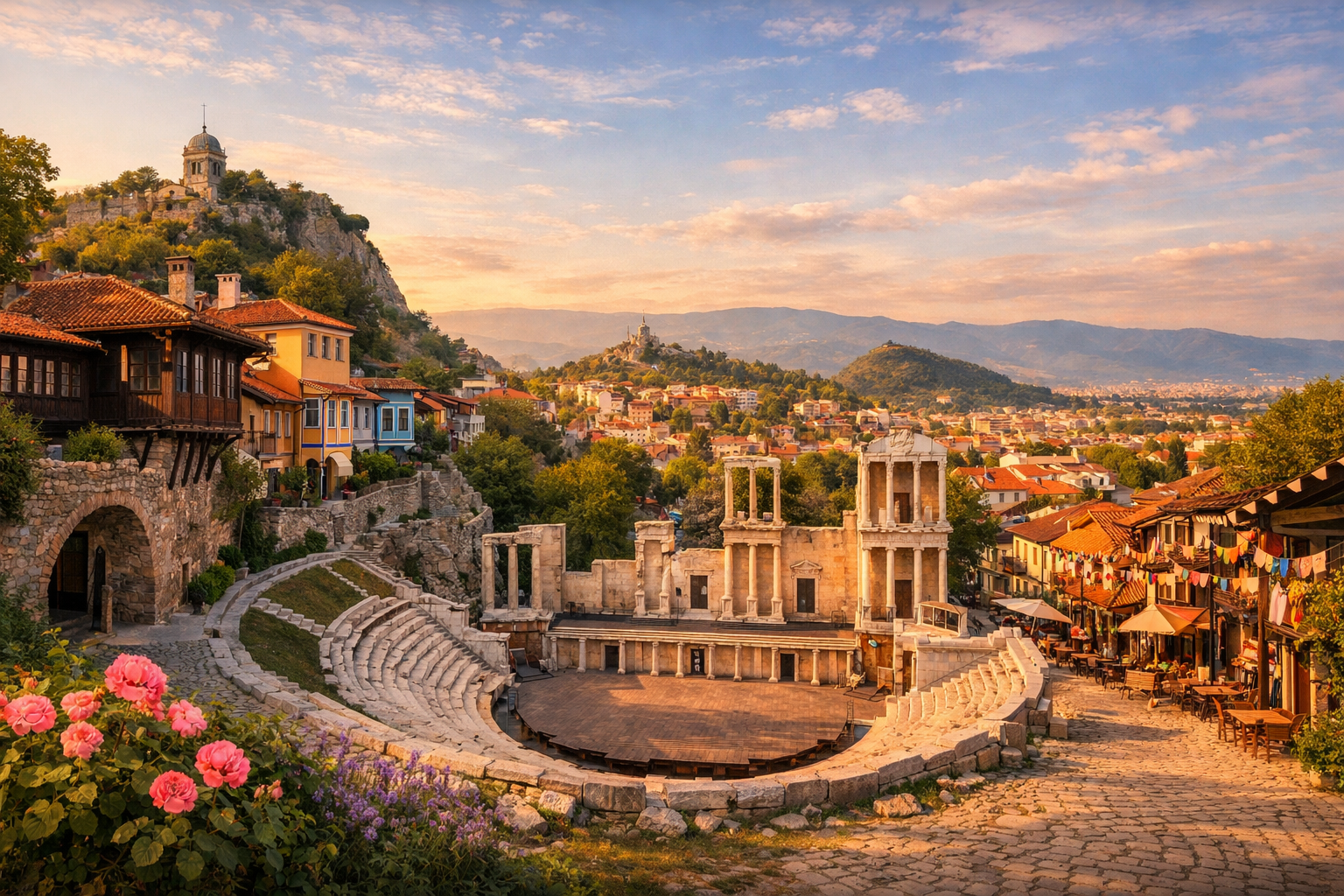
Discover Plovdiv, one of Europe’s oldest cities, where cobbled lanes in the Old Town lead to the striking Roman Theatre and colorful Revival-era houses. Wander through the creative energy of Kapana, then head into the sunlit wine regions of the Thracian Plain for an easy, affordable escape from April to October.

🧭 DAY-BY-DAY ITINERARY

Ready-made country and city routes with daily plans, sights, transport and accommodation. Buy PDF guides for independent travel.

🧭 DAY-BY-DAY ITINERARY


Day 1 — Plovdiv: arrival, the central part of the city, and Kapana

  • 🚆/✈️ Arrival in Plovdiv. If you are flying into Plovdiv Airport, it is convenient to allow about 25–35 minutes for the ride to the center by taxi, and a bit more time if using the shuttle, which is tied to the flight schedule and runs from/to Bus Station South. If you arrive by train or intercity bus, the central pedestrian area and most hotels in the center are usually reachable in 10–20 minutes by taxi or on foot, depending on your luggage.

  • 💤 After check-in, leave yourself at least 1–1.5 hours to rest: Plovdiv reveals itself especially well at a slow pace, when there is no need to rush anywhere. For a budget itinerary, it makes sense to stay either near Tsar Simeon Garden and the main pedestrian street, or on the edge of the center and the Old Town — this way you will be able to walk a lot and spend the minimum on transport.

  • 🚶 Start getting to know the city from the main pedestrian zone and gradually move into the Kapana district — the most creative and lively neighborhood of modern Plovdiv. Kapana translates as “The Trap,” and the name is surprisingly accurate: narrow streets, bright facades, designer signs, little bars, coffee shops, craft stores, gallery spaces, and inner courtyards really draw you in for several hours. During the day the district is great for a leisurely walk and photos, and in the evening it begins to glow with lights and turns into a softly buzzing urban salon under the open sky. It is worth not setting rigid goals here, but simply wandering, turning into side passages and watching how the old Balkan urban rhythm merges with modern creative Plovdiv.

  • 🍷 It is best to devote the evening to a light gastronomic introduction to the Thracian Plain region: many wine bars and restaurants in the center offer local Bulgarian wines by the glass, which is especially convenient before a full wine outing in the following days. Do not overload the first day: after the journey, it is best to finish your walk by 21:00–22:00 and get a good night’s sleep.


Day 2 — Plovdiv: the Old Town, Hisar Kapia, the Ethnographic Museum, and the Roman Theatre

  • 🚶 Dedicate the morning to Plovdiv’s Old Town — one of the most atmospheric historic districts in the Balkans. It is best to start early, while there are still few people on the cobbled streets and the soft light falls beautifully on the facades of the Bulgarian Revival-era houses. The architectural and historical reserve “Old Plovdiv” is located on three hills and preserves traces of several eras at once: from antiquity and the Middle Ages to the 19th century. It is especially pleasant to walk here without rushing: everywhere you can see bay windows, carved cornices, painted facades, old stone staircases, and unexpected viewpoints from which the city opens up in layers — tiled roofs, bell towers, minarets, modern neighborhoods, and the distant plain.

  • 🏛️ Be sure to walk to Hisar Kapia and the Regional Ethnographic Museum. The area around these points is the quintessence of old Plovdiv: the arch of an ancient gate, church courtyards, merchants’ houses, and the curves of the streets create the feeling of a city-palimp­sest in which every era has left its own line. The Ethnographic Museum is especially good not only for its exhibition, but also for the building itself — it is one of the most beautiful houses in the Old Town, where the luxurious symmetry and decorative facade frame your introduction to the everyday life, crafts, and traditions of Southern Bulgaria almost theatrically.

  • 🚶 Then make your way calmly down to the Ancient Theatre. For moving around inside the Old Town, photo stops, and a short coffee break, allow at least 3–4 hours in total. Plovdiv’s Roman Theatre is one of the main reasons to come here even for those who have already seen ancient ruins in other countries. It was built in the 1st century CE, is astonishingly well preserved, and is still used as a functioning stage. Thanks to its position on the hillside, the space looks almost unreal: marble rows, the stage colonnade, and a wide view over the modern city create a rare effect in which antiquity is not fenced off from life, but literally built into it. It is worth lingering here longer and imagining how two thousand years ago this place gathered audiences much as it still does today for concerts and summer festivals.

  • 🌇 Toward evening, you can finish the route with a calm walk back through the center. If you still have energy, stop by the Roman Stadium in the central part of the city: this is not a separate long visit, but an impressive short stop that helps you understand the scale of ancient Philippopolis. For dinner, it is convenient to return to the Kapana area or the central street.

Day 3 — Plovdiv: Nebet Tepe, the Archaeological Museum, and city panoramas

  • 🚶 The third day is ideal for a deeper immersion in the city’s ancient history. Start with Nebet Tepe — one of the hills where the oldest core of Plovdiv was formed. This is not just a viewpoint, but a place where the multilayered nature of history is felt especially clearly: there were Thracian, Hellenistic, Roman, Byzantine, and later fortifications here. It is best to make the morning ascent without hurrying, in comfortable shoes, with water and pauses for photos. From here, the structure of the city is easy to read, and the space itself has a rare quality: it is at once archaeological, scenic, and very alive. On a clear day the panoramas are especially striking — you can see the roofs of the Old Town, the modern center, the Maritsa River, and the clean lines of the surrounding plain.

  • 🏛️ After Nebet Tepe, it makes sense to go down to the Regional Archaeological Museum on Saedinenie Square. This combination works very well: first you see the relief and the city from above, and then you assemble the historical picture through artifacts, inscriptions, sculpture, ceramics, and materials from different eras of Philippopolis. For an affordable but meaningful itinerary, this is one of the best museum stops in the city. For a comfortable visit, it makes sense to allow about 1–1.5 hours.

  • 🌿 After the museum, make the next part of the day lighter: a walk through the central streets to Tsar Simeon Garden. After stone, hills, and archaeology, this green stretch of the route provides a pleasant contrast. The park is convenient for resting, taking a short break, grabbing a coffee to go, and leisurely observing the city. If your trip falls in the warm season from April to October, it is especially pleasant to spend the late part of the day here, when the heat subsides.

  • 🌆 In the evening, you can once again climb to one of the viewpoints in the Old Town or return to Kapana with a different sense of the place: after Nebet Tepe, the ancient theatre, and the museum, the district is perceived not just as a trendy neighborhood, but as a modern layer above a very ancient city. This rhythm — history by day, lively urban life in the evening — makes Plovdiv feel especially complete.

Day 4 — Plovdiv and surroundings: the wine regions of the Thracian Plain

  • 🚗 Dedicate the fourth day to the nearby wine-producing areas. Around Plovdiv, it is especially convenient to plan a short wine trip for half a day or almost a full day without turning it into a tiring transfer. The Thracian Plain is one of Bulgaria’s key wine regions, known for its mild climate, long warm season, and strong red wines, as well as increasingly interesting white and rosé options. For an independent traveler, three scenarios are optimal: an organized round-trip transfer/taxi, car sharing if you are confident driving abroad, or a rental car. Taking tastings into account, the safest choice is a taxi, private transfer, or a visit with a driver who will not drink alcohol.

  • 🍇 The format of the day is best kept gentle: depart after breakfast, drive about 30–60 minutes one way depending on the specific winery, then visit 1–2 estates with a lunch break, and return to Plovdiv by early evening. Do not try to fit in too much: one full tasting with a walk around the property and lunch already gives a rich impression. The spring-summer and early autumn season is especially good because the vineyards look alive and textured, and the drive itself through flat and hilly landscapes becomes part of the journey.

  • 🌄 The wine countryside around Plovdiv is attractive not only for the drinks, but also for the atmosphere of southern Bulgaria: quiet roads, fields and vineyards, bright light, a sense of openness, and a very unhurried rhythm. It is a beautiful conclusion to the route after the stone streets of the Old Town and the ancient monuments. Once back in Plovdiv, leave time for packing and a final walk through the center — already without rushing, as a farewell to the city.

  • ⚠️ Important in practice: Bulgaria as a whole is suitable for independent tourism if you follow standard precautions; it is recommended to keep an eye on your belongings in public transport and tourist areas, use official taxis, and go into the mountains only on marked trails. For this route, the point about official taxis and a responsible attitude toward wine tastings is especially relevant: after tastings, do not get behind the wheel.

Flight tickets

eSIM for travel

Buy PDF guide

Buy PDF guide — 8.57 USD

PDF — 8.57 USD