
Buy PDF guide

Buy PDF guide — 25.71 USD

PDF — 25.71 USD

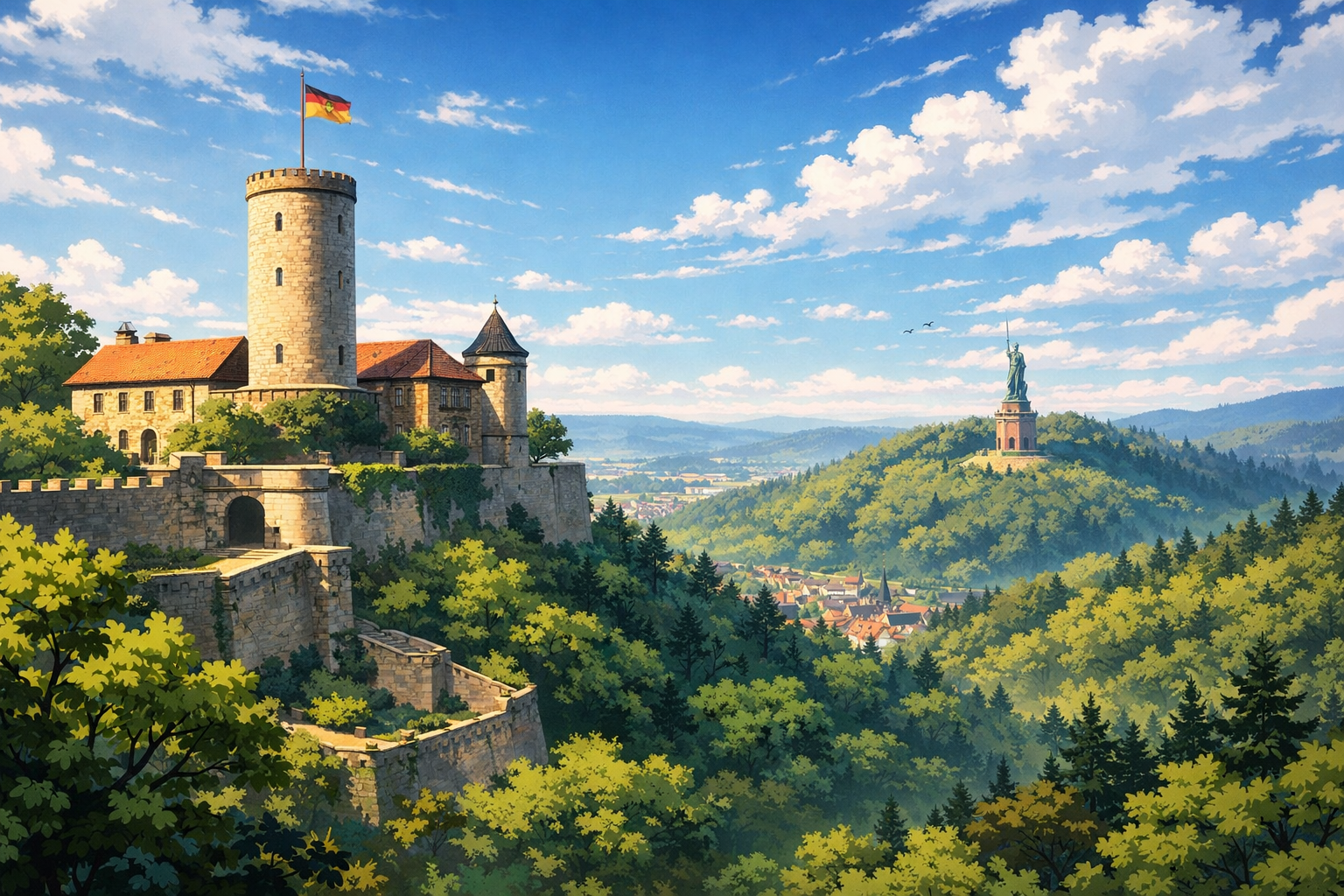
Bielefeld, Sparrenburg Castle and Teutoburg Forest

Bielefeld, Sparrenburg Castle and Teutoburg Forest

Explore Germany’s Teutoburg Forest on a scenic loop from Bielefeld to Detmold’s towering Hermannsdenkmal and the otherworldly Externsteine, over Oerlinghausen’s hills to Kalkriese’s Varus Battle Museum, then back again. Where ancient stones and Roman history meet forested trails and half-timbered charm, this compact route delivers legends and big views.

🧭 DAY-BY-DAY ITINERARY

Ready-made country and city routes with daily plans, sights, transport and accommodation. Buy PDF guides for independent travel.

🧭 DAY-BY-DAY ITINERARY


Day 1 — Bielefeld: arrival, Old Town and an “entry point” into the Teutoburg Forest theme

  • 🚆 Arrival in Bielefeld (Bielefeld Hbf): convenient connections to the airports of Düsseldorf/Cologne, Hanover and Paderborn. Check in and an easy walk through the pedestrian zone — City Hall, Theaterplatz, shopping arcades. At sunset, climb to the terraces of Johannisberg Hill for your first panorama of the Teutoburg Forest ridge: the texture of the wooded crests immediately makes it clear why the natural passes here have always carried strategic weight.


Day 2 — Sparrenburg: a fortress on the ridge (tour, casemates and tower)

  • 🚶 Sparrenburg is the heart of Bielefeld and a “stone symbol” of control over the Bielefeld Pass. Take a 45-minute guided tour of the casemates (underground passage ≈300 m), then climb the tower (121 steps): the 360-degree panorama shows how the medieval fortress “held” the route through the forested ridge. Outside, read the logic of fortification: bastions, curtain walls, traces of 16th–18th century modernizations. Afterwards — a promenade along the ridge and a descent to the center via shady paths.

Day 3 — Bielefeld museums: context for prehistory, urban history and modernism

  • 🏛️ Ravensberger Park: a cluster of museums in a former industrial complex. The Bielefeld Historical Museum — industrial archaeology, textiles, city plans and engineering; the Naturkunde Museum “namu” — the ridge’s geology, paleontology and rare collections (a good “key” to understanding the terrain you’ll be walking). Optionally — Kunsthalle Bielefeld (Philip Johnson building): a model modernist “box pavilion” and a dialogue with the sculpture park.

Day 4 — Hermannsweg ridge: Sparrenburg → Oerlinghausen (on foot)

  • 🥾 14–15 km along a Hermannshöhen (Hermannsweg) stage: from the walls of Sparrenburg along conifer edges via viewpoints (the Bismarck Tower “Eiserner Anton”) to Oerlinghausen. This is “landscape architecture”: the ridge as a natural artery since antiquity, where every pass is a “gateway to the country.” Picnic and return to Bielefeld by public transport (or overnight in Bielefeld).

Day 5 — Oerlinghausen: archaeological open-air museum (dwellings from the Stone Age to the Early Middle Ages)

  • 🚶 The archaeological open-air museum in Oerlinghausen is a “living” reconstruction of ancient households: a longhouse, workshops, costumes and technologies. It’s a convenient place to “assemble” in your head the evolution of settlements from hunting camps to early medieval farmsteads. In the evening — transfer and check-in in Detmold: a convenient base for Hermannsdenkmal and Externsteine.

Day 6 — Detmold: Hermannsdenkmal and the “myth of the Teutoburg Forest”

  • 🚶 The Arminius Monument (Hermannsdenkmal) is the tallest statue in Germany (with pedestal over 50 m), built atop the Grotenburg. The new Hermanneum visitor center explains how an ancient episode accumulated national meanings. Climb to the viewpoint and walk forest loops to nearby memorials — you can clearly see how the peaks “stage-manage” view corridors.

Day 7 — Detmold: LWL-Freilichtmuseum (90 ha, 120 historic buildings)

  • 🚶 Germany’s largest open-air museum: estates, craftyards, mills, a school, a post office — 500 years of Westphalian everyday architecture. Look at the construction: half-timbering, roofs, stoves, farmyards, placement of buildings relative to roads and water — “how a village is assembled from scattered parts.”

Day 8 — Externsteine: a “stone amphitheater” and the surrounding trails

  • 🚶 Externsteine is a chain of 40-meter sandstone rocks in the bowl of a forest lake. Climb stairways to platforms, see the reliefs and the chapel, loop around “by the water” with mirror-like reflections. The day’s route is built as “rock sculpture + trails”: how people read and sacralized the relief. The info center covers the archaeology and natural history of the site.

Day 9 — Paderborn and Wewelsburg (Carolingian “Kaiserpfalz” + a unique triangular fortress)

  • 🚆 Morning — Paderborn: the museum in the Kaiserpfalz on the original foundation of Charlemagne’s palace — a rare opportunity to “read” Carolingian planning and court life. After lunch — Wewelsburg (a Renaissance triangular fortress; museum and memorial exhibitions). The best way to combine both sites in one day is to rent a carshare for a day or coordinate regional trains/buses with a time buffer.

Day 10 — Kalkriese (Bramsche): the Varus Battle museum and park

  • 🚆 Train to Osnabrück/Bramsche and bus to the museum-park: reconstructed earthen ramparts and Roman army finds “ground” the ancient story in a specific landscape. The exhibition covers tactics, logistics, material traces of the battle; outside — a walk across the battlefield with observation points.

Day 11 — Bielefeld: botanical garden, promenades and final views

  • 🚶 An unhurried day in the city: the hillside Botanical Garden, Johannisberg promenades, the neighborhoods around the Theater. In the evening — return to Sparrenburg: we “stitch together” in our minds the route line — from the ridge-top fortress and ancient narratives to vernacular architecture and the industrial era.

Day 12 — Departure: time buffer and “friendly logistics”

  • 🚆 Plan your journey with a buffer: regional trains to the airports or a taxi transfer. If your flight is late—museum shopping in Ravensberger Park and coffee on the central streets. The finale is a look at the ridge of the Teutoburg Forest: it’s easy to see why this “forest ridge” shaped both roads and fortifications for centuries.

Flight tickets

eSIM for travel

Buy PDF guide

Buy PDF guide — 25.71 USD

PDF — 25.71 USD