
Buy PDF guide

Buy PDF guide — 17.14 USD

PDF — 17.14 USD

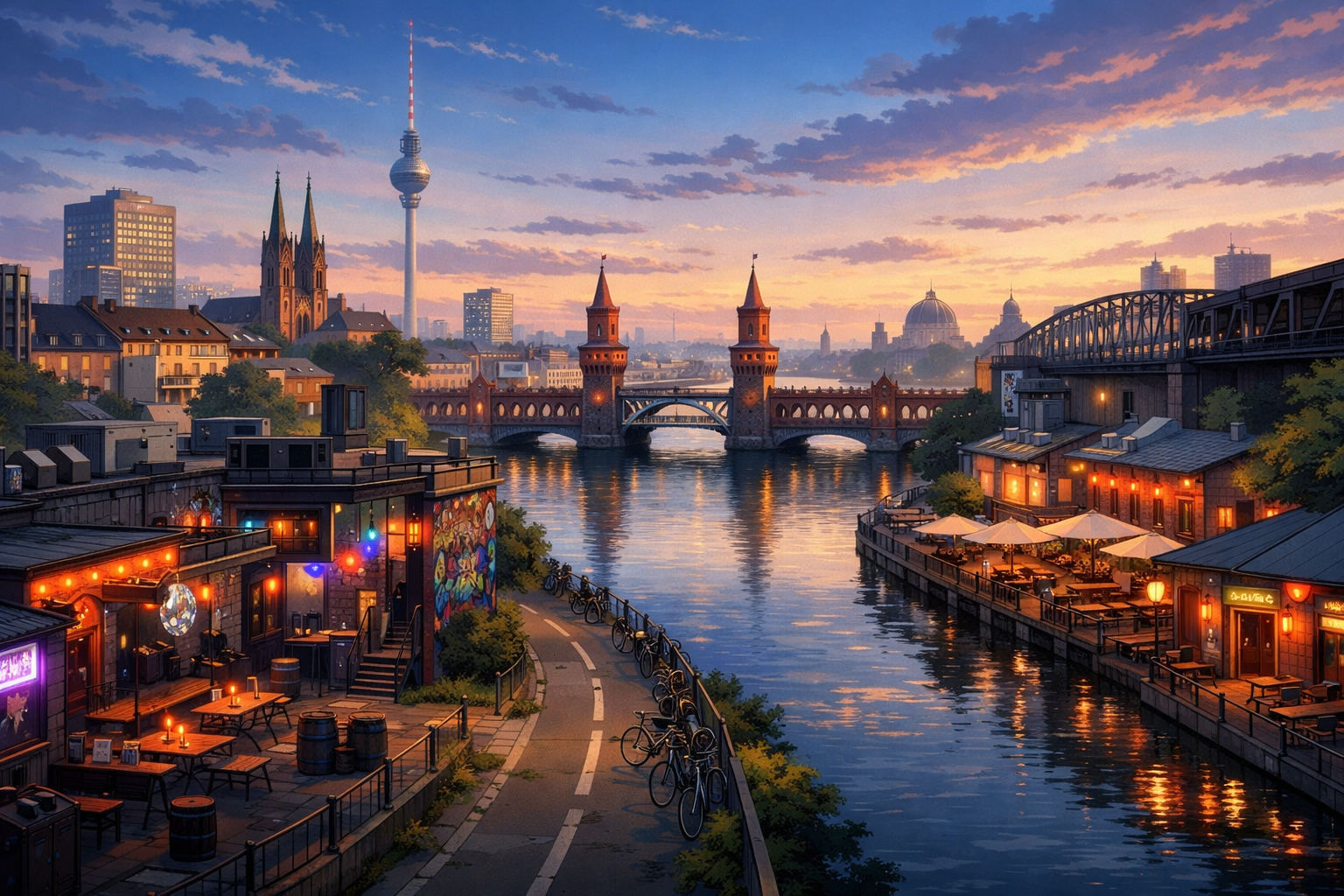
Berlin — techno clubs, underground bars, beer halls, a bike tour around the Kreuzberg district.

Berlin — techno clubs, underground bars, beer halls, a bike tour around the Kreuzberg district.

Berlin pulses with late-night energy, from Kreuzberg’s gritty charm and underground bars to Friedrichshain’s legendary techno clubs. Ride through the city by bike, stop for a beer hall classic, and catch the creative spirit that flows from Mitte to Schöneberg and Neukölln.

🧭 DAY-BY-DAY ROUTE

Ready-made country and city routes with daily plans, sights, transport and accommodation. Buy PDF guides for independent travel.

🧭 DAY-BY-DAY ROUTE


Day 1 — Berlin: arrival, Kreuzberg, and a gentle introduction to the city

  • 🚆 Landing at BER and getting to central Berlin is easiest via FEX, S-Bahn S9/S45, or regional trains: the trip to the central districts usually takes about 30–45 minutes, and to Kreuzberg or Friedrichshain with one transfer — around 45–60 minutes. After check-in, leave at least 1–1.5 hours for a shower, a short rest, and resetting after the journey: Berlin is best experienced not in a rush, but in the rhythm of “you’ve had time to exhale — and now you’re already heading into the city.”

  • 🚶 Start your introduction with Kreuzberg — a district that давно became synonymous with Berlin freedom, urban layering, and vibrant street energy. Here you can almost physically feel how Turkish bakeries, graffiti, punk heritage, trendy wine bars, nightclubs, and courtyards where the history of squats and the alternative scene never fully dissolved into new bourgeois comfort all meet in one space. A walk along Oranienstraße and the surrounding streets gives you the right first contact with the city: not polished, but honest — with the smell of coffee, smoke, rain on asphalt, and conversations in a dozen languages.

  • 🍺 Dedicate the evening to your first beer stop without overloading the program — BRLO BRWHOUSE by Gleisdreieck. It’s one of the best places to clearly begin the beer line of the route: its own craft brewery, industrial container architecture, a spacious hall, and a terrace that looks especially good at dusk when U-Bahn trains are already rumbling around you. It’s a great place to try modern German styles and seasonal brews while also feeling how gastronomy and urbanism work in Berlin: not like a museum, but alive and a little rough around the edges.

  • 💤 After the bar, don’t plan a heavy night. Better save your energy for the coming days: the trip back to most hotels in Mitte, Kreuzberg, or Friedrichshain usually takes 10–25 minutes by U-Bahn/taxi, and this evening should end early — with the feeling that you’ve only just opened the door to the city, not already squeezed every last drop out of it.


Day 2 — Berlin: bike tour through Kreuzberg, Görlitzer Park, and underground bars

  • 🚲 In the morning, set out on a bike tour that covers Berlin’s alternative districts and reveals Kreuzberg especially well. A 3–3.5 hour format with a bicycle and helmet is the optimal way to see the district not as a set of points, but as a single living organism. Along the way, the transitions between courtyards, canals, bridges, fragments of old subcultural Berlin fabric, and new venues that have carefully settled into this landscape without destroying it completely are especially vivid.

  • 🚶 After the tour, have a slow lunch and take a walk through Bethanien, the area around Oranienstraße, and Görlitzer Park. The park itself is a place with a difficult but very Berlin kind of urban reputation: not a manicured garden, but a territory of contrasts where recreation, street life, music, groups of young people, and the rough reality of the district long coexisted in a blur. Today it’s best visited during the day, seeing it as part of living Kreuzberg rather than a postcard. The atmosphere around it matters more than ticking it off the list: here you can hear how the city talks to itself.

  • 🍸 In the evening, move on to underground bars in the Kreuzberg–Schlesisches Tor area. Choose smaller places with dim lighting, loud selections, a post-punk or electronic undertone, and minimal distance between people and the bar. In Berlin, what’s valued is not flashy luxury, but the feeling of the right environment — where the bar looks a little careless, and because of that feels like it belongs. This kind of evening is best built not on the principle of “seeing everything,” but as a 2–3 stop bar hop within walking distance.

  • 🚶 For moving between spots, allow 10–20 minutes on foot and another 15–20 minutes for pauses. Berlin evenings are tricky because the city pulls you in: a bench by the canal, a kiosk with spontaneous beer, a conversation in a courtyard, or vinyl in some cramped little place can easily turn a plan into a night walk. That’s exactly the right scenario for day two.

Day 3 — Berlin: East Side Gallery, Holzmarkt, and a techno evening in Friedrichshain

  • 🚶 It makes sense to dedicate the third day to the eastern side of the city — East Side Gallery, the Spree riverfront, and Friedrichshain. A walk along the preserved section of the Berlin Wall is not just a tourist episode, but an important reminder that all of modern Berlin, including its club and alternative identity, grew out of the trauma of division, empty spaces, warehouse zones, and the later takeover of space by artists, musicians, and the nightlife scene. It’s best to walk here slowly, paying attention not only to the murals themselves but also to the urban backdrop around them.

  • 🍺 During the day, head to Holzmarkt 25 — a creative riverside quarter where Berlin’s bar, music, and semi-underground culture feels especially natural. This place grew from the kind of urban energy where not only parties matter, but also the very idea of open public space: the riverbank, courtyards, workshops, small food spots, stages, wooden structures, and a slightly utopian atmosphere of freedom. It’s a great place for a long pause with beer, a late lunch, and some rest by the water.

  • 🎧 Save the night for the main techno highlight of the route — Friedrichshain and its legendary club axis. If you want to touch the most famous side of the Berlin techno myth, focus on the area around Ostbahnhof and the former industrial zones. Here techno is perceived not as entertainment, but as an almost ritual form of urban life: a strict door, long waiting, heavy sound, concrete, anonymity, and total immersion in the night without external gloss.

  • 💤 It’s important to budget energy and flexibility for the techno evening in advance. Dinner is best made filling, then return to the hotel for 1–2 hours of rest, change clothes, and head to the club late in the evening. From the center to most major club venues in Friedrichshain, the trip usually takes 15–30 minutes. If the night turns into a long one, keep the next day a little softer in pace.

Day 4 — Berlin: a late morning, Mitte, beer classics, and an intellectual bar evening

  • 💤 After a club night, don’t overload the morning. The ideal scenario is a late breakfast, a slow exit from the hotel, and only then moving on to a route through Mitte. This district often feels more “collected” and cultural, but behind its tidy façade lies an important nerve of modern Berlin: a former eastern center transformed into a mix of galleries, courtyards, design spaces, and calm streets where the contrast with nighttime Friedrichshain is especially easy to feel.

  • 🏛️ During the day, you can combine an unhurried walk with one strong museum or historical site — for example, Berlinische Galerie or the Jewish Museum if you want a slightly more emotional and deeper context. After a full club night, places like these unexpectedly work especially strongly: the city opens up not just as the pure energy of the night, but as a complex memory of the 20th century, migration, division, loss, and cultural renewal.

  • 🍺 Dedicate the evening to a calmer but substantial beer line — Lemke am Alex or another strong urban beer hall in central Berlin. Here the route moves from the “young” craft aesthetic toward the urban beer tradition: long conversations, tasting several brews, hearty food, and the feeling that beer in Germany is not background, but a full part of local culture.

  • 🥃 If you still have energy, add one underground or rock-oriented bar late in the evening, but without a marathon. The day should work as a restoration of rhythm: 20–30 minutes for transfers, more seated pauses, fewer lines and less noise. That’s how the balance between the nightlife program and real enjoyment of the city is maintained.

Day 5 — Berlin: Jewish history, the city’s documentary memory, and an evening around Schlesisches Tor

  • 🏛️ Give the fifth day to historical and very serious Berlin. Start with the Jewish Museum Berlin — it’s not just a museum collection, but an architectural and emotional experience in which the very shape of the space becomes part of the story. It’s important to move slowly here and leave time for silence: the exhibition, transitions, voids, light, and lines of the building work no less powerfully than the texts and objects.

  • 🚶 Then move on to Topography of Terror — a documentary center on the site of the former structures of Nazi terror. This part of Berlin shows in an astonishing way how the city knows how to speak about the hardest things without decoration or excess pathos. After spaces like this, you want to take fewer photos and simply walk more: through Niederkirchnerstraße, toward Potsdamer Platz, and then pause for coffee and a late lunch.

  • 🍸 In the evening, return again to the darker and more informal side of the city — this time to the bar cluster around Schlesisches Tor and the approaches to Friedrichshain. After a museum day, small venues with strong character work especially well: places with lots of wood, stickers, subdued light, beer, simple cocktails, and their own crowd. These bars offer not entertainment for the sake of a checklist, but a feeling of local code.

  • 🚆 For travel between the museums and the evening districts, allow 20–35 minutes by public transport. Berlin is big, but it’s convenient to assemble it in pieces: one daytime cluster, then rest, then an evening program. Don’t try to glue everything into one continuous run — the city benefits from pauses.

Day 6 — Berlin: Gleisdreieck, industrial spaces, and a second techno night

  • 🚶 After several packed days, it’s worth choosing a route with lots of breathing room. Park am Gleisdreieck is an excellent daytime stop: former railway land transformed into a modern public space, perfectly reflecting Berlin’s ability to rework its industrial past into new urban life. It’s pleasant here simply to walk, look at the traces of tracks, cyclists, skaters, and the way green space grows into the hard urban framework.

  • 🏛️ If you want to add a museum accent, it makes sense to visit Deutsches Technikmuseum: it’s one of those Berlin museums where the industrial and transport theme is perceived not dryly, but almost like an adventure. Airplanes, machinery, railway history, and the scale of the former industrial site fit very well with the overall mood of this day.

  • 🍺 Toward evening, have an early dinner with beer to prepare for the second techno night. Unlike the first one, this night can be more experimental: you don’t have to chase only the most hyped name; sometimes it’s much more interesting to choose clubs and spaces with a more local, sharper, more “their own” character. In Berlin electronic music, what matters is not the number of famous names, but the alignment of sound, environment, and your own state of mind.

  • 🎧 Allow 20–30 minutes for the trip to club spots, plus extra time for the line and entry. Between the daytime and nighttime parts, a hotel rest of at least 2 hours is essential. It is often exactly this break that determines whether the night will be a genuine pleasure or turn into a tired forced march.

Day 7 — Berlin: Tempelhofer Feld, Neukölln, and a big bar-and-beer Saturday

  • 🚶 Open up the seventh day through Tempelhofer Feld — the former field of Tempelhof Airport, which today has become one of Berlin’s most beloved open spaces. This place is incredibly Berlin in its idea: a gigantic runway territory without any attempt to tame it into something “too pretty.” People ride, run, sit on the concrete with drinks, fly kites, have picnics — and all of this creates a rare feeling of freedom within a metropolis.

  • 🚶 After the walk, move on to Neukölln — a district that in recent years has become one of the main centers of the young urban scene. Here you can especially feel the mix of migrant everyday life, new gastronomy, bar culture, old Berlin, and almost endless conversations about gentrification. It’s worth walking without haste: through canals, quiet side streets, cafés, wine bars, and local pubs.

  • 🍺 Make the evening into a big bar-and-beer outing: first a beer hall or brewery taproom, then 2–3 underground bars, and if you want, finish in a music bar or a small club venue. This format works especially well on Saturday because the city gains a special density: the bars are noisy, the streets are full of people, and the route itself feels like part of a large Berlin performance without a stage.

  • 🚕 After midnight, it’s better not to build overly complicated transfers. For the way back, it’s convenient to keep taxi or ride-hailing in mind, especially if you’re moving between Neukölln, Kreuzberg, and Mitte. This is an evening for spontaneity, so let the logistics be as simple as possible.

Day 8 — Berlin: final morning, shopping, a calm lunch, and departure for the airport

  • ☕ It’s best to make the last day soft and beautiful in its rhythm. Don’t try to squeeze in another big district — Berlin is remembered much better through a calm finale: a late breakfast, a short walk along your favorite street, coffee on a terrace, a couple of purchases in a concept store, bookshop, or music shop. The city should remain as an aftertaste, not as the feeling of a race until the very last minute.

  • 🎁 If you’re staying in Mitte, it’s convenient to dedicate the morning to the area around Hackescher Markt or Alexanderplatz; if in Friedrichshain — walk along the Spree and see the industrial banks one more time; if closer to Zoo or Charlottenburg — create a more elegant urban finale. It’s important to leave at least 1–1.5 hours for a calm lunch and packing.

  • 🚆 For the trip to BER from central districts, usually allow 45–60 minutes door-to-door by public transport, and by taxi — more often around 35–60 minutes depending on the district and traffic. For an international flight, it’s better to leave with a good time buffer, especially if your departure day falls on Friday, Saturday, or morning hours.

  • 💤 The finale of this route is not about “fitting in one more thing,” but about fixing the main idea: Berlin as a city where techno clubs, underground bars, beer halls, historical memory, vacant lots, canals, concrete, and freedom do not argue with one another, but come together into a rare feeling of living, stubborn, and very human urban energy.

Flight tickets

eSIM for travel

Buy PDF guide

Buy PDF guide — 17.14 USD

PDF — 17.14 USD