
Buy PDF guide

Buy PDF guide — 8.57 USD

PDF — 8.57 USD

Berlin Potsdam in one route

Berlin Potsdam in one route

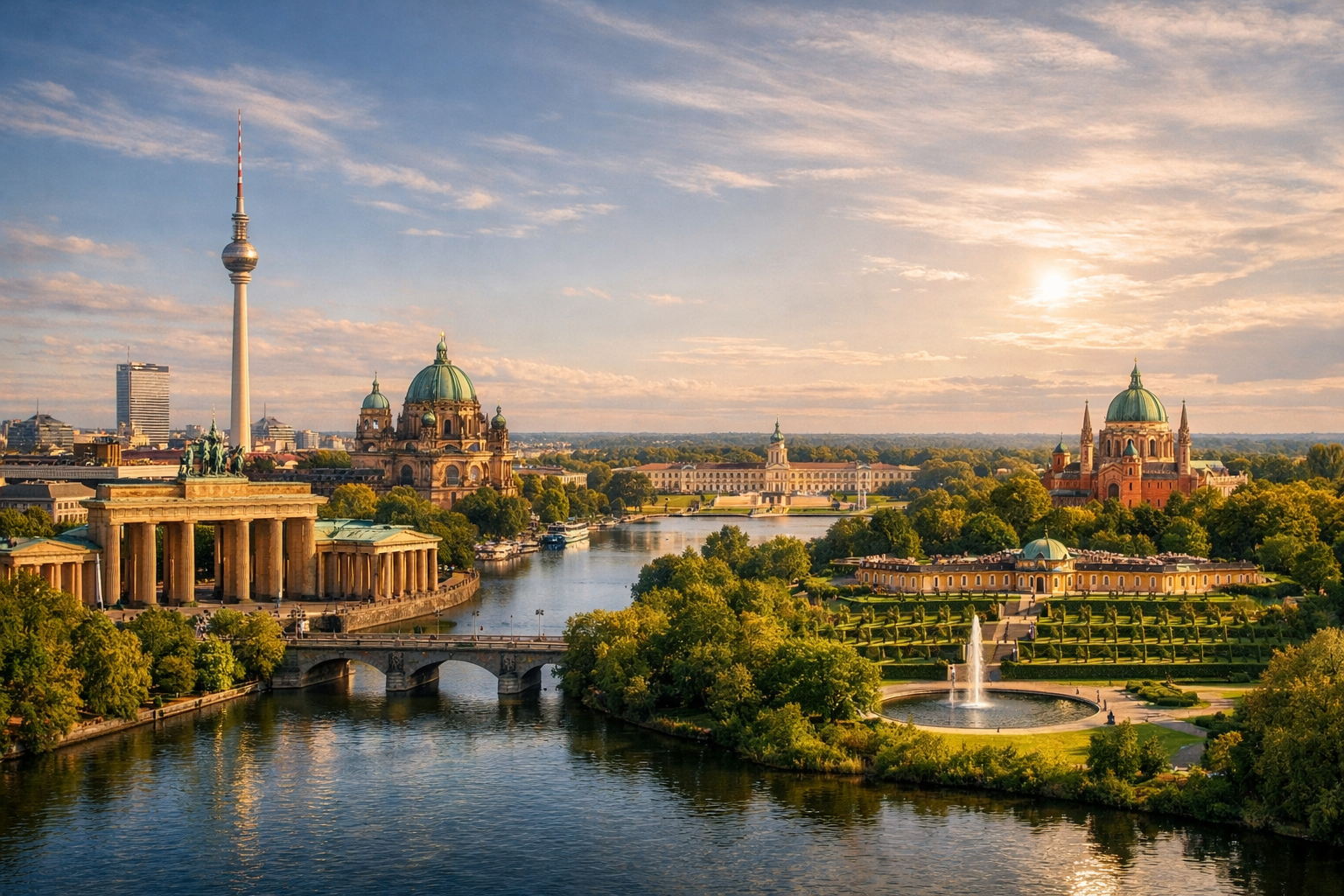
Discover the perfect day trip from Berlin: a seamless route to Potsdam and back, where grand palaces, lakeside gardens, and relaxed historic streets offer a striking contrast to the capital’s energy. It’s an easy escape that blends Berlin’s urban pulse with Potsdam’s elegant charm in one memorable journey.

🧭 DAY-BY-DAY ROUTE

Ready-made country and city routes with daily plans, sights, transport and accommodation. Buy PDF guides for independent travel.

🧭 DAY-BY-DAY ROUTE


Day 1 — Berlin: Museum Island, Unter den Linden, and an evening by the Brandenburg Gate

  • 🚆 Arrival at BER and transfer to central Berlin is best planned with the Airport Express FEX: the ride takes about 19 minutes to Potsdamer Platz and about 23 minutes to Hauptbahnhof. If you are staying around Friedrichstraße, Museum Island, or Unter den Linden, this is one of the fastest and calmest ways to get there without unnecessary transfers. It is reasonable to allow 1.5–2 hours for check-in and a short rest after the journey, especially if you arrive in the morning or after an overnight flight.

  • 🚶 It is best to dedicate the first day to the most ceremonial and historically rich heart of Berlin. Start with Museum Island — an ensemble on the Spree where classical facades, stone staircases, bridges, domes, and views of Berlin Cathedral create the feeling not just of a city walk, but of a slow entry into a European cultural capital. Even if you do not go into every museum right away, the atmosphere of the island itself works as the perfect introduction to the trip: you can feel Prussian monumentality all around, yet right beside it lives the modern city with cafés, trams, street musicians, and a stream of people from all over the world. This is an especially good place to walk without rushing: admire the facade of the Neues Museum, stroll along the water, stop by the James-Simon-Galerie, and catch that rare moment when Berlin opens up not as a “harsh metropolis,” but as an elegant open-air museum.

  • 🏛️ If you want one main museum stop for the day, the logical choice is the Neues Museum: it is one of the most beautiful and thoughtful examples of how Berlin combines archaeology, architecture, and the dramatic history of the building itself. The museum was heavily damaged during the war and later restored in a way that did not erase the traces of time. Inside, you will find ancient Egyptian and prehistoric collections, and this is where the famous bust of Nefertiti is kept. For a comfortable visit, it is worth allowing 1.5–2 hours, then taking a break for coffee or a late lunch so the first day does not turn into a marathon.

  • 🚶 After the museum, walk along Unter den Linden toward the Brandenburg Gate. This is one of those European avenues where history is literally laid out in perspective: embassies, academic buildings, cathedrals, squares, and broad alleys gradually lead you to the city’s most famous symbol. Along the way, you can see Berlin Cathedral, the State Opera, Humboldt University, and feel how the rhythm of the street changes — from museum-like concentration to a ceremonial urban stage.

  • 🌆 The evening is ideally finished at the Brandenburg Gate and the Reichstag with a walk through Pariser Platz and the nearby Tiergarten. In the pre-sunset hour, the stone and glass here are especially beautiful: the light becomes softer, the flow of people is less intrusive, and the space feels almost cinematic. If you still have energy, you can calmly walk to the Memorial to the Murdered Jews of Europe — it makes an especially strong impression in the evening, when there is less bustle around. For the first day, this is enough: the route is dense but logical, almost entirely walkable, and the total walking load usually fits into 8–10 km with stops.


Day 2 — Berlin: Reichstag, Tiergarten, Potsdamer Platz, and Kulturforum

  • 🚶 It is best to structure the second day so that urban symbols, green spaces, and modern art alternate with each other. Start in the morning around the Reichstag and the government quarter: here Berlin looks completely different from Museum Island. Instead of Baroque and Neoclassical grandeur — glass, openness, broad lines, water, and the feeling of the country’s new political center. The Reichstag building itself, with its famous dome, is not just a landmark but one of the main visual images of reunified Germany. Even if you do not go inside, a walk around it gives a strong sense of the scale and historical density of this place.

  • 🌳 From here, it is very pleasant to head into Tiergarten — a huge city park that feels not like a decorative garden but like Berlin’s true green breath. Broad paths, meadows, old trees, canals, and unexpectedly quiet corners make it an ideal place for a break between the urban sections of the route. You can walk toward the Victory Column and then move on without rushing to Potsdamer Platz. It is best to allow 1.5–2 hours for the park and a walk with short stops: this very unhurried pace is what makes the day comfortable.

  • 🏙️ Potsdamer Platz is a completely different Berlin: a district that became a symbol of postwar recovery and modern urban energy. Glass facades, business centers, cinemas, shopping spaces, and wide squares create a contrast with the historic quarters of the previous day. It is a convenient place for a lunch break because the area is well adapted for travelers: everything is close, walking links are short, and there is a large choice of cafés and restaurants.

  • 🏛️ After lunch, head to the Kulturforum and the Neue Nationalgalerie. This is one of the most important places for those who love 20th-century architecture and modern art. The museum building itself, designed by Ludwig Mies van der Rohe, is perceived as a work of art in its own right: strict geometry, transparency, openness of space, and an almost meditative purity of lines make the visit special even for those who do not usually think of themselves as museum people. It is best to allow around 2 hours for the museum and a short rest nearby.

  • 🌙 In the evening, you can return to the Unter den Linden area or stay closer to Friedrichstraße if you want a more relaxed ending with dinner and a walk without any must-see stops. This day is good because it does not involve tiring transfers: everything is built around short walking sections and clear movements by U-Bahn, S-Bahn, or bus. In intensity, it is slightly gentler than the first day, which is useful before heading to Potsdam the next day.

Day 3 — Potsdam: Sanssouci, the park, Neues Palais, and the historic center

  • 🚆 In the morning, head from Berlin to Potsdam. The most practical option is the regional RE1 train to Potsdam Hauptbahnhof: the journey takes about 25–30 minutes, trains run frequently, and the transfer itself is not tiring, making it ideal for a day-trip format. From the station, it is convenient to reach the historic center and the key sights of Potsdam by tram or bus, but if the weather is good and you want to feel the city gradually, part of the route can be done on foot.

  • 🏰 The main idea of the day is to devote it to Potsdam as a city of royal residences and gardens, rather than trying to “tick off” everything at once. Start with Sanssouci Palace and the park of the same name. Sanssouci is often called the Prussian answer to Versailles, but in reality this place is far more камерное and intimate in its own way. The palace itself, built as the summer residence of Frederick the Great, is elegant, bright, and surprisingly human in scale: it does not overwhelm, but rather invites a slow walk. Vineyard terraces, symmetrical alleys, cascades of greenery, sculptures, and the gentle relief of the park create an atmosphere of refined leisure in which it is very easy to forget that you are only half an hour from a noisy capital.

  • 🌿 It is reasonable to set aside at least 3–4 hours for a walk through Sanssouci Park with a visit to the palace. This is not a place to rush through. Pauses matter here: sit on a bench, look at the perspectives of the alleys, walk to the Chinese House, or simply give yourself time for unhurried movement. From April to October, a free shuttle operates in the park between Grünes Gitter and Neues Palais along the service road, which can help save energy if you do not want to walk through the entire park.

  • 🏛️ After the main walk, it is worth walking or riding to the Neues Palais — the New Palace, which shows another side of Prussian representation. If Sanssouci feels like an elegant private retreat, the New Palace is much more ceremonial and demonstrative: it is architecture of status, scale, and political messaging. It rounds off the palace-and-park part of the day well because it provides contrast and helps you see how different the language of monarchical power could be.

  • 🚶 In the second half of the day, move to the historic center of Potsdam — to Alter Markt and Museum Barberini. This district noticeably differs from the park landscape: here you feel the urban fabric, reconstructed facades, squares, domes, and a more compact street rhythm. Museum Barberini is an excellent final cultural stop for the day, especially if you want to end the route not only with architecture but also with painting. Even a short visit here after the palaces feels very natural.

  • 🌆 Before returning to Berlin, leave time for a calm dinner or at least coffee in the center of Potsdam. This is an important pause: after a big park day, it helps keep the trip from turning into a race. The return on RE1 in the evening usually takes the same 25–30 minutes, and by night you are back in Berlin again without the feeling of a heavy transfer.

Day 4 — Potsdam: Cecilienhof or Barberini, then departure from BER

  • 🚆 It is best to keep the last day more flexible and not overload it with long walks. If you want one more full outing to Potsdam, focus on the Neuer Garten area and Cecilienhof Palace. From Berlin, it is more convenient to get there via Potsdam Hauptbahnhof with a short transfer to a bus or a tram-and-bus connection. For the trip from central Berlin to the palace area, it is usually wise to allow about 1–1.5 hours, including waiting time and an unhurried pace.

  • 🏰 Cecilienhof Palace is completely unlike Sanssouci. This is not Rococo and not ceremonial Prussian luxury, but a late residence in the style of an English country house, built already in the 20th century. It was here that the Potsdam Conference of 1945 took place, so the site carries not only architectural value but also immense political memory. Inside and outside, there is an astonishing intersection of eras: a камерная aristocratic residence suddenly becomes the stage for decisions that shaped postwar Europe. This makes the visit especially powerful — not because of outward grandeur, but because of the concentration of history.

  • 🌳 A walk through Neuer Garten is best perceived as a calm conclusion to the whole trip. This park is quieter, softer, and less ceremonial than Sanssouci. Here it is easier to simply walk, look at the water, trees, palace facades, and gradually let go of the rhythm of travel. If you do not want to go to Potsdam again, an alternative could be an easier Berlin finale: for example, one museum block, a walk by the Spree, or free time for shopping and a leisurely lunch in Mitte.

  • 🖼️ Another excellent option for the last day is to stay in the historic center of Potsdam and choose Museum Barberini, if you did not manage to visit it the day before or want to devote more time to it. This format is especially convenient before a flight: minimal long walking stretches, compact logistics, and an impression that is rich but not exhausting. Usually 2–3 hours are enough for the museum and a walk around Alter Markt.

  • ✈️ Be sure to leave extra time for the trip back to BER airport. From central Berlin, FEX takes about 19 minutes from Potsdamer Platz and about 23 minutes from Hauptbahnhof, but to this you need to add the trip to the station, waiting time for the train, and the usual airport buffer. If you are traveling from Potsdam on your departure day, it is reasonable to plan the route via Berlin Hauptbahnhof or Südkreuz with a good time reserve. The final day should feel calm and manageable: fewer stops are better than a nervous race with suitcases.

Flight tickets

eSIM for travel

Buy PDF guide

Buy PDF guide — 8.57 USD

PDF — 8.57 USD