
Buy PDF guide

Buy PDF guide — 6.43 USD

PDF — 6.43 USD

BERLIN - Berlin nightlife bars clubs techno scene

BERLIN - Berlin nightlife bars clubs techno scene

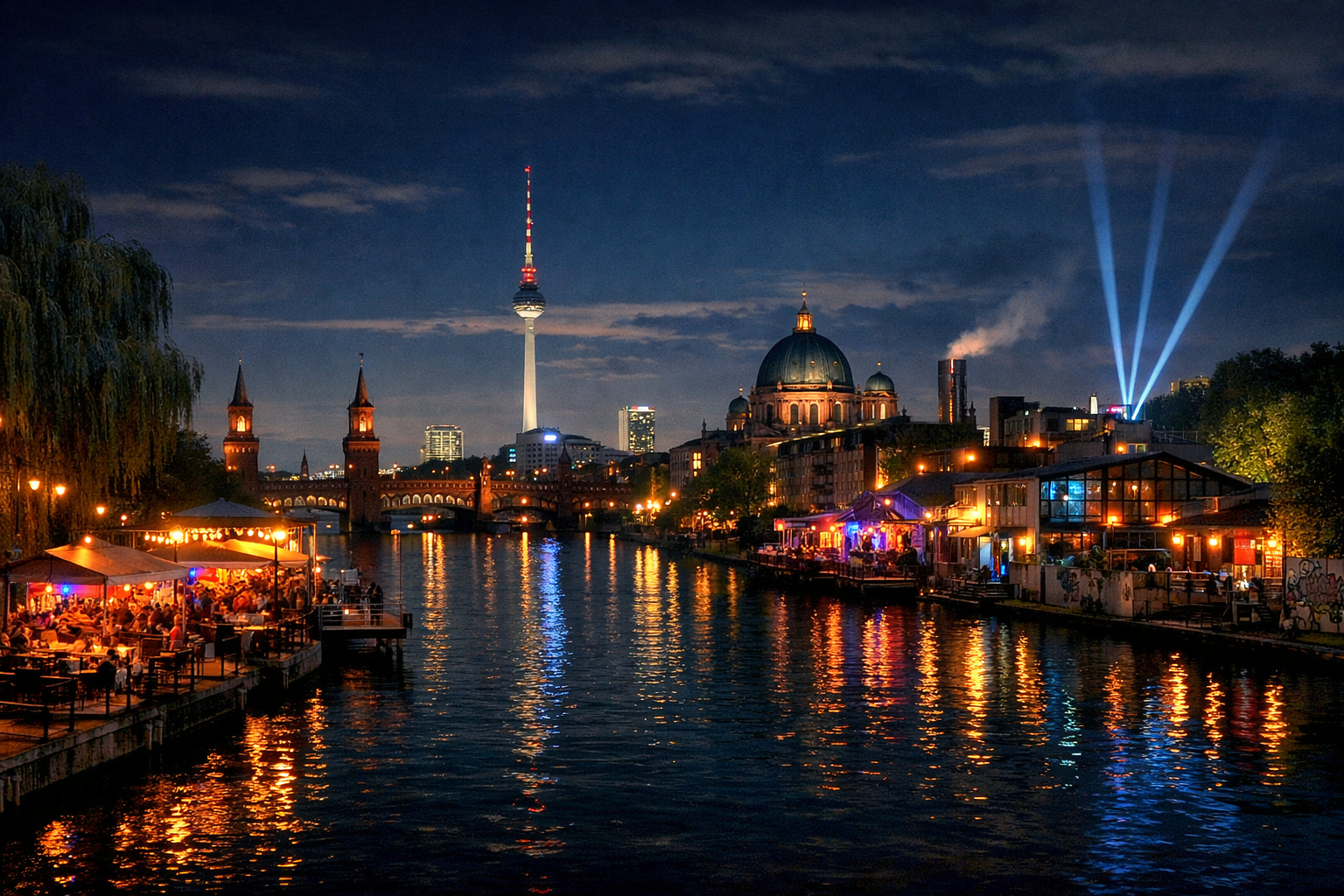
Berlin comes alive after dark, with smoky bars, hidden clubs and a nightlife scene that feels effortlessly electric. From gritty basements to sunrise dance floors, the city’s legendary techno culture keeps the energy going all night.

🧭 DAY-BY-DAY ITINERARY

Ready-made country and city routes with daily plans, sights, transport and accommodation. Buy PDF guides for independent travel.

🧭 DAY-BY-DAY ITINERARY


Day 1 — Berlin: Mitte, Museum Island, a cocktail start and the first club night

  • 🚆 It’s best to plan your arrival at BER and your transfer into the center without rushing: Berlin Brandenburg Airport has its own railway station directly beneath Terminal 1, and the most convenient scenario for your first base in the center is FEX or the S-Bahn. Getting to the Friedrichstraße area usually takes about 38 minutes including a short transfer and finding your way on site, while Potsdamer Platz is about 27 minutes away; it’s a realistic and comfortable option without a taxi and without the risk of getting stuck in traffic.

  • 🚶 It’s better not to overload the first day: after check-in, head to Mitte — this is where Berlin reveals itself not only as a capital of museums and history, but also as a city with a special, almost cinematic evening energy. A walk from Friedrichstraße along Unter den Linden to Museum Island and Berlin Cathedral offers a gentle introduction to the city: strict Prussian architecture, the waters of the Spree, pockets of greenery, domes, bridges and reflections in the canals create the feeling that Berlin is both monumental and surprisingly alive at the same time. In this area, its many layers are especially tangible: the imperial past, traces of the divided city, a modern European capital and an endless cultural scene all exist here not one after another, but all at once together.

  • 🚶 If you want to add some art to the day, stop by the Alte Nationalgalerie on Museum Island. It’s one of Berlin’s most beautiful museum addresses, where the classical staircase, colonnade and the staging of the building itself already set the mood before you even enter. The 19th-century collection makes the museum especially pleasant for a city-break rhythm: there’s no feeling of a museum marathon, but rather a well-measured aesthetic immersion — Romanticism, Realism, the Impressionists, calm halls and beautiful views over the island part of the center. After a flight, it’s an ideal cultural pause before the nighttime part of the itinerary.

  • 🍸 Start the evening calmly: Mitte and the surrounding quarters are better for a warm-up before clubs than jumping straight into a long sleepless night. The optimal scenario is dinner, then one cocktail or wine bar around Hackescher Markt / Friedrichstraße / Rosenthaler Platz, and only after that moving toward the main nighttime plan. A Berlin specialty is that the night here is rarely built as a quick “eat-drink-go home” sequence: it unfolds gradually, and that is exactly what makes the local scene so absorbing. It’s important to save your energy, not start too late, and remember that the best club hours in Berlin often come well after midnight.

  • 🎛️ For a first major club introduction, it makes more sense to choose Tresor if you want a truly historic techno experience without the mythology surrounding Berghain’s face control. Tresor is one of the symbols of Berlin’s techno culture, a place with an industrial pulse, underground energy and exactly the feeling that draws electronic music fans here from all over the world. Its current venue on Köpenicker Straße continues the legend of old 1990s Berlin: rough concrete, darkness, rhythm, metallic density of sound and an atmosphere where the decor doesn’t entertain but underscores the music. You should go here not as to a “tourist club,” but as to an experiential place: without extra noise, in comfortable dark clothing, and ready to spend several hours inside.

  • 💤 The return after the night should also be planned realistically: including waiting for transport, a short walk to the station and the ride back to the hotel after a club outing, it’s reasonable to count on about 60 minutes. So don’t plan a packed program for the next morning — it’s better to leave room for a late breakfast and a slow start.


Day 2 — Berlin: East Side Gallery, Friedrichshain, bar culture and a big techno night

  • 🌤️ The morning of the second day should be gentle: a late wake-up, a long breakfast, coffee without rushing, and only then heading into the city. The best area for a day like this is Friedrichshain, where rough post-industrial aesthetics unexpectedly combine with waterfronts, graffiti, designer hotels, art spaces and a sense of freedom that makes Berlin so beloved by creative professionals, musicians and anyone tired of overly polished capitals.

  • 🚶 Start with East Side Gallery — it’s not just a “wall with paintings,” but one of the strongest urban walks in Berlin. More than a kilometer of the former Berlin Wall runs along the Spree and today is perceived at once as a memorial, an open-air gallery and the nerve of a city that lived through division, the fall of borders and cultural rebirth. A slow pace works especially well here: walk the whole stretch, study the famous murals and the lesser-known works, and observe how tourist energy coexists with genuine historical weight. This place is a reminder that modern Berlin club freedom did not grow out of gloss, but out of a real political and urban rupture.

  • 🚶 After East Side Gallery, it’s worth continuing the day along the waterfront toward Oberbaumbrücke and further in the direction of Holzmarkt / Kater Blau. This part of the city gives you a completely different Berlin — less museum-like, more physical, slightly chaotic and very atmospheric. What’s beautiful here is not only the destinations, but the movement between them: bridges, water, old brick buildings, graphic facades, terraces, courtyards, random bars and the sense that the city is always inviting you to turn the wrong way — and that’s exactly where something interesting will be.

  • 🍹 During the day and early evening, it’s good to leave room for the bar scene. Berlin is strong not only in its “big clubs,” but also in the way the road to them is set up: beer bars, wine rooms, courtyard venues, loft spaces, summer decks by the water. In the Holzmarkt area and the neighboring quarters, it’s easy to spend several hours moving from one place to another without a rigid plan. That kind of rhythm helps you avoid burning out before midnight and makes the second night feel more cohesive: not like a series of checkpoints, but like one long, living immersion.

  • 🎚️ The main plan for the evening is Berghain / Panorama Bar as the most famous symbol of Berlin’s techno mythology. Even if you don’t get inside, the very approach to this place is already part of the cultural experience: the former industrial surroundings near Ostbahnhof, the restrained queue, the absence of a tourist carnival, the almost ritual composure of the crowd. If you do get in, it’s worth treating the night not as a hunt for a “tick on the list,” but as a complete dissolution into the space: powerful sound, the high ceiling of a former power plant, an almost sacred darkness, a long sense of time where 3 a.m. feels like the beginning rather than the finale. At the same time, having a backup plan is completely normal: if you want to shift the focus from legend to a more relaxed and artistic atmosphere, Kater Blau offers a different, more playful and riverside character to the night.

  • 🛌 After a night like that, it’s better not to fight your body. Plan for sleeping late and move the active morning part to the second half of the following day. For a three-day itinerary, that matters more than trying to “fit everything in.”

Day 3 — Berlin: Kreuzberg, cultural contrast, final evening and departure

  • ☕ It’s best to build the third day around contrast: after two evenings of music and urban noise, head to Kreuzberg — a district where Berlin reveals itself as a capital of memory, migration, art, counterculture and everyday freedom. There is less grandeur here, but more of the city’s real breath: Turkish bakeries, graffiti, bookstores, bicycles, inner courtyards, a mix of languages and the feeling that urban character is shaped not by shop windows, but by people.

  • 🏛️ The strongest cultural point of the day is the Jewish Museum Berlin. Even if you don’t usually like “heavy” museums, it is worth going here precisely for the architectural and emotional experience. Daniel Libeskind’s space works not only through the exhibition, but through the route inside the building itself: sharp lines, voids, intersections, a feeling of rupture and memory. It is one of those museums after which the city is perceived differently — not just as a beautiful European center, but as a place where history truly continues to exist within the urban fabric.

  • 🚶 After the museum, it’s good to walk through Kreuzberg without a dense must-see list: the district opens up through atmosphere rather than monuments. Head toward the Landwehrkanal, Oranienstraße or Görlitzer Park depending on your mood, stop for lunch at one of the international spots, give yourself time for some final shopping in independent stores and simply watch the life of the neighborhood. This kind of free-form block is especially valuable after a club trip: it gathers Berlin into one whole and shows that its strength lies not only in the night, but also in its daytime street culture.

  • 🍸 Make the final evening light and smart: instead of another exhausting night, it’s better to choose a bar route or a mid-size concert venue. If you want to leave yourself one more electronic accent as a memory, you can check the program at Festsaal Kreuzberg or head back toward the water and a more informal scene. A good finale for this kind of tour is not an attempt to top the previous night, but a graceful ending: dinner, a last cocktail, a walk through warm evening Berlin and the feeling that the city doesn’t let you go all at once.

  • 🚆 If your flight is in the evening or the next morning, it’s most convenient to plan the trip to BER with some buffer: from the central districts via a regional train or Airport Express plus a normal airport time cushion, it comes to about 50 minutes or more, and during busy hours it’s better to leave yourself a full comfortable time reserve. For night flights or very early transfers, it’s sensible to consider a taxi or an app booking, especially after a club or a late bar.

Flight tickets

eSIM for travel

Buy PDF guide

Buy PDF guide — 6.43 USD

PDF — 6.43 USD