
Buy PDF guide

Buy PDF guide — 6.43 USD

PDF — 6.43 USD

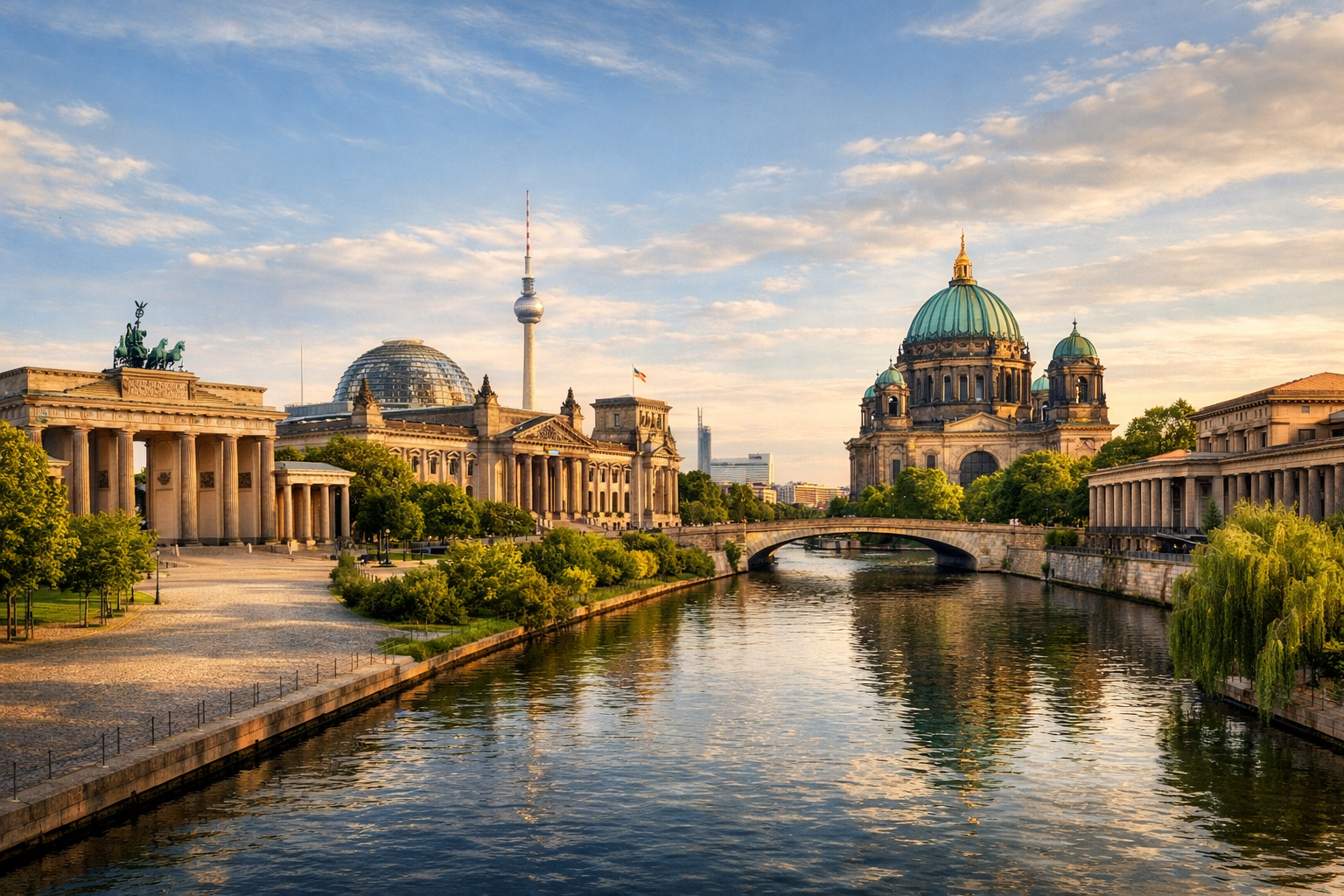
BERLIN - Classic Berlin Brandenburg Gate Reichstag Museum Island

BERLIN - Classic Berlin Brandenburg Gate Reichstag Museum Island

Berlin blends grand history with a bold, creative spirit. From the iconic Brandenburg Gate and the Reichstag to the world-class treasures of Museum Island, the city invites you to explore its past and its pulse in one unforgettable trip.

🧭 DAY-BY-DAY ROUTE

Ready-made country and city routes with daily plans, sights, transport and accommodation. Buy PDF guides for independent travel.

🧭 DAY-BY-DAY ROUTE


Day 1 — Classic Berlin: Brandenburg Gate, Pariser Platz and Unter den Linden

  • 🚆 If you arrive at BER Airport in the morning, the most convenient way to start the route is to head into the center on the Airport Express FEX or a regional train to Berlin Hauptbahnhof, and then continue on foot or by S/U-Bahn. From the main station to the Reichstag and Brandenburg Gate area, allow about 25–30 minutes of relaxed walking with short photo stops; if you want to avoid extra fatigue, it is more convenient to take one short ride on public transport and save your energy for the city center.

  • 🚶 Brandenburg Gate is not just Berlin’s most famous postcard image, but a rare place where history is felt almost literally in the air. When you step onto Pariser Platz, the strict and ceremonial silhouette of classical columns rises before you, crowned by the quadriga — the chariot of the goddess of peace. Once the gate was a symbol of the Prussian capital, then a witness to the city’s division and an almost mythical border line, and today it has become a sign of united Berlin and one of the strongest places of urban memory in Europe. It is especially beautiful here in the morning: the stone seems golden, there are fewer tourists, and the wide square gives you space to slow down, look around, and notice how monumental architecture stands beside a living, modern capital.

  • 🚶 After the gate, it is worth taking a slow walk along Unter den Linden — one of Berlin’s most famous streets. This route is not about ticking a box, but about atmosphere: on both sides you pass stately facades, embassies, university buildings, linden-lined avenues, and fragments of that very Berlin that has always been a city of ideas, power, culture, and debate. It is easy to allow 30–40 minutes here for a relaxed stroll, a coffee break, and photos. If you enjoy urban walks without rush, this is exactly where the feeling comes that Berlin reveals itself not through bright decoration, but through a blend of dignity, scale, and a light, almost street-like freedom.

  • ☕ After the first long walk, it makes sense to take a break in the Friedrichstraße area or near Gendarmenmarkt: in the compact center everything is close enough, and even a busy day can be arranged without tiring transfers. For the evening, it is better to keep the program light — a short walk back toward the gate or in the direction of Potsdamer Platz, to see how the historic center changes mood after sunset: strict facades grow darker, the squares become more intimate, and the city itself feels at once official, intellectual, and surprisingly cinematic.


Day 2 — Reichstag, the government quarter and a walk through Tiergarten

  • 🚶 The Reichstag is one of Berlin’s most powerful and symbolically charged places. The address of the German parliament building is Platz der Republik 1, and even the approach to it makes a strong impression: a broad square, a strict urban axis, open space before the facade, and the feeling that you are standing in a place where Germany’s history has quite literally been gathered in stone. The building lived through the imperial era, fire, war, a divided city, and then became one of the most important symbols of modern democratic Germany. Its massive historic structure looks solemn and almost severe, while the famous glass dome adds a modern meaning to the image — transparency, openness, and a dialogue between past and present.

  • 🕒 If you plan to visit the dome or terrace, it is better to book entry in advance for a specific time slot and allow about 1.5–2 hours for the whole visit, including security screening, the ascent, and quiet time at the top. Even if you limit yourself to viewing the exterior, the area itself deserves at least an hour: nearby there are good views of the government quarter, the River Spree, and modern administrative buildings. This is a very photogenic part of the city, but its main strength is not only the view, but the way the idea of the new capital is readable here: serious, open, and confident.

  • 🚶 After the Reichstag, it is convenient to head toward Tiergarten — a huge green park in the center of Berlin that works as a natural pause between intense urban impressions. Unlike the “ceremonial” squares, the city softens here: broad avenues, large trees, ponds, cyclists, runners, and local residents create a completely different rhythm. After museum or parliamentary spaces, a walk through Tiergarten is especially pleasant because it lets you reset and gives the route a human, relaxed pace. It is comfortable to set aside 1–1.5 hours for such a walk without the goal of “seeing everything.”

  • 🚶 In the evening, you can finish the day around Potsdamer Platz or return to Mitte for dinner. From a logistics point of view, this is a very convenient day: the main places are concentrated close to each other, and the total walking distance between locations remains realistic even for a slow-paced trip. The main thing is not to turn the day into a marathon. Berlin opens up better when there is room between the symbols for pauses, observation, and simply sitting on a bench overlooking the city.

Day 3 — Museum Island: Neues Museum, Altes Museum, Bode and a walk along the Spree

  • 🚶 Museum Island is the heart of cultural Berlin and one of those places where the city looks especially European, noble, and complete. This ensemble on an island in the middle of the Spree is included on the UNESCO World Heritage List and is perceived not as a scattered set of museums, but as a grand architectural composition created around the idea of art, memory, and education. It is especially pleasant to be here in the morning: the water is still calm, the facades reflect in the river, the bridges and embankments look almost theatrical, and the space between the buildings invites a slow walk without rush. Even if you are not planning to go into every museum, the island itself already makes the impression of a grand cultural stage set in which every staircase, column, and dome contributes to the overall image.

  • 🏛️ For a short three-day route, it is best to choose 1–2 museums rather than trying to cover everything at once. The most universal option is Neues Museum with its famous archaeological and Egyptian collections, including one of Europe’s most recognizable museum icons — the bust of Nefertiti. Entry for visitors is organized through James-Simon-Galerie at Bodestraße, 10178 Berlin, so the route around the island feels convenient and modern from the moment you enter. It is reasonable to allow about 2 hours for visiting Neues Museum, and then leave time for rest, coffee, and a walk around the outer edge of the island.

  • 🏛️ After that, you can choose one more stop according to your interests: Altes Museum suits those who love antiquity and the classic museum experience in a grand neoclassical building, while Bode-Museum is better for those drawn to sculpture, Byzantine art, and a more intimate, thoughtful atmosphere. The walks between the buildings on the island are short, usually within 5–15 minutes on foot, so the day remains realistic and not overloaded. It is very important to leave at least 40–45 minutes simply for an outdoor walk: go north to the Bode building at the island’s tip, look at the curved facade by the water, and feel how museum Berlin combines ceremony and calm.

  • 🌆 The best way to finish the trip is on the embankment of the Spree or in the Hackescher Markt area, which is easy to reach on foot from Museum Island. It is a beautiful finale specifically for a three-day route: you end the trip not by rushing between sights, but in a beautiful, lively urban space where history, water, cafés, and evening lights all remain close by. This kind of Berlin is remembered not only for its landmarks, but also for its special mood — slightly строгий, very intelligent, layered, and surprisingly humane.

Flight tickets

eSIM for travel

Buy PDF guide

Buy PDF guide — 6.43 USD

PDF — 6.43 USD