
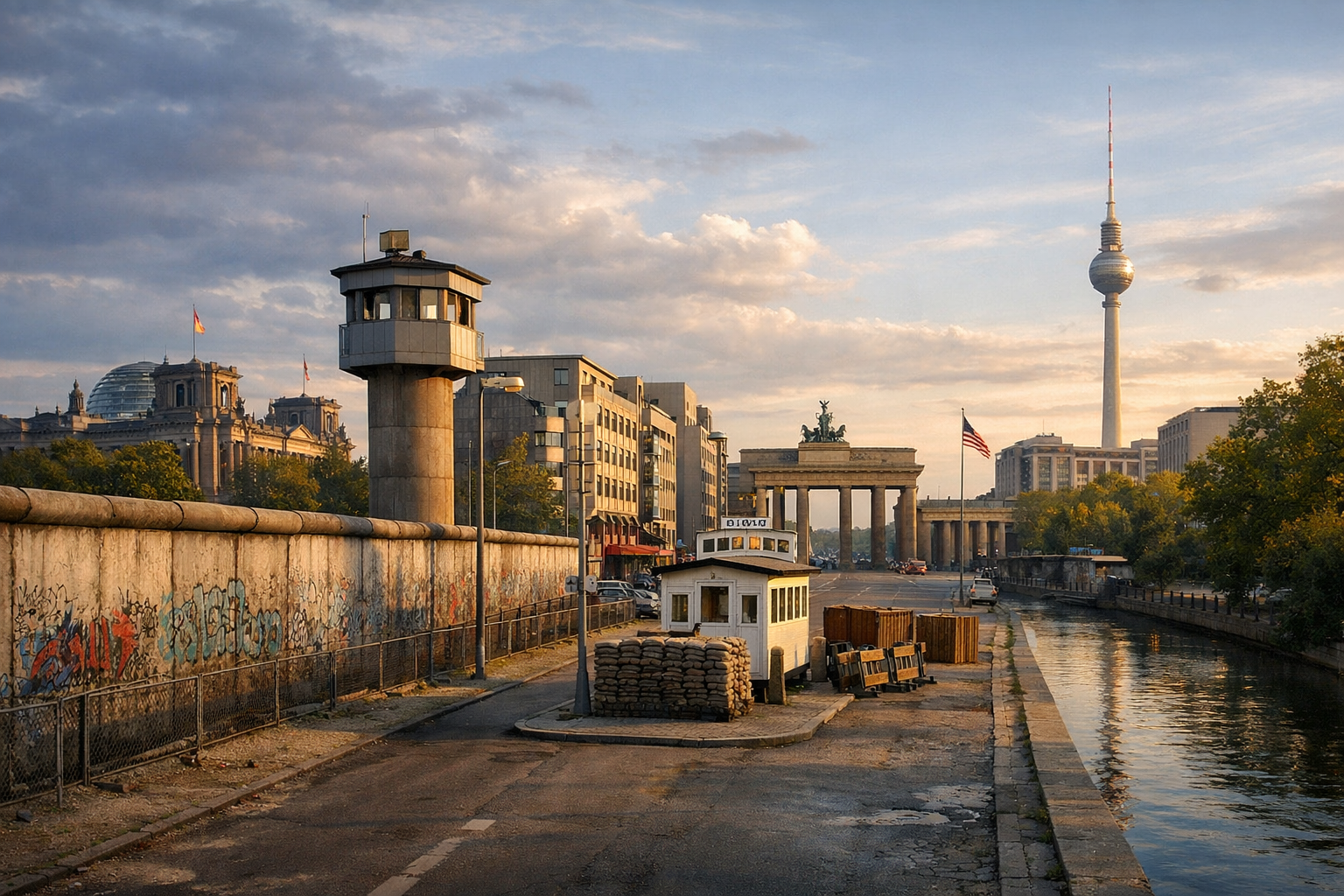
Day 1 — Berlin: Checkpoint Charlie, Friedrichstraße and the Berlin Wall Museum
🚶 Start your route in the Checkpoint Charlie area — one of the most recognizable symbols of the Cold War not only in Germany, but across Europe. It was here, on Friedrichstraße, that the most famous border crossing between East and West Berlin stood, where foreigners, diplomats, and representatives of the Allied forces were allowed to cross. Today, this place looks like a busy urban hub in the center of modern Berlin, but it is worth pausing for at least a few minutes to feel the dramatic contrast: where tourists, cafés, and city traffic move today, one of the most tense lines of ideological confrontation of the 20th century once ran. Here it is easy to imagine the atmosphere of constant control, fear of escape, espionage, and political tension that shaped life in the divided city for decades.
🚶 Then devote most of your time to Mauermuseum — Museum Haus am Checkpoint Charlie, located at Friedrichstraße 43-45, 10969 Berlin. This is one of the key stops on the route for understanding the human side of the history of the Berlin Wall. The exhibition is especially powerful because it does not speak about politics in abstract terms, but through the fates of specific people, their attempts to break free, and the ingenuity with which escapes were organized. Here you can see stories of tunnels, improvised hiding places in cars, hot-air balloons, modified vehicles, and other real ways of crossing the border. The museum leaves a strong emotional impression precisely because behind each display case you feel not museum formality, but the pulse of living history — personal risk, despair, hope, and the will to be free. Plan at least 2–2.5 hours for your visit, and if you like to read materials carefully, the full 3 hours.
☕ After the museum, it makes sense to take a break right in the Friedrichstraße / Zimmerstraße area. Allow 30–45 minutes for a quick coffee, snack, and rest: the route is emotionally intense, and here it helps not to rush, but to give yourself time to “process” what you have seen. In central Berlin, everything is very compact, so even a short stop does not disrupt the rhythm of the day.
🚶 After your break, walk to Topography of Terror, Niederkirchnerstraße 8, 10963 Berlin. The walk from the Checkpoint Charlie area takes about 15–20 minutes at an easy pace. This is no longer only the history of the wall, but a deeper historical layer: the place where, during the Nazi era, the central institutions of terror were located — the Gestapo, the SS, and the Reich Main Security Office. This pairing within one day is especially powerful: first you see how Europe was physically divided in the postwar decades, and then you find yourself in a space that reveals the roots of state violence and the mechanisms of total control. The open-air part of the complex, with its preserved wall fragment and documentary panels, creates a very powerful effect: in one place, two layers of German and European memory come together — the Nazi dictatorship and the country’s later division.
🚶 In the evening, end the day with a walk around Gendarmenmarkt and Unter den Linden. From Topography of Terror, it is easy to get here by U-Bahn or partly on foot, allowing about 20–30 minutes including transfers. This is a good way to finish the day: after heavy historical themes, you find yourself in an elegant part of Berlin with classical facades, soft evening light, and the feeling of a city that managed to survive the dramatic 20th century and piece itself back together again. If you still have energy, enjoy a relaxed dinner in the Stadtmitte area — convenient both logistically and atmospherically.