Buy PDF guide

Buy PDF guide — 6.43 USD

PDF — 6.43 USD

BERLIN - Alternative Berlin street art Kreuzberg Friedrichshain

BERLIN - Alternative Berlin street art Kreuzberg Friedrichshain

Berlin pulses with creative energy, and nowhere is that more alive than in Kreuzberg and Friedrichshain. Wander past bold murals, hidden courtyards, and rebellious street art that turn these neighborhoods into the city’s most colorful open-air gallery.

🧭 DAY-BY-DAY ROUTE

Ready-made country and city routes with daily plans, sights, transport and accommodation. Buy PDF guides for independent travel.

🧭 DAY-BY-DAY ROUTE


Day 1 — Kreuzberg: Oranienstraße, Bethanien, Görlitzer Park

  • 🚶 Kreuzberg is the Berlin where freedom of expression, the mixing of cultures, and urban energy born not from grand architecture but from the street itself are felt especially vividly. Historically, the district lay right by the border of the divided city and for a long time remained a space for squats, independent bars, migrant communities, political initiatives, and artistic experiments. This is exactly where alternative Berlin feels not like a museum set, but like a living environment: courtyards are covered with posters and tags, large murals appear on facades, and between Turkish bakeries, vinyl shops, workshops, and small galleries there remains a rare sense of urban authenticity. It is convenient to start the day on Oranienstraße — the nervous artery of Kreuzberg, where shop windows, graffiti, old signs, and the street crowd create an almost cinematic scenography. From here, it is pleasant to move slowly toward Mariannenplatz and the Künstlerhaus Bethanien complex, one of the district’s important cultural addresses, where contemporary art exists in dialogue with the harsh, slightly rough atmosphere of old Kreuzberg.

  • 🚶 Bethanien and the surrounding area around Mariannenplatz are wonderful because the alternative history of Berlin can literally be read here in the layers of the urban fabric. The former historic building, now associated with artistic initiatives and exhibition spaces, stands next to a square where the typical Kreuzberg mix of freedom, local life, and cultural memory can be felt. After that, it makes sense to walk to Görlitzer Park and the area around Görlitzer Bahnhof — this is another cross-section of the district: noisier, more relaxed, and more street-oriented. Here it is especially clear how Kreuzberg lives not by classic tourist rules, but by its own: someone is having a picnic on the grass, someone is going for a daytime coffee, someone is photographing yet another mural or a second-hand shop window. During the day, it is worth planning breaks for rest and coffee of at least 20–30 minutes each: the district does not demand rushing; on the contrary, it is best experienced through observation, short stops in courtyards, and slow walks between points.

  • 🚇 Day logistics: if you are staying near Warschauer Straße or East Side Gallery, Kreuzberg is easy to reach by U1/U3 to Görlitzer Bahnhof or Kottbusser Tor. The ride from Warschauer Straße to Görlitzer Bahnhof takes about 4 minutes, to Kottbusser Tor about 5 minutes; after that, allow 10–20 minutes on foot between the main points of the route in Kreuzberg. For the whole day, it is reasonable to plan 7–8 hours including walks, photo stops, lunch, and rest.


Day 2 — Friedrichshain: East Side Gallery, Oberbaumbrücke, RAW-Gelände, Urban Spree

  • 🚶 The second day is dedicated to Friedrichshain — a district where post-industrial Berlin, club culture, and street art come together into one of Europe’s most recognizable urban landscapes. It is best to start with East Side Gallery — the most famous and emotionally charged section of the Berlin Wall, transformed into an open-air gallery after the fall of the border. It is not just a long line of murals along Mühlenstraße, but a place where political memory and visual culture are literally layered on top of each other. As you walk along the concrete slabs painted by artists from all over the world, you feel a strange combination of freedom, tragic history, and tourist crowds: here it is important not only to photograph the famous images, but also to remember that before you is one of the strongest material traces of divided Berlin.

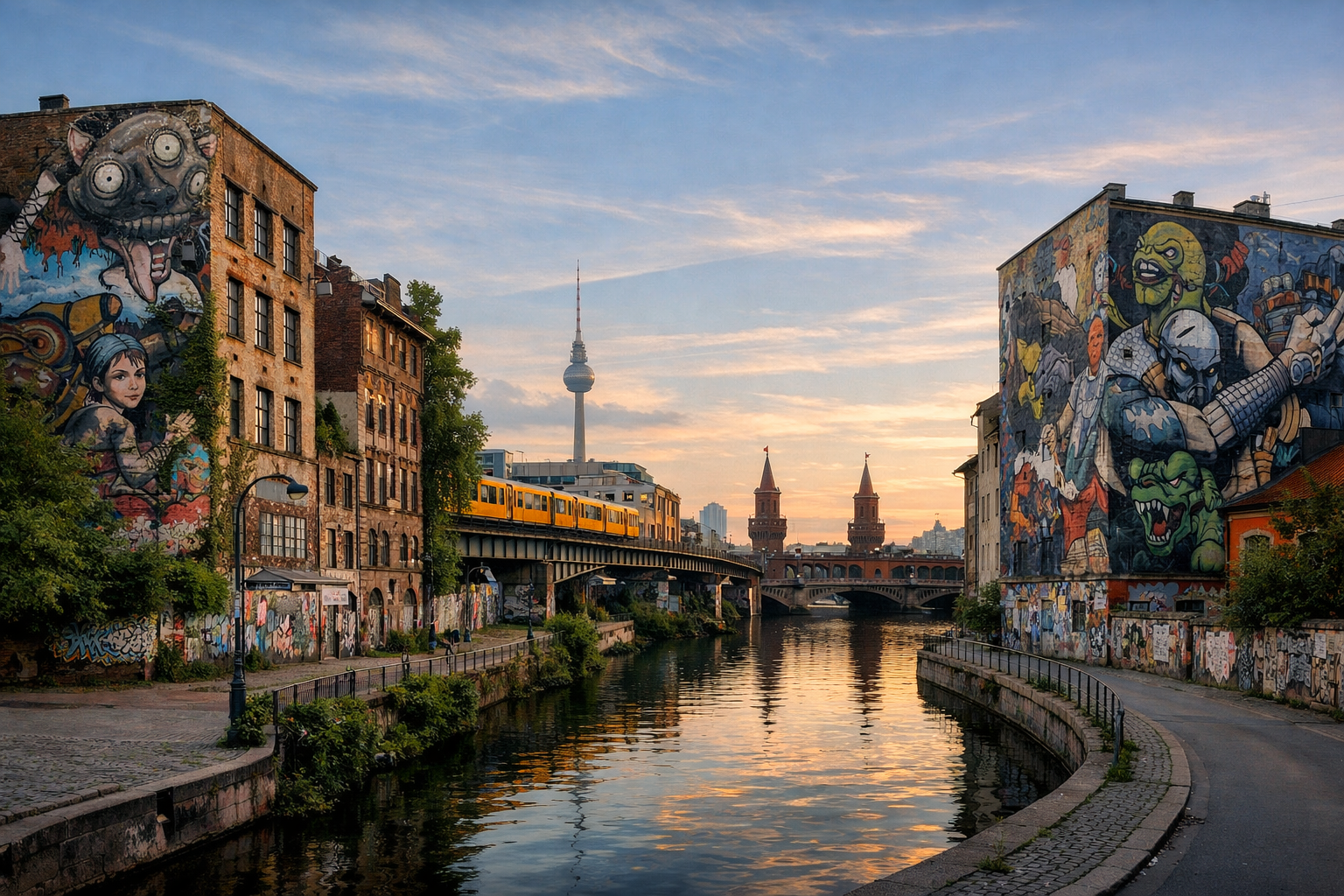
  • 🚶 From East Side Gallery it is natural to continue to Oberbaumbrücke — one of the city’s most beautiful and cinematic bridges, which once connected East and West Berlin and today connects Kreuzberg and Friedrichshain. The red-brick towers, the U1/U3 metro line overhead, the River Spree, and the constant movement of cyclists, trains, and pedestrians create that very Berlin scene you want to look at for a long time. From here, the route continues toward Warschauer Straße and RAW-Gelände — a former railway industrial site that has turned into a huge cluster of alternative culture. Here Berlin’s love for spaces that have not been polished into sterility is felt especially strongly: graffiti on every layer of the surface, inner courtyards, concert venues, bars, skate zones, temporary installations, and the feeling that the whole district keeps endlessly reinventing itself.

  • 🚶 A special pleasure is visiting Urban Spree and the neighboring areas around RAW-Gelände. This part of the route is good not because of a mandatory checklist of stops, but because of the very way of moving through it: walk without hurry, look at the walls, pass through archways, peek into courtyards, and leave time for spontaneous discoveries. Here street art is not isolated in a museum, but lives in direct contact with the city — with the railway, bars, markets, concerts, and evening light. Between East Side Gallery, Oberbaumbrücke, Urban Spree, and RAW-Gelände, the walking distances are short: 5–15 minutes on foot between the key points, so the day feels full but without exhausting transfers. It is best to allow at least 1–1.5 hours in total for lunch and rest, especially if you plan to stay by the Spree at sunset.

  • 🚇 Day logistics: if your base is in the East Side Gallery or Warschauer Straße area, almost the entire route can be done on foot. From hotels near East Side Gallery to the start of the walk along Mühlenstraße it is 5–10 minutes, from East Side Gallery to Oberbaumbrücke about 10 minutes on foot, and from the bridge to RAW-Gelände another 8–12 minutes. This is an ideal day without unnecessary transfers, with a total duration of about 6–7 hours at a relaxed pace.

Day 3 — Schöneberg/Kreuzberg: URBAN NATION, Berlinische Galerie, Jewish Museum, Park am Gleisdreieck

  • 🏛️ The third day is designed as a more “collected” view of Berlin’s urban art: after two days on the street, you move to spaces where alternative and visual culture are already interpreted in a museum and semi-museum context. It is best to start with URBAN NATION Museum for Urban Contemporary Art on Bülowstraße — a place that shows especially well how street art and urban art have long moved beyond spontaneous street practice and become an important part of the international artistic conversation. At the same time, the museum does not separate art from the street: the area around it is also rich in murals, and the visit can easily be complemented by a short walk through the neighboring blocks. Inside, what is usually especially interesting is how graffiti, poster art, muralism, installations, and works by artists for whom a building facade and an exhibition hall are parts of one visual biography coexist here.

  • 🏛️ Then it makes sense to move on to Berlinische Galerie and the Jewish Museum Berlin in the Lindenstraße/Alte Jakobstraße area. This is no longer “alternative Berlin” in the narrow sense of clubs and walls, but a deeper cultural layer of the city, where the conversation is about modernism, urban memory, architecture, photography, identity, and history. Berlinische Galerie complements the route particularly well because it allows you to see Berlin as an artistic object in itself: a city that has constantly reinvented the language of modernity. The Jewish Museum, in turn, adds emotional and historical depth to the route — not in the genre of a light stroll, but as an important stop for understanding Berlin’s memory and why this city today looks exactly the way it does: layered, uneasy, open, contradictory, and incredibly alive.

  • 🌿 It is best to end the journey in Park am Gleisdreieck — one of the most pleasant urban parks in central Berlin, created on former railway land. It is a very Berlin kind of space: wide paths, lawns, sports areas, open sky, a young crowd, and the feeling that the industrial past was not erased, but carefully turned into a comfortable urban environment. After three days of an intense route, the park provides the perfect finale: you can simply stroll without a goal, sit down with a coffee, relax on the grass, or catch the sunset. This final note nicely balances the richness of the museums and the urban energy of the previous days.

  • 🚇 Day logistics: from Warschauer Straße to Nollendorfplatz, it is easiest to go with a transfer on U1/U3 toward the west; from there to URBAN NATION it is a few minutes on foot. After the museum, getting to Berlinische Galerie and Lindenstraße is best done by U1/U3 + a short walk or by taxi/ride-hailing if you want to save energy. The distance between Berlinische Galerie and the Jewish Museum is small, about a 10–15 minute walk. From the museums to Park am Gleisdreieck, you can walk in about 20–25 minutes or shorten the way by public transport. For this day, allow 8–9 hours including a proper museum break and rest in the park.

Flight tickets

eSIM for travel

Buy PDF guide

Buy PDF guide — 6.43 USD

PDF — 6.43 USD