
Buy PDF guide

Buy PDF guide — 8.57 USD

PDF — 8.57 USD

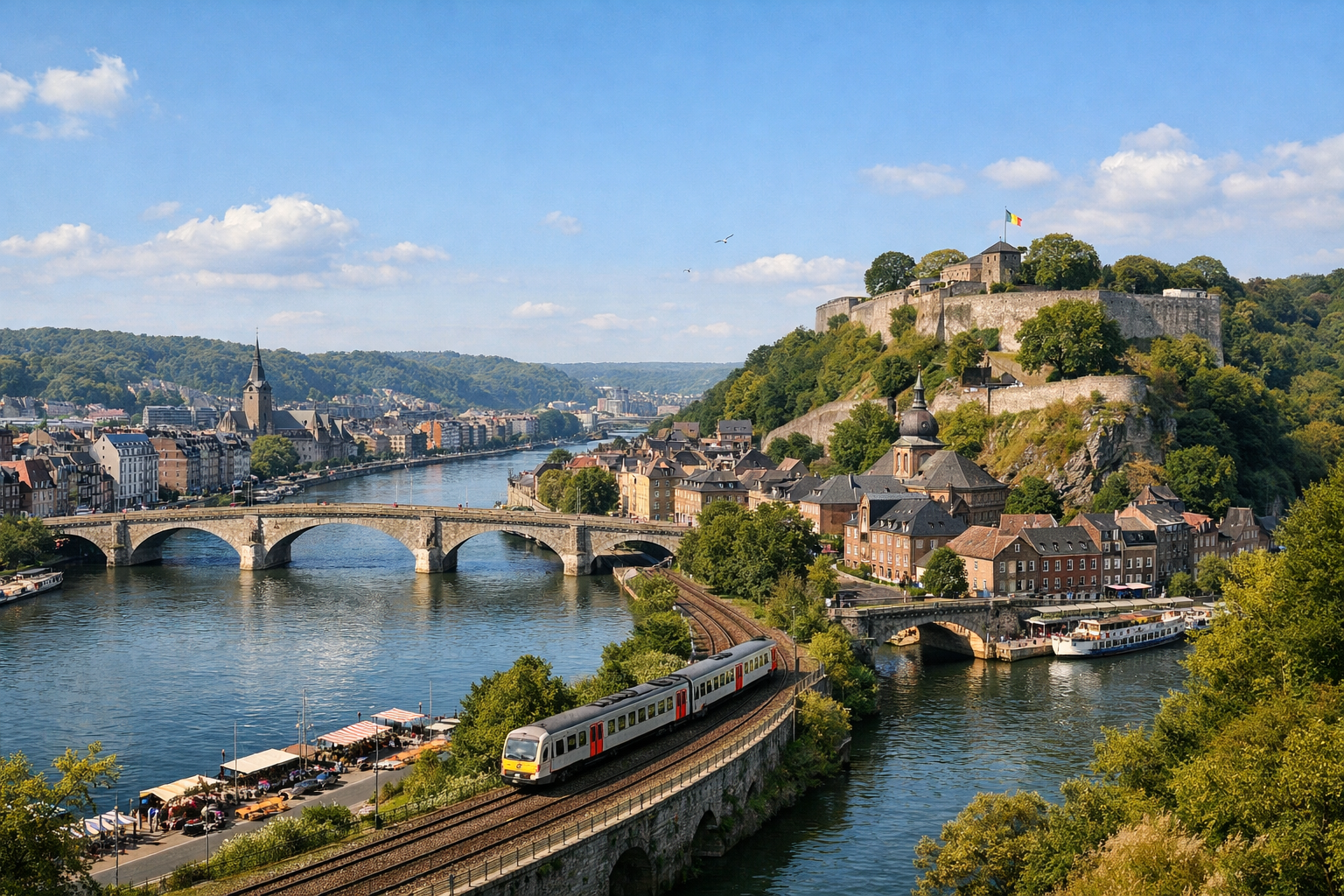
Belgium, Liège and Namur. A budget trip through French-speaking Wallonia with citadels, the Meuse embankments, markets, and trips on regional trains.

Belgium, Liège and Namur. A budget trip through French-speaking Wallonia with citadels, the Meuse embankments, markets, and trips on regional trains.

Discover French-speaking Wallonia on a budget with four easy days between lively Liège and graceful Namur. Wander beneath hilltop citadels, stroll the Meuse embankments, browse local markets, and let regional trains carry you through one of Belgium’s most characterful corners.

🧭 ROUTE BY DAY

Ready-made country and city routes with daily plans, sights, transport and accommodation. Buy PDF guides for independent travel.

🧭 ROUTE BY DAY


Day 1 — Liège: historic center, markets, and the Montagne de Bueren staircase

  • 🚆 It is best to plan your arrival in Liège via Liège-Guillemins station — the city’s main rail gateway and a convenient starting point for a budget route. You can get to the center by TEC public transport or, if you want to save money and stretch your legs after the trip, take a short local train to Liège-Saint-Lambert or walk part of the way through the embankments and old neighborhoods. It makes sense to keep this day at an easy pace without overload: check-in, a light lunch, and a long walk through the compact historic core.

  • 🚶 Liège is one of the most distinctive cities in French-speaking Belgium: not polished to a museum shine, but lively, dense, a little rough around the edges, and all the more interesting for it. In the center you can feel the old episcopal capital, a trading city on the river, and a modern student rhythm. Start at Place Saint-Lambert and the Palace of the Prince-Bishops — a huge complex that sets the tone for the entire historic center. It is especially clear here how Liège lived for centuries at the intersection of power, trade, and river routes. Nearby, it is easy to continue to Place du Marché and the Perron — the symbol of the city’s freedoms — and then dive deeper into the Hors-Château quarter with its narrow streets, old facades, unexpected courtyards, and old-town atmosphere without unnecessary staging.

  • 🛍️ If your day falls on a Sunday, be sure to include La Batte in your route — the famous market along the Meuse, considered the largest Sunday market in Belgium. It is an ideal place for a budget trip: you can grab an inexpensive bite here, buy fruit, cheese, bread, Asian street food, waffles, or simple takeaway dishes, while also feeling the real local rhythm rather than just a tourist showcase. Even if you do not arrive on a Sunday, the embankments of Quai de la Goffe and the neighboring streets are still worth a long walk: the water, bridges, facades, and constant movement create that very “Meuse-side” Wallonia people come here for.

  • 👣 The highlight of the day is the climb up Montagne de Bueren. These steep city steps are not just a photo spot, but one of Wallonia’s brightest urban symbols. It is best to go up closer to evening, when the light is softer and the city opens in layers: rooftops, bell towers, bends of the river, and neighborhoods on the slopes. This is a free activity that can give you a stronger feel for the city than many paid museums. After the climb, do not rush back: the upper part of the route and the surrounding streets of the citadel hill provide a quiet contrast to the noisy center.

  • 🍽️ A budget food plan for the day: breakfast is usually already included if you are staying in a hostel; during the day — the market, a bakery, sandwich bar, or frituur; in the evening — a simple brasserie, takeaway pizza, or a supermarket dinner. A realistic food budget in an economical style: about €18–35 per day per person.


Day 2 — Liège: the Meuse, Boverie Park, and a museum day without extra spending

  • 🚶 It makes sense to dedicate your second day in Liège to a combination of free urban spaces and one strong museum of your choice. Start the morning at Liège-Guillemins station, even if you were already there the day before: it is one of the most striking modern stations in Europe, and for a budget trip it is nice that this impressive architecture costs nothing. Then walk toward Parc de la Boverie and the Meuse embankments. This area gives a brighter and more spacious image of Liège: water, greenery, bridges, runners, bicycles, and long walking perspectives.

  • 🌿 The park and museum La Boverie are especially good for a slow-paced day. The park itself is free and suitable for a picnic, while the museum is housed in a beautiful building from the exhibition era, surrounded by water and greenery. If your budget is very tight, you can limit yourself to an outside walk and save the museum for the first Sunday of the month, when permanent collections at some Belgian museums are often free. If you still want to go inside, La Boverie is a good choice because of the moderate price of the permanent exhibition and the pleasant, undemanding layout of the visit.

  • 🏛️ An alternative or addition is Grand Curtius, one of Liège’s key museums, where the city’s history, decorative arts, archaeology, and arms collections are brought together under one roof. This is especially valuable for a short route: instead of several museums, you get one rich complex. The building itself and its inner courtyards are already worth the visit. If you choose only one paid museum for the entire Liège part of the trip, Grand Curtius often offers the best balance of price and substance.

  • 🚶 After the museum, return to the river and take a long, unhurried walk along the Meuse. In Liège it is important not only to “tick off sights,” but also to give yourself time for the city’s rhythm: terraces, bridges, river wind, tram-bus traffic, conversations in French, local shops, and the dense urban fabric. This city reveals itself not in a single postcard, but in a whole set of sensations. In the evening, it is sensible to go to bed a bit earlier: the next day is the move to Namur, and although the trip is short, a budget route benefits from an early start.

  • 💶 Typical costs for the day: transport within Liège if needed — a single ticket or a 1-day TEC pass; museum — about €5–9 for permanent collections depending on the venue chosen and ticket category; food — another €18–35. If you want, this day can easily be made almost completely free by focusing on the station, the park, the embankments, and the old streets.

Day 3 — Namur: citadel, cable car, and the old town between the Sambre and the Meuse

  • 🚆 The trip Liège-Guillemins → Namur on an SNCB regional train takes about 40–50 minutes, depending on the specific service and number of stops. It is one of the most convenient and logical journeys in all of Wallonia: no complicated transfers, along an important axis by the Meuse. For a budget trip, it is best to leave in the morning, leave your things at your new accommodation or in luggage storage, and head straight into town. Namur is noticeably more compact and calmer than Liège, so one full day here works very well.

  • 🏰 Namur’s main star is the citadel, one of the most impressive urban fortresses in Belgium. It does not overwhelm with monumentality, but unfolds gradually: fortifications, panoramic points, trees, old stone walls, spacious terraces, and long views over the meeting of the Sambre and the Meuse. The budget scenario here is very successful: the climb on foot and a walk around the upper areas can be practically free, and you do not need to overspend on paid elements such as separate exhibitions or special visits if your goal is simply an atmospheric city day.

  • 🚡 If you want to add a striking but not too expensive element, ride up or down on the Téléphérique de Namur. The cable car connects the lower town and the top of the citadel, and the short aerial trip gives beautiful views over roofs, water, and fortress slopes. However, for strict savings you can choose only a one-way ride and walk the other direction. This kind of compromise preserves the budget while still adding a vivid moment to the route.

  • 🚶 After the citadel, dedicate the second half of the day to old Namur. It is a very pleasant city for a slow walk: small squares, street cafés, a calm human scale, old facades, and the feeling of a provincial capital that is not trying too hard to impress. Walk to Saint-Aubain Cathedral, to the quarters around Rue de Fer and Rue de l’Ange, and then head back down to the water. It is here that you understand especially clearly why Namur is often seen as one of the coziest cities in Wallonia.

  • 🍽️ For an economical day in Namur, bakeries, sandwich bars, frituurs, and supermarkets near the center work best. If you stay in a hostel, it is convenient to use the shared kitchen in the evening. Expected costs: the train Liège → Namur at the regular fare or an automatically selected advantageous SNCB offer, the cable car — optional, food — about €18–35.

Day 4 — Namur: the Rops Museum, embankments, and return to Liège

  • 🏛️ It is best to make the last day lighter and more intimate. Dedicate the morning to the Musée Félicien Rops — one of Namur’s most interesting museums. Located in the old town, it offers not a huge but a concentrated cultural experience: prints, symbolism, decadence, subtle irony, provocation, and an important layer of 19th-century Belgian art. It is a good final accent for an itinerary built not on racing through top lists, but on combining urban atmosphere with meaningful yet affordable visits.

  • 🚶 After the museum, leave time for one final walk along the water. In Namur it is especially pleasant to stroll where the city opens toward the Meuse and the Sambre: without rushing, without mandatory checklists, with a pause for coffee, pastry, or simply a river view. If the previous day you climbed to the citadel at a brisk pace, today you can calmly pick up what was left below: the belfry, small streets of the old center, bridges, bookshop windows, and food displays.

  • 🚆 In the second half of the day — return to Liège along the same rail corridor Namur → Liège-Guillemins. On a short itinerary this is more sensible than trying to squeeze in another city such as Dinant: you do not lose time on extra transfers, you do not increase accommodation and ticket costs, and you keep the trip comfortable. If your journey home is planned from Liège, this ending is especially convenient.

  • 💡 In summary, the concept of the tour: this is specifically a budget trip through French-speaking Wallonia, focused mainly on rivers, citadels, markets, historic quarters, and real regional trains rather than expensive excursions. In an economical style, the estimate for overall everyday costs excluding international arrival in Belgium may be about €55–95 per day per person with accommodation in a hostel/simple budget hotel, public transport, and 0–1 paid attraction per day.

  • ⚠️ Information about safety, weather, road conditions, and route accessibility can change. Before the trip, check official warnings, the weather forecast, transport schedules, and possible restrictions on trails and urban passages. No destination can be considered completely safe.

Flight tickets

eSIM for travel

Buy PDF guide

Buy PDF guide — 8.57 USD

PDF — 8.57 USD