
Buy PDF guide

Buy PDF guide — 6.43 USD

PDF — 6.43 USD

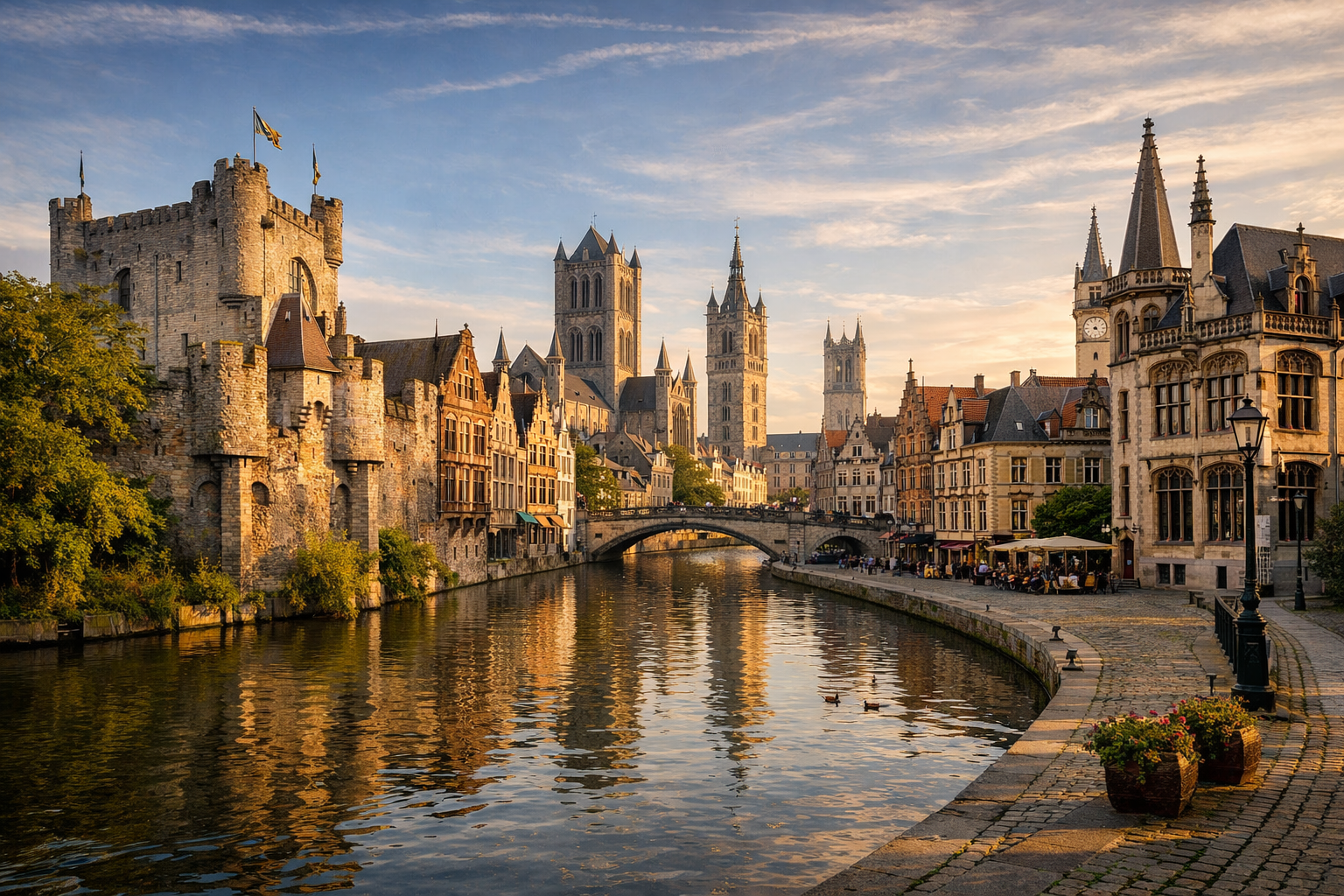
Belgium, Ghent. A relatively inexpensive alternative to Bruges with canals, a castle, historic quarters, and a vibrant student atmosphere.

Belgium, Ghent. A relatively inexpensive alternative to Bruges with canals, a castle, historic quarters, and a vibrant student atmosphere.

Ghent packs canals, a striking medieval castle, and beautifully preserved historic streets into a city that feels lively rather than overrun. Often seen as a more affordable alternative to Bruges, it pairs old-world charm with a youthful student energy that makes a few days here especially fun.

🧭 DAY-BY-DAY ROUTE

Ready-made country and city routes with daily plans, sights, transport and accommodation. Buy PDF guides for independent travel.

🧭 DAY-BY-DAY ROUTE


Day 1 — Ghent: historic center, canals, and a medieval skyline

  • 🚆 Arrival in Ghent is most convenient via Gent-Sint-Pieters station. If you are coming from Brussels Airport, the most budget-friendly and practical option is usually an NMBS/SNCB train to Gent-Sint-Pieters, normally about 1–1.5 hours depending on the connection and specific service. From the station, the easiest way to reach the center is by tram 1 or 3 toward Kouter/the center, and if you have little luggage and are staying close to the old core, you can combine the tram with a short walk. For the first day, it is enough to buy either a De Lijn single ticket if you plan 1–2 rides, or a day pass if you expect to use the tram actively.

  • 🚶 Start getting to know Ghent with the Graslei and Korenlei area — one of the most beautiful urban waterfronts in Belgium, and exactly the place where it becomes especially clear why Ghent is often called a calmer and better-value alternative to Bruges. There is no museum-like sterility here: historic facades of former guild houses reflect in the water, boats move along the canal, students sit on the steps, and medieval towers rise almost directly above your head. In the morning and near sunset, this part of the city is especially photogenic, and the walk here is completely free. It is best not to rush: stroll along the water, cross Saint Michael’s Bridge, and catch the famous view of the three towers — Saint Nicholas’ Church, the Belfry, and Saint Bavo’s Cathedral.

  • 🚶 Then it makes sense to move on to the Patershol and Oude Vismarkt quarters. Patershol is one of the most atmospheric old districts in Ghent: narrow streets, brick houses, unexpectedly quiet alleys, and the feeling of a city that truly lives, rather than only performing for tourists. During the day, it is pleasant to simply wander here without a goal, peeking into arches and small squares. This is a great budget part of the route: you get maximum impressions without entrance fees, and the density of beautiful views is so high that even a short walk feels like a full trip.

  • 🏰 After lunch, devote 1.5–2 hours to Gravensteen Castle, address: Sint-Veerleplein 11, 9000 Gent. This is one of the main reasons to go specifically to Ghent: a real stone medieval castle in the city center, with towers, arrow slits, and a stern, almost cinematic look. Unlike many “palace” sights in Europe, the defensive nature of the place reads clearly here: rough masonry, the inner courtyard, staircases, fortress walls, and views over the old town create a strong sense of immersion in the past. For a budget trip, this is one of the few paid stops truly worth keeping in the itinerary, because the visual payoff is very high.

  • 🚶 In the evening, return to the canals and take a free walk through the evening center: Sint-Michielsbrug → Graslei → Korenmarkt → Vrijdagmarkt. Evening Ghent is especially good because it does not require expensive entertainment: illuminated towers, reflections in the water, the hum of terraces, and very noticeable student energy create a rich atmosphere even without museums and bars. If you want an inexpensive dinner, choose simple cafés, fry shops, soup bars, bakeries, or Asian takeaway spots in the central part of the city; a budget dinner benchmark is roughly 8–18 € per person, while a quick snack can be put together for 4–8 €.


Day 2 — Ghent: cathedral, tower, student spirit, and city history

  • ⛪ Start the morning at Saint Bavo’s Cathedral, address: Sint-Baafsplein, 9000 Gent. Even without choosing the expanded paid options, the cathedral itself is one of the strongest stops on the route. This place combines religious history, urban memory, and great Flemish art. The interior impresses not only with its scale, but also with the depth of its details: stone, light, chapels, and the sense of layered history make it one of the country’s most important churches. If the budget allows, you can separately consider visiting the area with the Ghent Altarpiece — this is no longer just a religious object, but a work for which people come to the city from all over the world. But even with strict savings, the cathedral remains an essential stop.

  • 🚶 After the cathedral, head to the Ghent Belfry, in the Sint-Baafsplein / Botermarkt area. The bell tower is one of the city’s symbols and part of that famous medieval skyline that makes Ghent so recognizable. Going up the tower is a paid but comparatively inexpensive option; if you choose only one paid attraction on the second day, the tower offers the best balance of price and impressions. From the top, it is especially easy to see how Ghent is laid out: winding streets, a dense historic center, water, towers, and districts stretching toward the university areas. If you want to save more, you can limit yourself to viewing it from outside and walking around the square — the setting itself is already very expressive.

  • 🎓 During the day, shift toward the university atmosphere: the Kouter, Veldstraat, Sint-Pietersnieuwstraat area, and the surroundings of Vooruit. This is where Ghent reveals itself especially clearly not as scenery for tourists, but as a young, intellectual, and lively city. There are many students, bookstores, inexpensive cafés, cycling culture, and a very natural urban rhythm. This is one of the important differences from Bruges: instead of the feeling that “the city is open for viewing,” you get a sense of real everyday city life. For lunch in this part of town, it is easy to find budget formats — soup, a sandwich, a pasta box, falafel, or an Asian lunch for roughly 6–15 €.

  • 🏛️ In the second half of the day, head to STAM — Ghent City Museum, address: Godshuizenlaan 2, 9000 Gent. This is a very successful museum specifically for a short trip: it helps you quickly assemble Ghent into a coherent picture — from a medieval trading hub to a modern student city. The exhibition is usually easy to take in even for those who do not like “heavy” historical museums, because there is a lot of visual context, urban stories, and clear logic here. For a budget itinerary, STAM is also convenient because it helps compensate for not having many paid entries: one well-thought-out museum gives you a deep understanding of the place.

  • 🌳 If you still have energy, end the day with a calm walk through Citadelpark. This is not the medieval center, but another, greener and more relaxed layer of the city. The park is good for a pause after the museum, a short rest on a bench, and a gentle end to the day without extra expenses. It is convenient to return to the center by De Lijn tram or bus, and if the weather is good — on foot through more modern neighborhoods, to see Ghent not only as a postcard, but also as a normal European city to live in.

Day 3 — Ghent: markets, fine arts museum, and a slow finale by the water

  • 🛍️ Start the last day with a calmer urban rhythm: Vrijdagmarkt and the surrounding streets. This square is important not only historically, but also emotionally — it is here that you can see especially well how Ghent knows how to combine antiquity and everyday life. In the morning, it is pleasant to drink an inexpensive coffee here, get pastries from a bakery, and simply watch the city. If your trip format is very budget-oriented, focus on exactly these simple pleasures: the market, street facades, canals, bridges, and slow walking through neighborhoods often give more of a travel feeling than rushing between ticketed attractions.

  • 🏛️ Next, you can choose the Museum of Fine Arts Ghent (MSK), address: Fernand Scribedreef 1, 9000 Gent, if you are interested in painting and want one more cultural stop without overloading the route. MSK is Belgium’s oldest art museum, and its collection lets you see how deeply Flanders is woven into the history of European art. This is not a mandatory stop for an ultra-budget scenario, but it is a good choice if you prefer one quality museum instead of extra spending on less significant entertainment. An alternative with a tight budget is simply to stay in the park and historic center without buying a second museum ticket.

  • 🚶 After the museum or a walk in the park, return to the center for a final route along the canals: Reep → Korenlei → Graslei → Sint-Veerleplein. This is the ideal time for one last “slow Ghent”: to see the water, bridges, towers, and old facades again, but now without the rush of the first day. The city unfolds gradually: first it impresses visually, and then you begin to like it for its lived-in texture — bicycles by facades, university youth, barges on the water, quiet inner courtyards, and the way past and present connect so naturally here.

  • 🍟 For a final inexpensive lunch or early dinner, again rely on budget formats: fries, soup, sandwiches, daily specials in simple cafés, Asian take-away, or a supermarket + picnic by the water. A realistic daily food budget with a frugal approach is about 20–40 € per person if you combine bakeries, inexpensive cafés, and 1 more substantial meal. Before departure, be sure to leave enough time for the trip to Gent-Sint-Pieters: from the center by tram it is usually about 15–25 minutes including waiting time, while on foot it is noticeably longer.

  • ⚠️ Practical note: information about safety, weather, opening hours, track works, strikes, and temporary restrictions may change. Before the trip, be sure to check the official weather forecast, NMBS/SNCB train schedules, current De Lijn tram and bus routes, museum opening hours, and city alerts. No destination can be considered completely safe: keep an eye on your belongings in station areas and crowded tourist zones, especially in the evening and on days of major events.

Flight tickets

eSIM for travel

Buy PDF guide

Buy PDF guide — 6.43 USD

PDF — 6.43 USD