
Buy PDF guide

Buy PDF guide — 8.57 USD

PDF — 8.57 USD

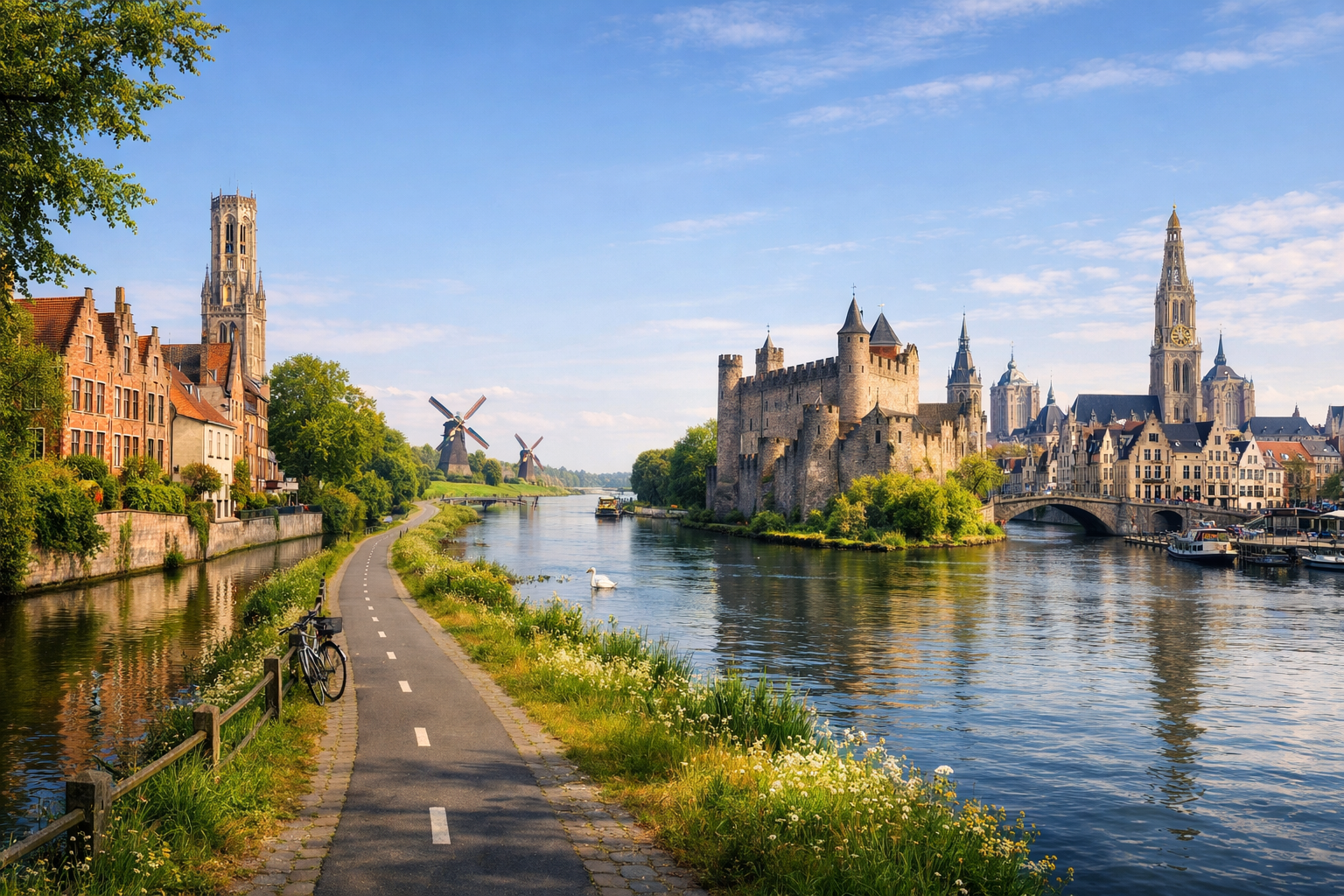
Belgium, Flanders. Cycling tour from Bruges through Ghent to Antwerp along canals, the banks of the Scheldt, and historic towns. Difficulty: easy. Season: April - October.

Belgium, Flanders. Cycling tour from Bruges through Ghent to Antwerp along canals, the banks of the Scheldt, and historic towns. Difficulty: easy. Season: April - October.

Cycle at an easy pace through the heart of Flanders, from fairy-tale Bruges to vibrant Antwerp via Ghent, Dendermonde and Hingene. Follow quiet canals, the wide banks of the Scheldt and a string of historic towns, with plenty of time to soak up medieval streets, waterside views and classic Belgian charm from April to October.

🚲 ROUTE BY DAY

Ready-made country and city routes with daily plans, sights, transport and accommodation. Buy PDF guides for independent travel.

🚲 ROUTE BY DAY


Day 1 — Bruges → Ghent: canals, polders, and a smooth start to the tour

  • 🚲 Start in Bruges, finish in Ghent. Approximately 48–55 km, pure riding time about 3.5–4.5 hours, elevation gain is symbolic — usually up to 80 m for the day. The surface is mostly flat: separated bike paths, asphalt along canals, quiet rural roads, and in places short sections of firm gravel. This is an easy day for an average tourist because Flanders here is almost flat and services appear regularly. A logical corridor is to leave Bruges via safe urban bike lanes and then keep toward the Gent–Brugge canal and rural roads through the Aalter/Nevele area to the western approach to Ghent. Main stops along the way: 1) suburban canals and green avenues on the way out of Bruges, 2) Aalter or Nevele for coffee, water, and a snack, 3) Ghent’s old docks as a beautiful final urban entrance. It is convenient to refill water and food supplies in Bruges before departure, then in Aalter and closer to Ghent; in Belgium tap water is usually drinkable, and in cities you can often ask for a refill in cafés. It is best to stay overnight in Ghent, closer to the center or to Gent-Dampoort/Gent-Sint-Pieters, so it is convenient with luggage and bike services. Road nuances: in the historic center of Bruges there are many tourists in the morning, so it is better to start early; with a westerly wind, exposed sections along canals ride more slowly; after rain, gravel shoulders may be a bit damp, but the route overall remains comfortable. The day is realistic even for a leisurely cycle tourist: short climbs are almost absent, navigation is simple, and the distance leaves time for stops and a calm visit of Ghent in the evening.


Day 2 — Ghent → Dendermonde: Scheldt embankments and river rhythm

  • 🚲 Start in Ghent, finish in Dendermonde. Approximately 42–50 km, pure riding time 3–4 hours, elevation gain about 50–90 m. Surface: long flat stretches along the Scheldt embankments and dikes, urban bike paths on the way out of Ghent, rural asphalt, and in places short gravel sections on riverside trails. Difficulty is easy. This is one of the most pleasant days of the tour: after leaving Ghent, the route gradually turns into a calm river landscape with meadows, villages, and the constant feeling of water nearby. Main stops: 1) the Oude Dokken area in Ghent as a modern waterfront zone, 2) the section near Melle/Wetteren for a break with river views, 3) the final entrance into Dendermonde with the Grote Markt and belfry. It is convenient to refill water and food in Ghent before the start, then in Wetteren and in small cafés along the Scheldt valley; a proper late lunch is best saved for Dendermonde. Overnight is best in the center of Dendermonde: the town is compact, beautiful, and well suited as an intermediate base. Road nuances: river trails are safe, but on weekends there are many local cyclists and pedestrians — it is better to keep a moderate speed; after heavy rain, puddles may appear on unpaved riverside sections, so for an ordinary tourist it is more convenient to choose parallel paved cycle roads where possible. The day is realistic because the distance is moderate, the elevation change is hardly noticeable, and the route itself naturally divides into short segments between villages and stops.

Day 3 — Dendermonde → Hingene/Bornem: the Scheldt, d’Ursel Castle, and quiet dikes

  • 🚲 Start in Dendermonde, finish in Hingene/Bornem. Approximately 32–40 km, pure riding time 2.5–3.5 hours, elevation gain about 40–70 m. Surface: flat dikes along the Scheldt, local asphalt, quiet rural roads, and short sections of compacted gravel. Difficulty is easy; this is the most relaxed day of the route. In essence, it is a beautiful slow transfer from one historic town into a river landscape between old estates, fields, and poplars. Main stops: 1) a morning loop through the center of Dendermonde and the Grote Markt, 2) the Scheldt embankments with views over the floodplain, 3) Kasteel d’Ursel in Hingene as the elegant highlight of the day. Water and food are easy to get at the start in Dendermonde; along the way, cafés in river villages and shops around Bornem are convenient. For the overnight stay, it is best to choose a base in Bornem or Hingene so you can stroll to the castle and along the village streets in the evening without rushing. Road nuances: wind is felt more strongly on the dikes than the forecast suggests; open sections in summer have almost no shade, so it is important to take at least 1.5 liters of water per person; during high water or seasonal works, some parts of the riverside path are sometimes bypassed via parallel local roads, which does not make the day harder. This day is realistic for an ordinary tourist because the mileage is small, the profile is practically flat, and the transfer leaves energy for cultural stops and a comfortable dinner.

Day 4 — Hingene/Bornem → Antwerp: finish along the Scheldt and a historic entrance into the city

  • 🚲 Start in Hingene/Bornem, finish in Antwerp. Approximately 38–48 km, pure riding time 3–4 hours, elevation gain up to 70 m. Surface: good riverside bike paths, quiet approach roads, and urban asphalt on the way into Antwerp. Difficulty is easy, but psychologically the day feels a bit busier because of the large city at the end. The route logic is to follow the Scheldt calmly for as long as possible, then enter the city via clear bike infrastructure, avoiding fast car corridors. Main stops: 1) the morning stretch along the Scheldt dikes, 2) a suburban pause before Antwerp with coffee and a navigation check, 3) Antwerp’s embankments and, if desired, a crossing through the Sint-Annatunnel for a dramatic urban finish. It is best to refill water and food in Bornem before the start and then once more in the southern suburbs of Antwerp; in the city itself there are already plenty of services. Overnight is best in central Antwerp or near Antwerpen-Centraal/Antwerpen-Berchem if you need a train the next day. Road nuances: closer to Antwerp, traffic density increases, but with the right bike corridors this remains a safe tourist transfer; in the city you should not rely only on car navigation — bike routes matter specifically; to cross the Scheldt you can use the historic Sint-Annatunnel or, if desired, DeWaterbus as an additional urban option, though the main finish can also be done without using water transport. The day is realistic for an ordinary cycle tourist because the distance remains in a comfortable range, the terrain is flat, and all the difficult urban moments are solved by quality cycling infrastructure and arriving in Antwerp early.

Flight tickets

eSIM for travel

Buy PDF guide

Buy PDF guide — 8.57 USD

PDF — 8.57 USD