
Buy PDF guide

Buy PDF guide — 8.57 USD

PDF — 8.57 USD

Bavarian Alps: Garmisch-Partenkirchen and Zugspitze

Bavarian Alps: Garmisch-Partenkirchen and Zugspitze

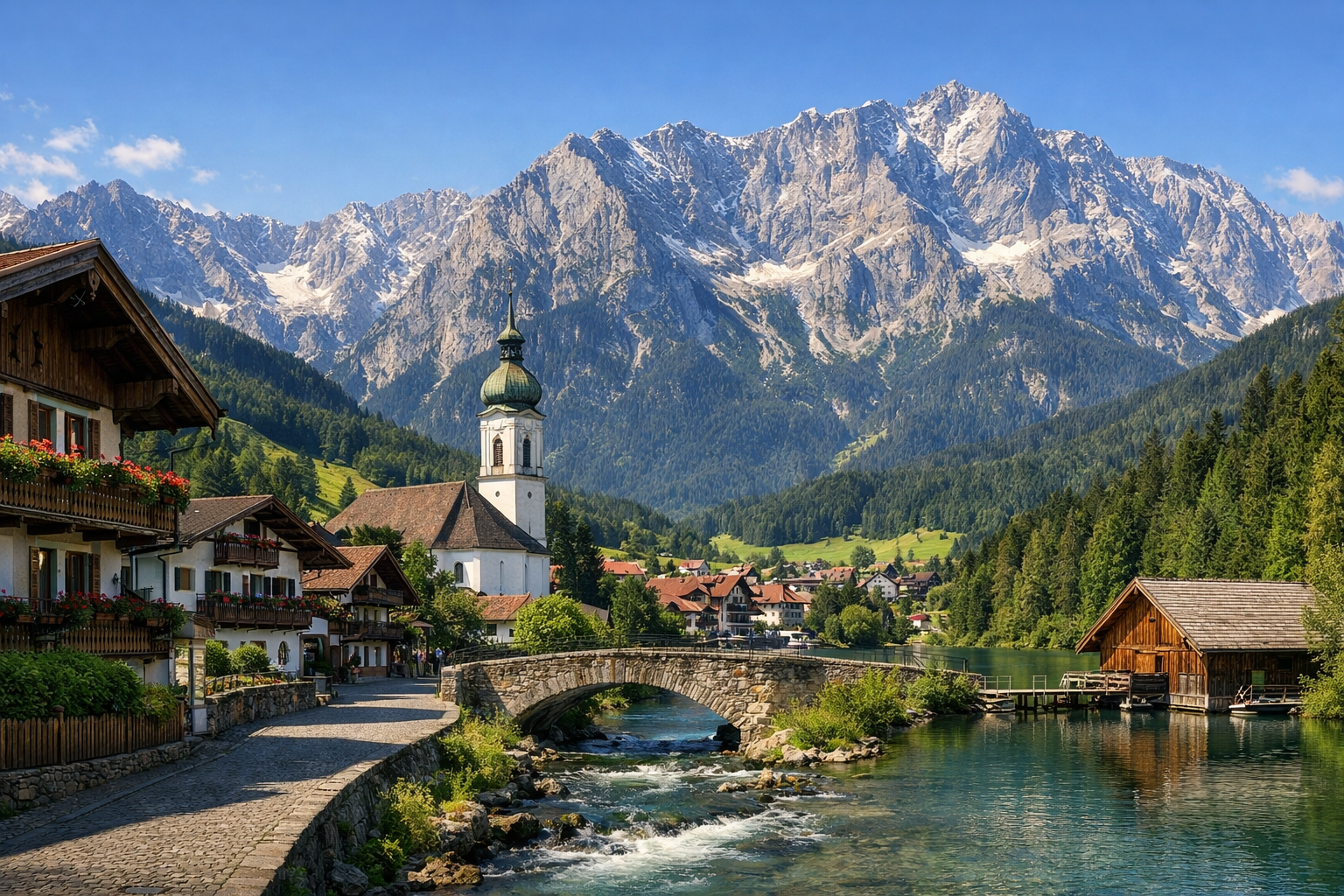
Discover the Bavarian Alps where storybook streets in Garmisch-Partenkirchen give way to crystal-clear lakes, forested valleys, and dramatic mountain views. Follow the route from Munich through Grainau to the summit of Zugspitze for fresh alpine air, unforgettable panoramas, and a taste of classic southern Germany.

🧭 DAY-BY-DAY ITINERARY

Ready-made country and city routes with daily plans, sights, transport and accommodation. Buy PDF guides for independent travel.

🧭 DAY-BY-DAY ITINERARY


Day 1 — Arrival: Munich → Garmisch-Partenkirchen

  • 🚆 Transfer: Munich Airport → Garmisch-Partenkirchen. By public transport, allow about 2 hr 20 min – 2 hr 50 min with connections via Munich; by car or private transfer, it is usually about 1 hr 40 min – 2 hr 10 min depending on traffic. After a flight, it’s best not to plan demanding mountain ascents for this day: the ideal scenario is a calm hotel check-in, a short walk, and an early rest.

  • 🚶 Garmisch-Partenkirchen is one of the most atmospheric Alpine resorts in Germany, where almost every street looks like a postcard. It is not a faceless ski center, but a living Bavarian town with two historic cores — the more elegant, resort-like Garmisch and the older, more traditional Partenkirchen. Here, house facades are decorated with Lüftlmalerei paintings, balconies bloom with geraniums in summer, and jagged mountain ridges constantly loom above the rooftops. Even if you simply wander without a plan, the town gives that very feeling of the “real Alps”: bell towers, wooden shutters, pastel facades, the smell of baked goods, and the constant presence of mountains in every opening between the streets.

  • 🚶 In the second half of the day, ease into the resort: walk through central Garmisch, then, if you still have energy after the journey, head toward historic Ludwigstraße in Partenkirchen. It is one of the most beautiful streets in the region: old frescoed houses, cozy inns, wine bars and Bavarian restaurants, carved signs, and a very cinematic atmosphere. This route is especially good for arrival day because it requires no rush, is barely tiring, and immediately sets the rhythm of the trip — slower, deeper, with pleasure in the details.

  • 💤 It is best to spend the night in Garmisch-Partenkirchen or Grainau. If you want to be closer to city walks, restaurants, and the train station, choose central Garmisch. If peace, views of the Zugspitze massif, and quick access to Lake Eibsee and the cable cars matter more, Grainau is especially convenient.


Day 2 — Partnach Gorge and Olympic heritage

  • 🚶 Partnach Gorge is one of the most impressive natural locations in all of Upper Bavaria and an ideal place to feel the power of the Alps not on a postcard, but literally right beside you. The gorge was carved by the rushing Partnach River, which for centuries cut into the rock, creating a narrow dramatic corridor with sheer stone walls, the roar of icy water, misty spray, and gallery tunnels hewn directly into the mountain. A walk here feels almost theatrical: one moment you follow the foaming water along the damp wall of the gorge, the next you find yourself in a dim tunnel where cascades and water spray are visible through openings. Even in summer it is cool and damp inside, so waterproof shoes and a light jacket are highly recommended.

  • 🚶 The start of the route is easy to reach from the Olympic ski jump stadium area, and this district itself deserves separate attention. The Olympic ski stadium in Garmisch-Partenkirchen is a place with strong sporting history, where the Alpine character of the region is especially tangible: mountain trails, sports traditions, and beautiful views of the slopes all meet here. Even if you do not go on a long hike, the combination of the stadium, the approach to the gorge, and the surrounding meadows makes for a full day in nature without excessive strain.

  • ⏱️ A practical pace for the day: from central Garmisch to the Olympic stadium area, allow about 10–15 minutes by taxi or bus, or around 30–40 minutes on foot. For the walk through Partnach Gorge itself and a relaxed stroll with stops, photos, and rest, it is reasonable to set aside 2.5–4 hours. If you want an easier day, you can limit it to the gorge and lunch in town; if you have the energy, add a walk higher up the valley, but without overdoing it so you keep your strength for Zugspitze.

  • 🚶 In the evening, it is nice to return to town and devote time to quiet relaxation: a café, dinner in a traditional Bavarian style, a short walk through the center. This is an important balance in the itinerary: after the raw power of the gorge, there is no need to finish the day with another demanding transfer. Garmisch is especially beautiful in the evening, when the tourist noise fades, the peaks darken against the sky, and the streets become almost intimate.

Day 3 — Grainau, Eibsee, and ascent to Zugspitze

  • 🚆 Transfer: Garmisch-Partenkirchen → Grainau / Eibsee. By cog railway or bus to the Eibsee area, people usually allow about 35–45 minutes, depending on the starting point and any connection. This is where the main mountain day of the itinerary begins.

  • 🚠 Zugspitze is the highest peak in Germany and, without exaggeration, the climax of the whole trip. Going up here is not just a box to tick for the “highest point in the country,” but a complete visual event. Already on the approach to Eibsee, the color of the lake is striking: a saturated emerald-blue, almost unreal in clear weather. Then the scale begins to shift: from forests and water, the gaze rises to rock walls, snowfields, and a severe high-alpine landscape. The cable car lifts you literally into another world — from soft Bavarian pastoral scenery into a realm of wind, stone, panoramas, and sharp light.

  • 🚶 At the summit, the main thing is not to rush. This is a place where you want not to “quickly take a photo,” but to give yourself time for the viewing platforms, a cup of coffee or lunch with a view, short walks between viewpoints, and simply contemplation. On a clear day, the panorama takes in the mountain ranges of Germany and Austria, while distant ridges roll away in waves toward the horizon. This is that rare case where even a very popular place lives up to all expectations: the scale is truly felt physically, and the air, light, and sense of height make the experience almost cinematic.

  • ⏱️ For the whole day including travel, ascent, queues in high season, time at the top, and descent, it is better to honestly allow 6–8 hours. The Zugspitze cable car runs on a schedule, and the cog railway and mountain lines may depend on the season, weather, and technical maintenance windows, so this day is best kept as flexible as possible. If the forecast is ideal, start as early in the morning as you can: that gives you a better chance of seeing a clearer panorama and avoiding some of the daytime crowds.

  • 🚶 After descending, do not leave immediately if you still have energy: a walk by Eibsee is one of the most beautiful calm finales to such a day. The lake lies at the foot of the massif like a mirror reflecting the rocks and forest. Even a short walk along the shore after the heights gives a very beautiful change of rhythm: from the severe summit to quiet water, from wind and icy air to a soft Alpine evening.

Day 4 — Culture and departure: museums of Garmisch-Partenkirchen → Munich

  • 🚶 It is best to make the final day calmer and more cultural, without major physical strain. This is a good time for museums and historic spaces that reveal the region not just as a beautiful resort, but as a place with its own memory, character, and cultural depth. If the trip coincides with changeable weather, this kind of finale is especially helpful because it does not depend on cloud cover in the mountains.

  • 🚶 Werdenfels Museum helps you see what this Alpine world was like before the era of modern lifts and tourist postcards: traditional daily life, crafts, religious art, everyday objects, and the local history of the Werdenfels region. Museum Aschenbrenner adds a completely different layer of impressions — decorative arts, porcelain, Christmas-themed displays, glass, and the intimate atmosphere of a private collection. Richard-Strauss-Institut will especially appeal to those who love music and cultural history: composer Richard Strauss is closely connected with Garmisch-Partenkirchen, and through this place the resort opens up not only as a natural location, but also as an intellectual one.

  • ⏱️ In the morning, it is reasonable to plan 2–3 hours for one or two museums and lunch before the road. Then — transfer to Munich. From Garmisch-Partenkirchen to Munich Airport by train usually again takes about 2 hr 20 min – 2 hr 50 min, so on departure day be sure to leave at least 4.5–5 hours before an international flight, especially if you are traveling by public transport with connections.

  • 💤 If your flight is late, you can take a final walk through central Garmisch before leaving: buy local delicacies, postcards, mustard, cheese, sweets, or simply once more look at the Alpine facades and mountain peaks above the rooftops. It is a good end to the trip: not in a rush, but with the feeling that you managed both to see the main natural wonders and to feel the human scale of this beautiful Bavarian region.

Flight tickets

eSIM for travel

Buy PDF guide

Buy PDF guide — 8.57 USD

PDF — 8.57 USD