
Buy PDF guide

Buy PDF guide — 10.71 USD

PDF — 10.71 USD

BAVARIA - Romantic Road Würzburg Rothenburg Füssen

BAVARIA - Romantic Road Würzburg Rothenburg Füssen

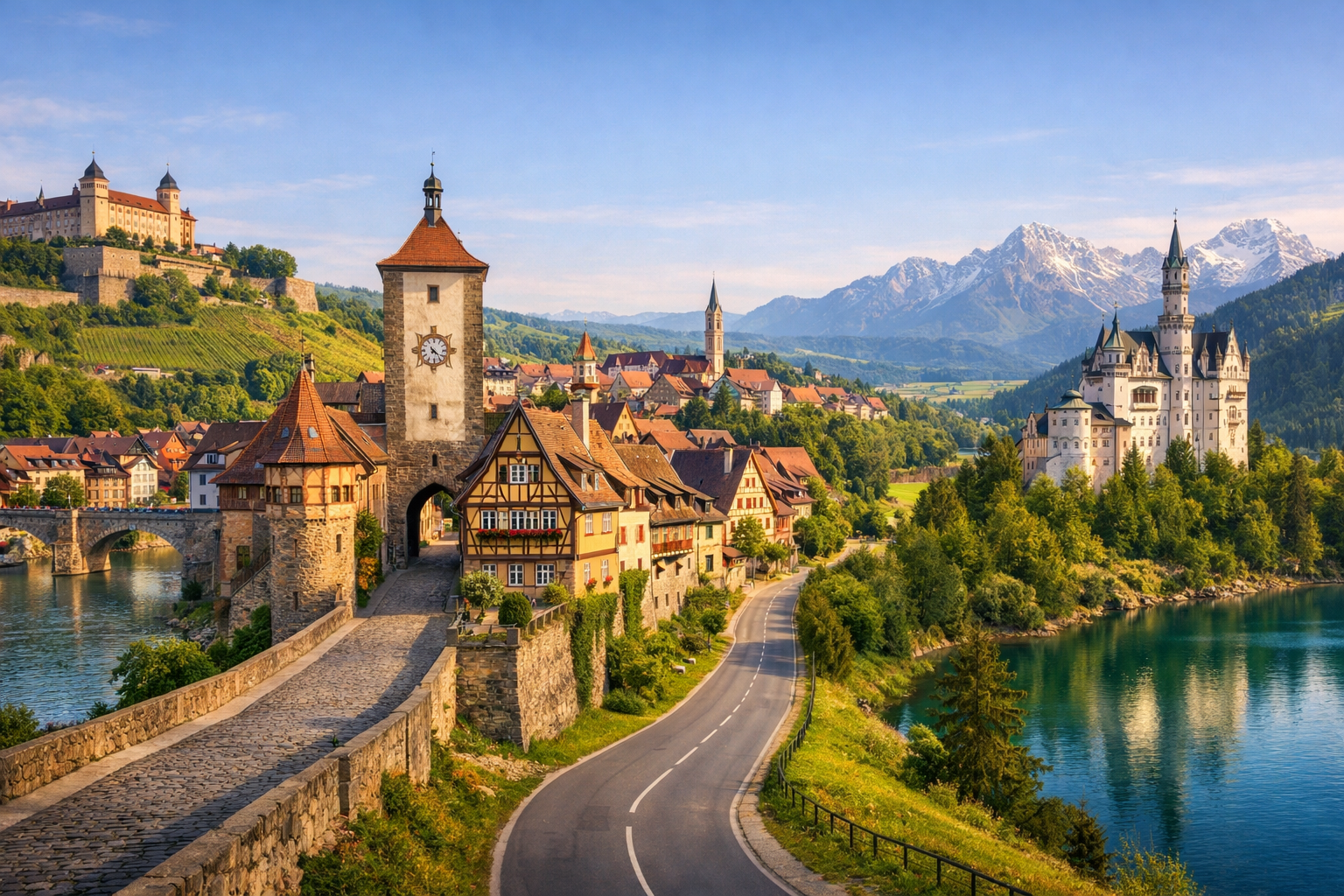
Follow Bavaria’s Romantic Road from Würzburg through storybook Rothenburg ob der Tauber to the alpine beauty of Füssen. Along the way, baroque towns, medieval walls and castle-dotted landscapes create one of Germany’s most enchanting journeys.

🧭 DAY-BY-DAY ROUTE

Ready-made country and city routes with daily plans, sights, transport and accommodation. Buy PDF guides for independent travel.

🧭 DAY-BY-DAY ROUTE


Day 1 — Würzburg: Residence, Hofgarten, and the old town

  • 🚶 Würzburg is an elegant introduction to the Romantic Road, a city where Franconian wine, Baroque architecture, and river panoramas come together into a very cohesive, almost theatrical impression. Start the day with the Würzburg Residence, one of the most outstanding Baroque palaces in Europe and a UNESCO World Heritage Site. It is not just the former residence of the prince-bishops, but a true manifesto of the era: ceremonial halls, a grand staircase, Tiepolo frescoes, gilded decor, and the feeling that you have entered a world where power spoke the language of beauty. After the interiors, be sure to step out into the Hofgarten — a formal palace garden with trimmed avenues, fountains, sculptures, and a calm geometric sense of space. It is a pleasant place to catch your breath after the richness of the museum and to feel how Baroque works not only in halls, but also in the landscape.

  • 🚶 Then head toward the old town: through elegant streets to the Marktplatz, the cathedral, chapels, and the Alte Mainbrücke bridge. This stone bridge over the Main is one of Würzburg’s most atmospheric spots: statues of saints, views of Marienberg Fortress, tiled roofs, and a glass of local Franconian wine in your hand create exactly that “European evening” people come here for. Würzburg is wonderful because it does not demand rushing: you do not need to tick off dozens of sights, it is enough simply to walk, occasionally turning into quiet lanes, peeking into wine bars, and letting the city reveal itself gradually. For the first day, this is the ideal tone for the route — beautiful, rich, but without exhaustion.


Day 2 — Transfer Würzburg → Rothenburg ob der Tauber and evening in the medieval town

  • 🚆 Transfer: Würzburg → Rothenburg ob der Tauber by regional trains with a change at Steinach (bei Rothenburg) — usually about 1h 10m–1h 30m. From the station to the old town it is about a 10–15 minute walk. This is a comfortable daytime transfer without an early start, so in the morning you can have a relaxed breakfast and leave closer to midday.

  • 🚶 Rothenburg ob der Tauber is no longer just a beautiful town, but almost a perfect stage set of medieval Germany, preserving its walls, towers, gates, cobbled streets, and that very image many people imagine when they hear the words “fairy-tale old town.” But the main thing here is not only its photogenic quality. Rothenburg has a rare trait: it truly knows how to slow you down. Even if there are many visitors during the day, by evening the crowd disperses, and the town becomes especially expressive — lanterns glow more softly, facades grow warmer, and the emptying streets create the feeling that time has stepped slightly backward.

  • 🚶 After checking in, devote the second half of the day to a leisurely walk along the town walls, Marktplatz, Herrngasse, and the viewpoints over the Tauber valley. The Plönlein area is especially beautiful — one of the most recognizable urban views in Germany, where a narrow street splits between towers and half-timbered houses. Do not try to “cover” everything at once: it is better to experience the town in the rhythm of the evening, when footsteps echo on the cobblestones, shop windows glow with warm light, and the walls and towers look almost cinematic. This is an ideal day for visual enjoyment and a gentle change of pace after Baroque Würzburg.

Day 3 — Rothenburg: walls, museums, and the Tauber valley

  • 🚶 A full day in Rothenburg is worth dedicating not only to postcard views, but also to its substance. In the morning, the best option is to walk the town walls and towers while the streets are still relatively quiet. From above, you can especially feel the layout of the old imperial town: the roofs seem folded into a historical relief, the towers set the rhythm, and beyond the walls opens the soft Franconian landscape. Then stop by the RothenburgMuseum, located in a former monastic complex, which helps you see the town not as a tourist image but as a living historical organism with several centuries of memory, religious art, and urban everyday life.

  • 🚶 In the second half of the day, contrast works well: visit the Medieval Crime Museum. It is one of the most unusual places on the route — not for “scary stories,” but for understanding how ideas of law, punishment, authority, and social order changed in Europe. The exhibition makes a strong impression precisely because of its historical concreteness. After the museum, it is especially pleasant to step back onto Rothenburg’s streets and head down to the viewpoints or toward the gardens at Burggarten. From there, beautiful views open over the Tauber valley — green, calm, and almost pastoral, as if specially created to balance the drama of medieval urban history. In the evening, you can repeat a short walk through the center: Rothenburg is one of those towns that feels different in the morning, afternoon, and evening.

Day 4 — Transfer Rothenburg → Füssen and a first introduction to the Allgäu

  • 🚆 Transfer: Rothenburg ob der Tauber → Füssen by regional trains with several changes — usually about 4h 30m–5h 30m depending on the connection. This is the longest transfer of the route, so it is best planned as a separate transport day with an early departure, coffee breaks, and no overloaded evening program.

  • 🚶 Füssen is the southern finale of the Romantic Road, where medieval Germany gradually gives way to an Alpine landscape. After the Franconian towns, it feels different: the air seems clearer, the horizons wider, and the urban fabric gains a sense of a resort town and closeness to the mountains. After checking into your hotel, head out for an easy walk through the historic center. It is pleasant here to pass through the narrow streets of the old town to St. Mang’s monastery, the Lech River, and Kaiser-Maximilian-Platz. Füssen does not overwhelm with monumentality — rather, it charms through its combination of compactness, colorful facades, and Alpine backdrop.

  • 🚶 If you still have energy, go up to Hohes Schloss — the high castle that rises above the town and immediately gives the right perspective: from here, all of Füssen is easy to read, along with the curves of its streets, the greenery of the surroundings, and the mood of southern Bavaria. It is best to keep the evening in Füssen calm: after a long transfer, it is more important to rest, have dinner, and save the main outings for the next day. That is exactly how the route stays realistic and comfortable, without feeling like a race.

Day 5 — Füssen: Hohes Schloss, city museum, and the castles of Schwangau

  • 🚍 Local trip: from Füssen to the Schwangau / Hohenschwangau area it is convenient to go by local buses in about 10–15 minutes, followed by a short walk to the castle ticket and entrance area. It is reasonable to allow almost the whole day for visiting this area, taking into account queues, the ascent, breaks, and viewpoints.

  • 🚶 The last day of the route is best spent as the culmination of the entire trip. In the morning, you can start with Hohes Schloss or with the Museum of the City of Füssen in the former monastery of St. Mang. The museum is especially good because it connects the city’s history not only with its religious past, but also with the region’s musical culture: Füssen is considered an important center of European lute and violin craftsmanship. Baroque halls, historic interiors, and museum collections create the feeling that before you is not just a small town by the Alps, but a place with a very deep cultural layer.

  • 🚶 After that, head toward Hohenschwangau, to the famous royal castles. Even if you have seen Neuschwanstein in hundreds of photographs, in person it makes a stronger impression than expected: not so much because of its size, but because of its location — against a backdrop of wooded slopes, mountains, and lakes, it looks like a materialized Romantic fantasy of the 19th century. Nearby is Hohenschwangau Castle, warmer in mood and historically more “lived-in,” associated with the childhood of Ludwig II. The most spectacular point of the day is a walk to Marienbrücke or to the viewing areas with panoramas over the valley and lakes. It is a beautiful and highly photogenic finale to the five-day route: from the Baroque and wine of Franconia to medieval walls, and then to the Bavarian Alps and royal castles.

Flight tickets

eSIM for travel

Buy PDF guide

Buy PDF guide — 10.71 USD

PDF — 10.71 USD