
Buy PDF guide

Buy PDF guide — 6.43 USD

PDF — 6.43 USD

BAVARIA - Oktoberfest in Munich

BAVARIA - Oktoberfest in Munich

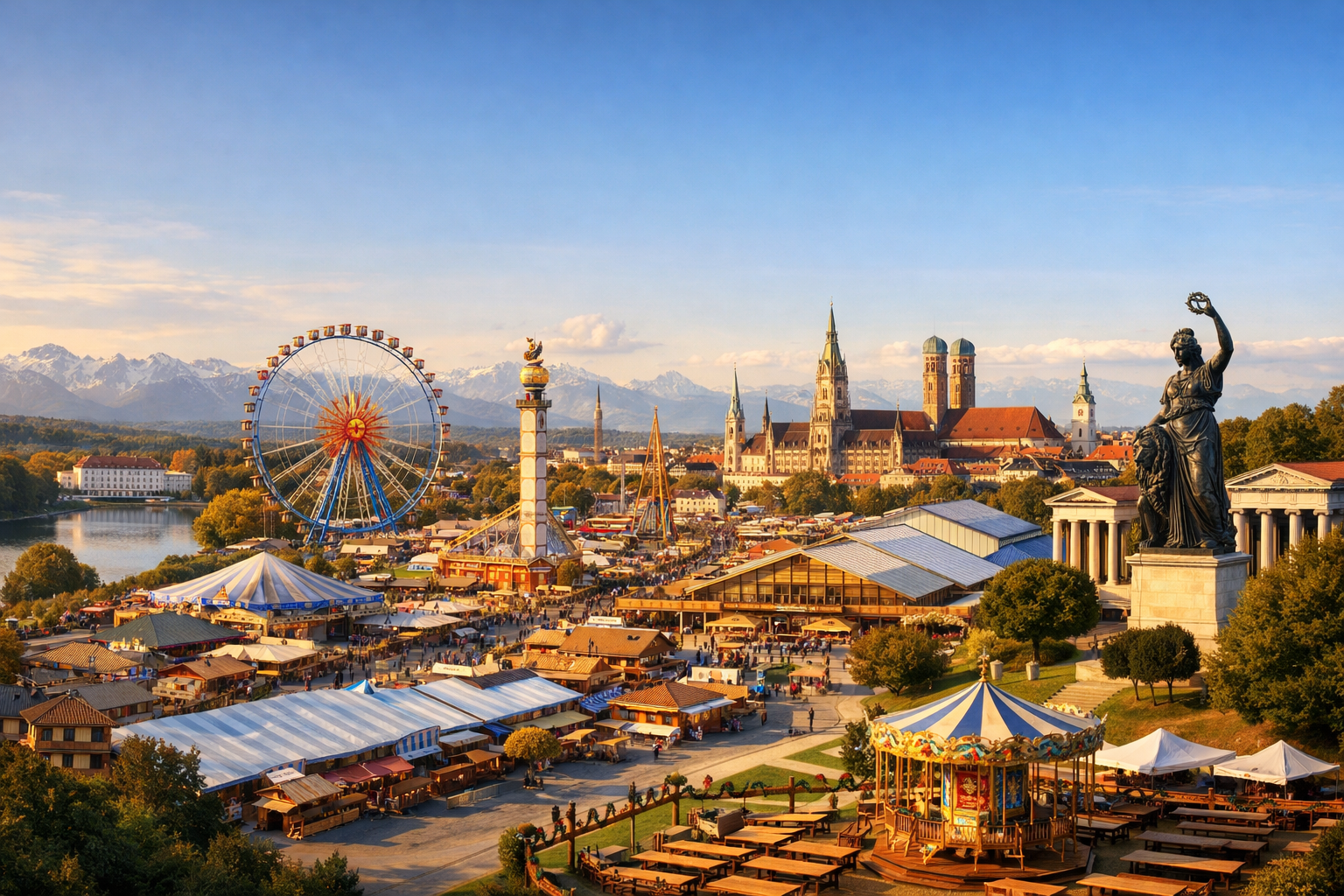
Bavaria comes alive in Munich during Oktoberfest, when the city fills with music, laughter, and the clink of beer steins. It’s a lively taste of Bavarian tradition, with festive tents, local flavors, and an atmosphere that’s impossible not to love.

🧭 DAY-BY-DAY ROUTE

Ready-made country and city routes with daily plans, sights, transport and accommodation. Buy PDF guides for independent travel.

🧭 DAY-BY-DAY ROUTE


Day 1 — Arrival in Munich, hotel check-in, and a first immersion into Oktoberfest

  • 🚆 Transfer: Munich Airport → city center. The most convenient public transport option is the S-Bahn S1 or S8, which reaches the center in about 35 minutes; alternatively, there is the Lufthansa Express Bus to Hauptbahnhof in about 45 minutes. If you want fewer transfers with luggage, it is convenient to go to the central station, leave your things at the hotel, and only then head to Theresienwiese. For the first day, the most practical choice is the Airport-City-Day-Ticket: it covers the trip from the airport and all further travel around the city during the day.

  • 🏨 After landing, allow around 2.5–3.5 hours total for the road, baggage claim, getting into town, and checking in. This is especially important for Oktoberfest: it is better not to rush straight from the plane to the festival, but first catch your breath, wash up, change clothes, and rest a little. The best scenario is to check into a hotel in Altstadt, Hauptbahnhof, or Isartor, take a 45–60 minute break, and only then go or walk to Theresienwiese in a more comfortable state.

  • 🍺 Oktoberfest at Theresienwiese is not just a beer festival, but a huge city event with an almost theatrical atmosphere, where Bavarian tradition meets a fairground, live music, historic costumes, amusement ride lights, and the dense, joyful noise of a crowd of thousands. The official 2026 festival runs from September 19 to October 4. During the day, the atmosphere feels more family-friendly and stroll-oriented: you can admire the tent facades, walk between the rides, visit souvenir pavilions, and try roast chicken, pretzels, candied almonds, and desserts. By evening, the space changes — the music grows louder, the tents come alive, people sing along with the orchestras, and the whole Wiesn starts to feel like a giant open-air stage.

  • 🚶 For your first introduction, do not plan too aggressive a pace. It is better to devote 4–6 hours to a relaxed immersion: walk around the grounds, choose 1–2 tents or beer gardens, ride one attraction, pause for dinner, and simply watch the crowd. If there is a long line for the tents, do not turn the evening into a fight to get in: at Oktoberfest there are plenty of impressions outside the big tents too. A good tactic for the first evening is to save your energy, leave before very late at night, and keep yourself fresh for the next day.

  • 🚶 If you are staying in the center, it is useful to remember that from Hauptbahnhof to Theresienwiese it is often easier to walk in about 15 minutes than to spend energy on a short overcrowded metro segment. This is especially convenient in the evening, when the area around the festival is busy. After returning to the hotel, be sure to leave yourself at least 7–8 hours for sleep: the route is short but насыщенный, and comfort matters more here than “seeing everything”.


Day 2 — Old Munich: Marienplatz, the Residenz, the English Garden, and an evening at Wiesn

  • 🚶 Start the day in Munich’s historic center — the area around Marienplatz, where the city reveals itself not as a backdrop to the festival, but as an old Bavarian capital with grand architecture, church silhouettes, arches, inner courtyards, and the feeling of a well-preserved European urban stage. It is pleasant not to rush here: walk through the narrow streets of Altstadt, stop by Viktualienmarkt, admire the facades of old houses, and give yourself time simply to tune in to the city’s rhythm. If Oktoberfest is a storm of emotions, then central Munich is its worthy historical counterpoint.

  • 🏛️ The Munich Residenz is one of the city’s main palace attractions and the largest city palace in Germany. Inside, it is an entire world of ceremonial halls, royal apartments, a treasury, and theatrically luxurious interiors where you can feel the history of the Bavarian Wittelsbach dynasty. What makes this place especially impressive is that it is not just beautiful, but almost cinematic: each hall seems made for grand ceremonies, diplomatic receptions, and court life, where gold, stucco, tapestries, and vaulted ceilings come together into a complete picture of a former monarchical capital.

  • 🌳 After the museum part, it is ideal to switch to the English Garden. This is one of the largest urban parks in the world, and its main charm lies in the fact that it does not look “formal,” even though it was historically carefully designed. Here long avenues open onto wide lawns, the water reflects the sky and trees, and a walk easily turns into relaxation without a goal. You can go to Monopteros for a beautiful view, walk toward the Chinese Tower, and allow yourself a slow, relaxed rhythm. After the noisy Wiesn, this park works especially well as a balance: it gives your body air, quiet, and a sense of space again.

  • ☕ In the middle of the day, plan a calm lunch and a mandatory break of at least 1–1.5 hours. The mistake of many short trips to Munich is overloading the day as if every stop must be “checked off.” In practice, the most pleasant scenario is a museum in the morning, a walk and lunch during the day, a short rest at the hotel in the late afternoon, and then a second visit to Oktoberfest with fresh energy.

  • 🍻 In the evening, return to Theresienwiese more deliberately: now you can choose a more focused experience. For example, concentrate on the atmosphere of a specific tent, the food, the rides, or the beautiful evening light of the fairground. In the dark, Oktoberfest is especially spectacular: carousel lights, music, laughter, bright signs, and the flow of people in dirndls and lederhosen make the place feel almost unreal. Even if you do not aim to sit in a beer tent for a long time, an evening walk through Wiesn alone already gives a full sense of a great Bavarian celebration.

Day 3 — Deutsches Museum, the Isar, and a calm finale before departure

  • 🏛️ Deutsches Museum is one of those museums that is truly worth giving a dedicated morning to. It is a grand world of science and technology on Museumsinsel, where exhibitions are devoted to transport, physics, music, aviation, energy, communications, and dozens of other topics. Even if you do not consider yourself a “museum person,” it is easy to get engaged here: the displays do not feel academically heavy, but instead spark genuine interest and a sense of the scale of human ingenuity. In a city like Munich, this museum feels especially fitting: after two days of festival and historic Bavaria, it shows the region’s third face — engineering, intellectual, and modern.

  • 🚶 After the museum, it is nice to walk along the Isar and around Isartor. This part of the city gives a pleasant, not overly grand finale to the trip: water, bridges, urban facades, calm streets, and the feeling that Munich knows how to be not only festive and ceremonial, but also very livable. If you have enough time, you can return toward the old town for one last coffee, souvenirs, or a leisurely lunch.

  • 🖼️ If art is closer to you than technology, instead of a long visit to Deutsches Museum you can choose Pinakothek der Moderne. This is a strong contemporary museum spot with art, design, architecture, and graphics under one roof. This option is especially good for those who want to end the route with a more “urban” and aesthetic mood rather than diving again into a large universal exhibition.

  • 🧳 On the final day, be sure to plan time buffer without rushing. If your flight is in the evening, it is wise to finish the active part of the program at least 4–4.5 hours before departure: return to the hotel, pick up your luggage, get to the airport calmly, and avoid depending on crowds, traffic, or overloaded transport. From the center, it is again convenient to take the S1/S8 to the airport, and if you want a more direct route from Hauptbahnhof, the Lufthansa Express Bus works well.

  • ✨ This third day is best lived gently: without racing, with an emphasis on beautiful details, a good breakfast, a calm walk, and a pleasant ending. In a short three-day route through Bavaria, this is exactly what makes the trip feel complete: Oktoberfest gives emotions, old Munich gives character, and the final museum-and-walk day leaves the feeling that you saw the city in depth, not only as a backdrop for a great celebration.

Flight tickets

eSIM for travel

Buy PDF guide

Buy PDF guide — 6.43 USD

PDF — 6.43 USD