
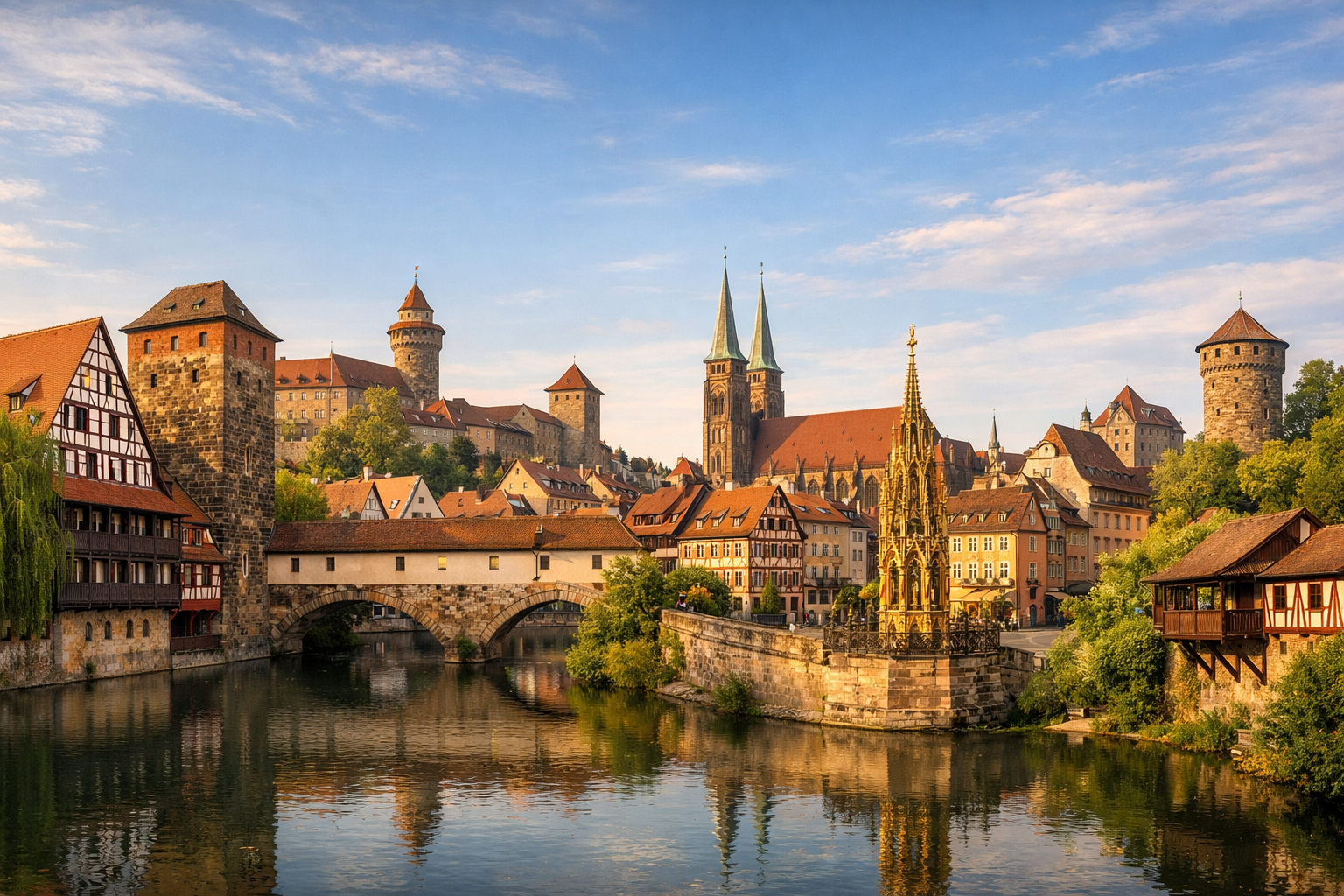
Day 1 — Nuremberg: medieval center, market square, and Imperial Castle
🚆 Arrival in Nuremberg is convenient to plan via Nürnberg Hauptbahnhof or Nürnberg Airport. From the airport, the fastest way to the center is by the U2 line: it takes about 15–20 minutes to reach the central part of the city, and around 18 minutes to the Hauptbahnhof/Opernhaus area. The old town itself is very compact, so after check-in it makes sense to get around mostly on foot: this is exactly the kind of route that opens up not through rushing, but through a slow immersion in the atmosphere of towers, bridges, half-timbered facades, and cobbled streets.
🚶 Start the day at Hauptmarkt — the main square of old Nuremberg, which still preserves the feeling of a great medieval urban theater. On weekdays there is a market here, and the space around it feels like a living set from the history of the Holy Roman Empire: the house facades, the Gothic Frauenkirche, the rhythm of city trade, and the famous Schöner Brunnen come together into a complete picture of an old trading city. This is not just a “beautiful square,” but the nerve center of the historic core, from which it is easy to structure the entire first day. It is pleasant to linger here over coffee and pastries, then slowly walk to the neighboring streets, allowing yourself short pauses for photos and taking in the details.
🚶 From Hauptmarkt, head uphill toward Burgviertel — the most cinematic quarter of old Nuremberg. On the way, it is worth stopping by Albrecht Dürer’s house, located in one of the city’s most recognizable corners. Albrecht-Dürer-Haus is a rare chance to see not an abstract museum “about an artist,” but a real house from the late Middle Ages and Renaissance, where the space itself tells the story of everyday life, craft, the quiet of the workshop, and the intellectual energy of 16th-century Nuremberg. The narrow rooms, wooden ceilings, and atmosphere of an old burgher house work here no worse than the exhibits: the place lets you feel what the city was like, where art, trade, and craftsmanship existed as one.
🚶 Next, it makes sense to climb up to Kaiserburg — Nuremberg’s Imperial Castle. It rises above the city not just as a viewpoint, but as a symbol of Nuremberg’s political weight in the Middle Ages. It is here that you especially feel the scale of the city of the past: from above you can see the red-tiled roofs of the old center, the lines of the fortification walls, and the bell towers that create an almost perfect silhouette of a South German historic city. Inside the complex, the historic rooms, the Imperial Chapel, the museum section, and the legendary deep well are especially interesting. It is worth allowing at least 2–3 hours for the castle, including the ascent, the visit, and a calm pause to enjoy the views.
☕ After the castle, be sure to leave time to rest around the castle hill or on the way back to the center. Nuremberg does not respond well to an overly packed minute-by-minute schedule: its beauty reveals itself in the transitions between points — in arches, quiet alleys, stairways, small squares, and unexpected views of towers. A comfortable pace for the first day is 5–7 hours including lunch, photo stops, and breaks. In the evening, it is nice to return to Hauptmarkt or the area by the Pegnitz River: the illuminated old town looks especially soft and intimate.