
Buy PDF guide

Buy PDF guide — 8.57 USD

PDF — 8.57 USD

BAVARIA - Berchtesgaden and Lake Königssee

BAVARIA - Berchtesgaden and Lake Königssee

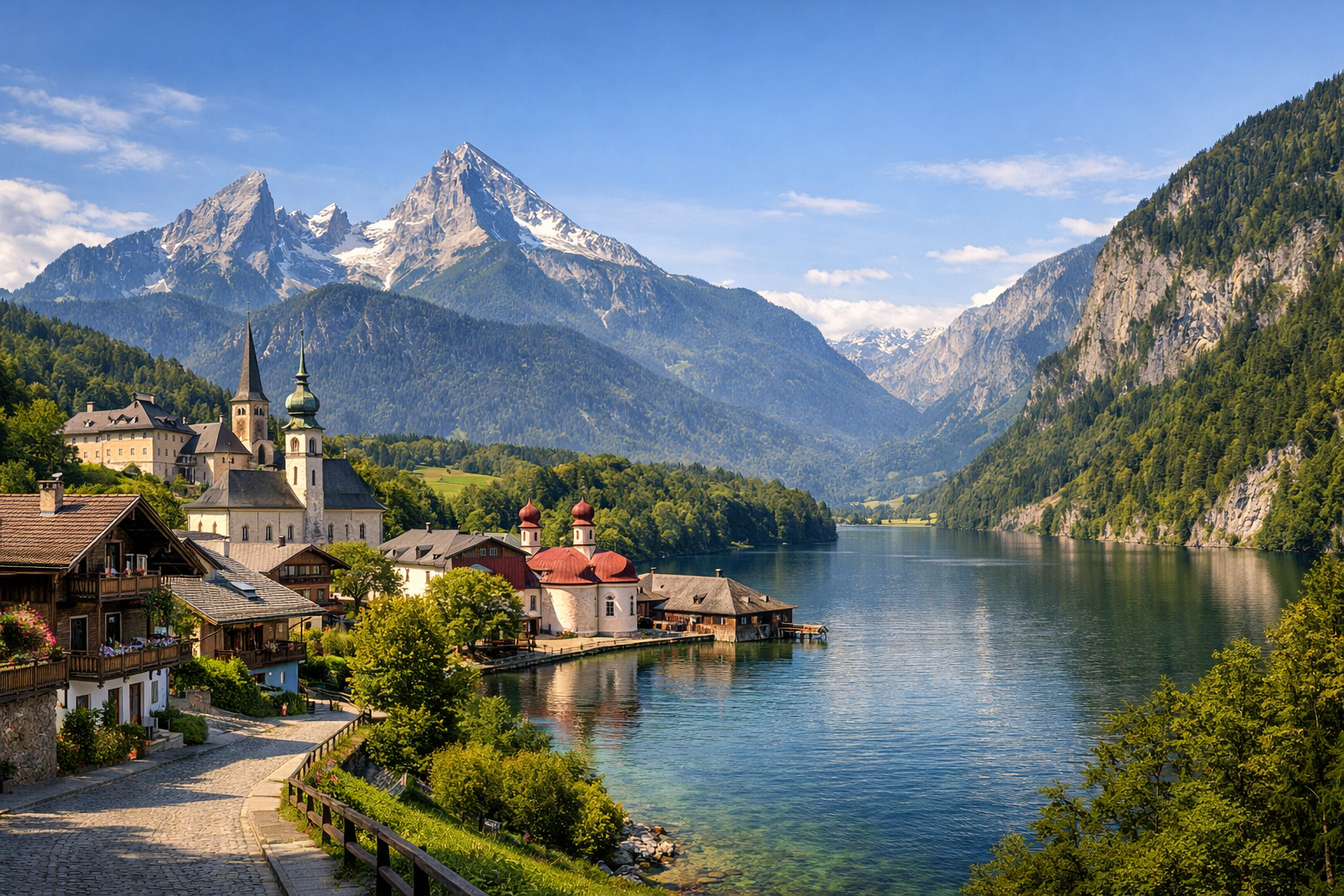
Berchtesgaden and Lake Königssee reveal Bavaria at its most dramatic, where emerald water, sheer Alpine cliffs, and storybook villages sit just beyond Salzburg. Follow the route from Berchtesgaden to Königssee and up to Obersalzberg for a journey that blends mountain beauty, quiet grandeur, and a deep sense of place.

🧭 DAY-BY-DAY ROUTE

Ready-made country and city routes with daily plans, sights, transport and accommodation. Buy PDF guides for independent travel.

🧭 DAY-BY-DAY ROUTE


Day 1 — Salzburg → Berchtesgaden: a gentle entry into the Alps

  • 🚆 Transfer: Salzburg Airport → Berchtesgaden. The most realistic car-free option is first a short transfer/taxi to Salzburg Hbf (~15–20 minutes), then a regional train to Berchtesgaden Hbf with a change in Freilassing; in total, usually allow about 1 h 30 min–2 h including waiting time. If you take a taxi or private transfer directly from the airport, the trip to Berchtesgaden usually takes about 35–45 minutes depending on traffic and the border crossing.

  • 🚶 Berchtesgaden is one of those rare Alpine towns that immediately gives you the feeling of a “proper” Bavarian journey: not a noisy resort, but an intimate mountain world with old-town towers, painted facades, the smell of fresh pastries, and the constant presence of huge mountains on the horizon. It is especially pleasant not to rush on the first day: after the journey, it is better to devote time to a walk through the historic center, step out onto the square by the Royal Palace, peek into lanes lined with traditional houses, and simply catch the rhythm of the region. Berchtesgaden does not overwhelm with scale; on the contrary, it gently draws you into the trip: every street seems to suggest that here, rest is built not around rushing from point to point, but around attentive enjoyment of the landscape, light, air, and details.

  • 🏛️ In the second half of the day, it is convenient to visit the Nationalparkzentrum «Haus der Berge» — a modern and very well-designed center that helps you understand what exactly makes this part of Bavaria special. Its exhibition “Vertical Wilderness” literally takes the visitor through all the natural zones of the national park: from the depths of Königssee through forests, Alpine meadows, and rocky areas up to the peaks of the Berchtesgaden Alps. This is not a dry museum “with display cases,” but a space where the landscape is explained through light, sound, panoramas, and interactive elements. This kind of start is especially good before further walks in the region: after it, the lake, mountain walls, boats, cable cars, and viewpoints are perceived not just as a beautiful backdrop, but as parts of a single Alpine system.

  • ☕ It is best to keep the evening calm: check in, have dinner in the center or at the hotel, and go to bed early. In Berchtesgaden, early starts really pay off: both at Königssee and on the mountain routes there are far fewer people in the morning, the air is cleaner, and the light is softer and more photogenic.


Day 2 — Königssee: boat, St. Bartholomä, and emerald water

  • 🚌 Transfer: Berchtesgaden Hbf → Königssee/Seelände by local bus usually takes about 10–15 minutes. From the stop to the pier is just a few more minutes on foot. In high season, it is worth arriving as early as possible: in good weather, queues for the boats grow noticeably already by late morning.

  • 🚶 Königssee is one of the most cinematic natural scenes in all of Bavaria, and in person it makes an even stronger impression than on postcards. The lake cuts deeply into the mountain massif and resembles a Norwegian fjord: almost sheer rock walls descend to the water, and the water itself seems not just green, but somehow glowing from within, dense, emerald, and almost unreal. There is no feeling of an ordinary promenade here — on the contrary, everything is arranged so that nature keeps the leading role. That is why the electric boat trip on Königssee is perceived not as a transfer, but as a full ritual of immersion into the national park.

  • ⛴️ The boat trip to St. Bartholomä is a regional classic, and absolutely deservedly so. The almost silent movement across the water, the famous echo demonstrated on the lake, and the slow approach to the reddish domes of the pilgrimage church create a very complete, almost meditative impression. The St. Bartholomä peninsula looks like a set from an old legend: a church right by the water, neat lawns, forest, stern mountains all around, and a feeling of complete detachment from the bustle. Here it is pleasant not only to take photos, but also simply to walk without hurry, sit by the shore, and give yourself time for silence — in a place like this, it becomes part of the route.

  • 🥾 If you have the energy, the day can be extended with a continuation of the boat route farther along the lake or a short walk around the pier areas. But it is better not to overload this day: Königssee is most beautiful when the traveler has room for stops, contemplation, and a leisurely lunch with a view of the water. Ideally, allow at least 5–7 hours for the whole outing including the journey, waiting for the boat, the round trip itself, and relaxed time on shore.

  • 🌆 In the evening, return to Berchtesgaden. After a day rich in nature, a simple plan works well: a short walk through the center, dinner, and an early night so that the next day you can go higher and see the region not from water level, but from above.

Day 3 — Jenner and Schönau am Königssee: panoramas, air, and the great Alpine horizon

  • 🚌 Transfer: from Berchtesgaden to the lower Jennerbahn station in the Schönau am Königssee area, it is convenient to travel by bus; depending on your starting point, allow about 15–25 minutes. For the ascent and walks at the top, it is sensible to reserve at least half a day, and better yet, almost the whole day.

  • 🚠 Jennerbahn is one of the most beautiful ways to “read” this region from above. Already during the ascent, the very logic of spatial perception changes: what seemed the day before like separate points — the lake, villages, bands of forest, rocky bastions — suddenly comes together into a grand Alpine panorama. The cable car lifts you not simply to a viewpoint, but into a world of light, wind, and open horizon, where every step along the panoramic trails gives a new angle on Königssee, the Watzmann massif, and the relief of the national park.

  • 🥾 At the top, it is better not to turn the day into a sporting feat if the goal is a comfortable 4-day trip. The ideal format is a leisurely walk along easy panoramic sections, stops at viewpoints, coffee or lunch in a mountain restaurant, and time for photographs. In clear weather, the drama of the local landscape is felt especially strongly from here: green slopes abruptly give way to gray rock walls, the lake below looks like a narrow glittering ribbon, and the air seems almost crystalline. This is the kind of day when you simply want to breathe deeper and look farther.

  • 🌿 After descending, you can devote time to Schönau am Königssee itself — a quiet resort village often perceived merely as the gateway to the lake, though it has its own charm. This is a very “proper” Bavarian idyll: neat houses, flowers on balconies, mountains very close by, and a feeling of rest without strain. If you still have energy, you can take a short walk around the area, sit on a terrace with mountain views, or simply allow yourself a pause before the final day.

Day 4 — Obersalzberg and the region’s salt history → departure

  • 🚌 Transfer: Berchtesgaden Hbf → Dokumentation Obersalzberg on bus 838 takes about 15 minutes. From the center to Salzbergwerk Berchtesgaden — about 5 minutes by bus 840 or around 25–30 minutes on foot. If you are then heading back toward Salzburg, it is best to keep a buffer of at least 2.5–3 hours before a flight or long-distance train.

  • 🏛️ Dokumentation Obersalzberg is a place with a completely different mood from the lake and Jenner panoramas, but that is exactly why it is so important for understanding the region. Against the backdrop of an almost unbelievably beautiful mountain landscape, a heavy historical perspective of the 20th century opens up here: how an idyllic Alpine landscape became linked with the Nazi leadership and a politics of terror. The exhibition is done seriously, clearly, and without unnecessary pathos; it helps you see that Berchtesgaden is not only nature and a holiday postcard, but also a place of memory, where the beauty of the landscape does not cancel out the complexity of history. It is comfortable to allow about 1.5–2 hours for the visit.

  • ⛏️ After that, it makes sense to move on to another, deeper and much older history of the area — salt. Salzbergwerk Berchtesgaden has been working with salt for many centuries, and this “white gold” largely shaped the region’s economy and importance long before modern tourist routes appeared. A visit to the mine feels like a small adventure: a ride deep into the mountain, the cool air of the underground galleries, stories about extraction, engineering solutions, and the enormous role of salt in Alpine history. It is not just “something to do in bad weather,” but one of the keys to understanding Berchtesgaden.

  • 🎒 After the museum or the mine — return for your luggage and depart. If there is very little time left before the road, it is better to finish the tour without rushing: coffee in the center, one last look at the mountains, and a calm transfer to Salzburg or farther along your route. This kind of finale ties the whole trip together well: in four days, the region manages to reveal itself as a rare combination of majestic nature, thoughtful infrastructure, and a very rich historical layer.

Flight tickets

eSIM for travel

Buy PDF guide

Buy PDF guide — 8.57 USD

PDF — 8.57 USD