
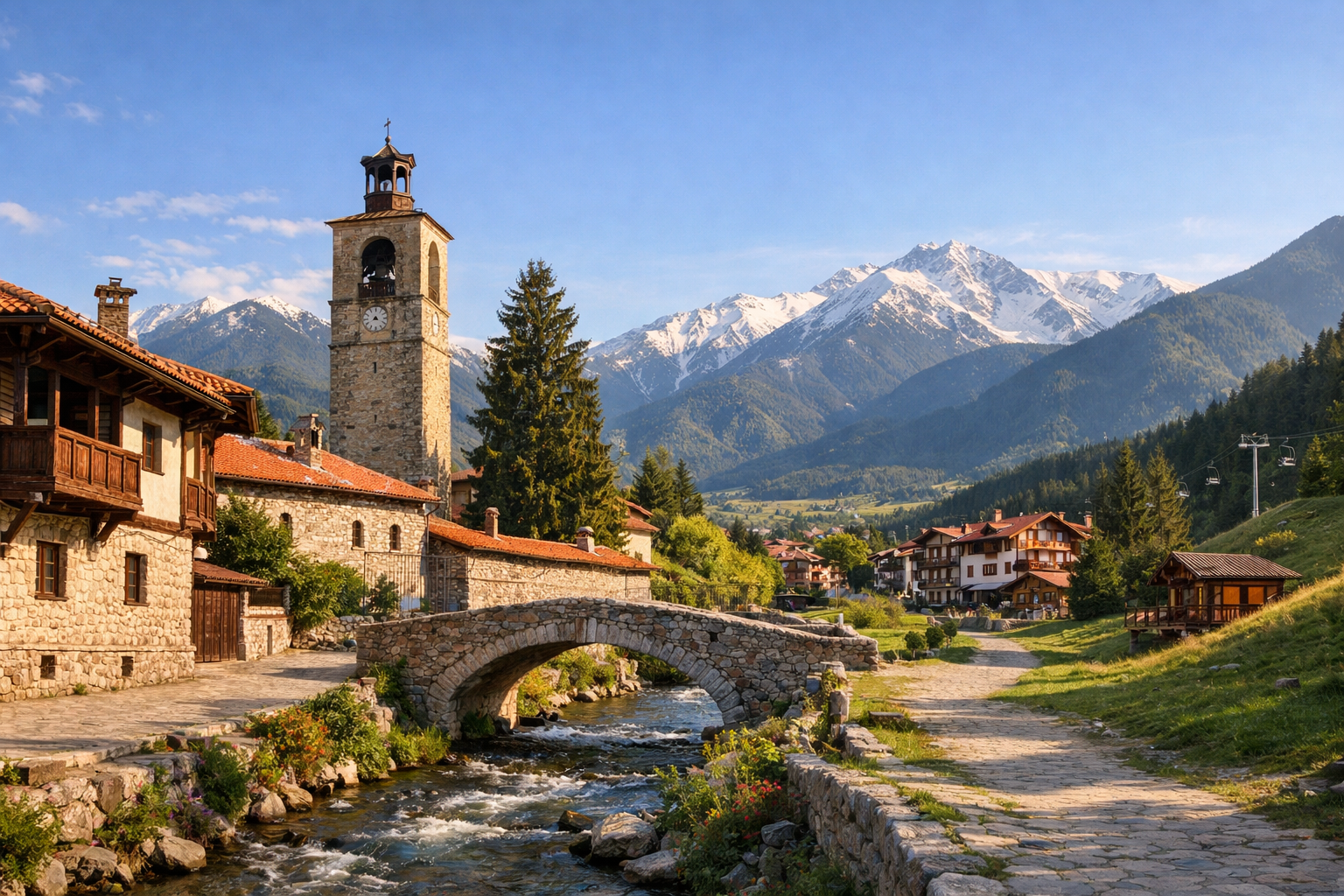
Day 1 — Sofia → Bansko: arrival and the old town
🚆/🚐 Transfer: Sofia → Bansko. The most practical option after landing is a car transfer or bus; the trip usually takes about 2 h 30 min – 3 h 15 min depending on traffic, weather, and your departure point in Sofia. If you rent a car, the route goes through scenic mountain stretches, and as you approach Bansko you already get beautiful views of the Pirin Mountains. It makes sense to plan check-in for after midday so you can calmly leave your bags, rest a little, and not turn the first day into a marathon.
🚶 Bansko’s old town is the part of the resort that makes the trip worthwhile even for those who are usually indifferent to ski destinations. Behind its reputation as a modern ski center, there is still a genuine Balkan town here with stone fortress-like houses, narrow streets, heavy wooden gates, inner courtyards, and distinctive architecture from the Bulgarian Revival era. In Bansko’s historic core, you feel a rare combination of coziness and strength: the houses do not look decorative, but real — the kind where people lived, traded, stored supplies, protected family, and preserved their craft. In the evening this area is especially beautiful: the light becomes softer, the texture of stone and wood emerges, and a walk among the old facades creates a completely different rhythm compared with the area by the gondola. This is exactly where you best feel that Bansko is not only a mountain resort, but also a town with a very dense historical memory.
⛪ The main focus of your first walk is the Holy Trinity Church, one of Bansko’s most recognizable symbols. It is a large 19th-century church with a massive bell tower, a spacious courtyard, and an important role in the history of the Bulgarian National Revival. Even if you are not aiming to study religious history in detail, the place makes a strong impression with its architecture and scale: in the context of a small mountain town, the church feels especially significant. Nearby, it is pleasant to slow down, look at the old quarters, sit in the square, and move into a more leisurely evening — with dinner in a mehana, local wine, and an early rest after the road.
💤 On the first evening, it is better not to overload the schedule: after a walk through the old center and dinner, it makes sense to return to the hotel early to rest before the more active days ahead. If you stay closer to the gondola, allow about 15–20 minutes on foot to get to the historic center; if you stay in the old town area, everything will be compact and very convenient.