
Buy PDF guide

Buy PDF guide — 10.71 USD

PDF — 10.71 USD

Bansko - Dobrinishte thermal baths and the Pirin Mountains

Bansko - Dobrinishte thermal baths and the Pirin Mountains

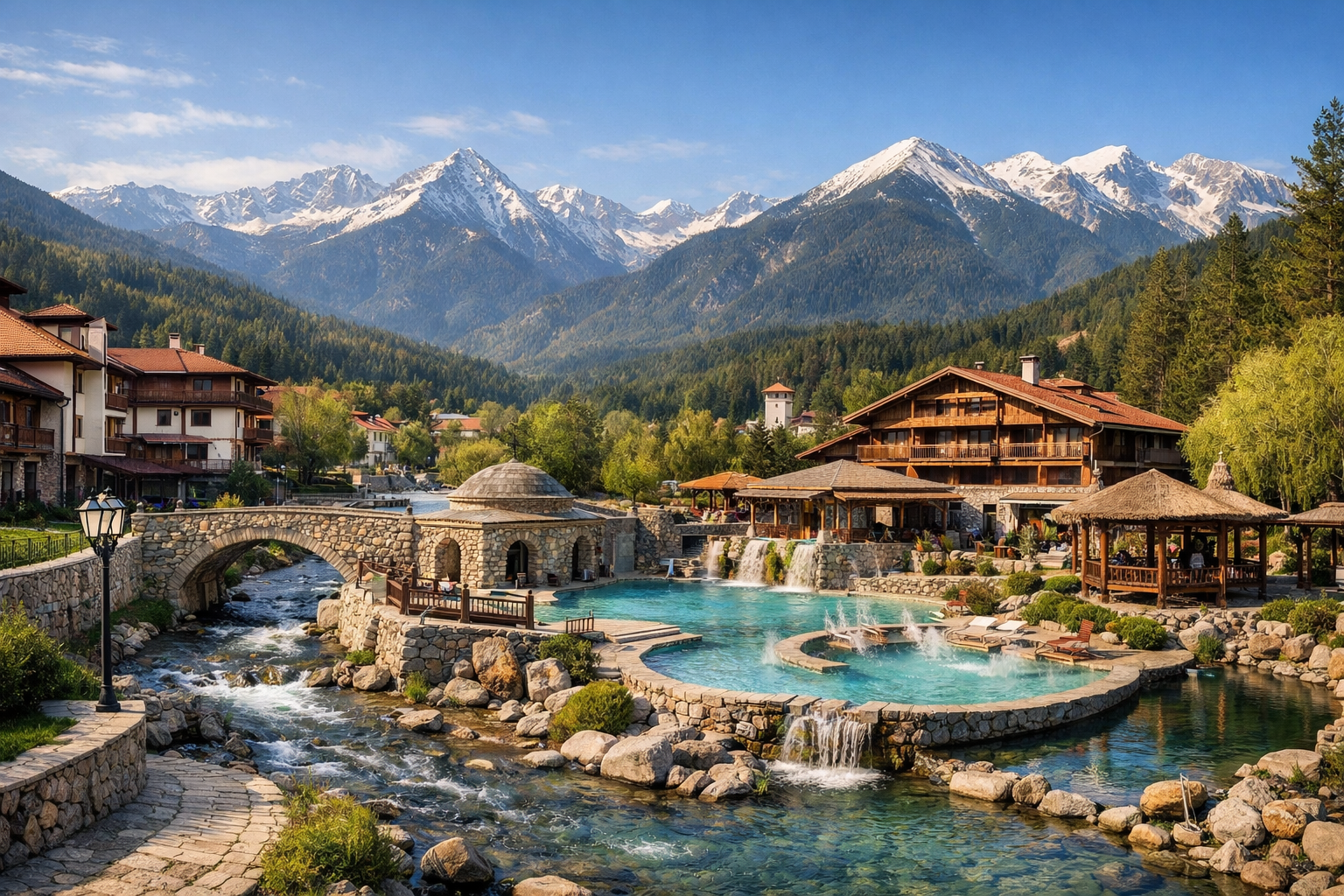
Unwind between mountain air and mineral springs in Bansko and Dobrinishte, where alpine charm meets the soothing warmth of natural thermal baths. Framed by the dramatic Pirin Mountains, this corner of Bulgaria invites you from lively ski-town streets to peaceful spa escapes and unforgettable highland views.

🧭 DAY-BY-DAY ROUTE

Ready-made country and city routes with daily plans, sights, transport and accommodation. Buy PDF guides for independent travel.

🧭 DAY-BY-DAY ROUTE


Day 1 — Sofia → Bansko: arrival, old town, and a first feel for the resort

  • 🚆 Transfer: Sofia Airport → Bansko. The most convenient realistic option without a car is to get from the airport to Sofia Central Bus Station and then change to an intercity bus to Bansko. Including the transfer and extra time for luggage, allow around 3.5–4.5 hours on the road in total. If you take a private transfer or a rental car, the journey usually takes about 2–2.5 hours depending on traffic and weather.

  • 🚶 Bansko is a rare place where a ski resort and an old Balkan town do not simply sit side by side, but are literally intertwined. After the journey, it is best not to overload the day and instead devote it to gentle acclimatization: check in, exhale, have a coffee with a view of Pirin, and head out for an unhurried walk through the old center. Stone fortress-like houses, heavy wooden gates, narrow lanes, quiet courtyards, and the massive walls of churches create here not a “tourist backdrop,” but a very alive and grounded atmosphere of the Bulgarian Revival. In the evening Bansko is especially beautiful: the air becomes cooler, the slopes darken above the town, and around the old mehanas you hear the hum of conversation and smell grilled meat, roasted peppers, and homemade bread. It is the perfect first evening not to rush, to go to bed early, and to prepare for the rich days ahead.

  • 🚶 If you still have energy, walk to Nikola Vaptsarov Square and the area around the Holy Trinity Church. This is one of those parts of Bansko where you can especially feel the town’s scale: it is both compact and substantial at the same time. It is a good place to understand the geography of the route — where the old center is, where the museum area is, and where the road toward the gondola and farther up into the mountains begins. For dinner, it is best to choose a place in the old part of town, and afterward return to the hotel without haste and get a good night’s sleep: the next day brings a full immersion into the culture and rhythm of Bansko.


Day 2 — Bansko: museums, Revival quarters, and the atmosphere of old Pirin

  • 🚶 This day is best devoted not to lifts, but to Bansko itself as a historic town. Start with the Nikola Vaptsarov House-Museum — one of the resort’s main cultural addresses. Here an unexpected side of Bansko is revealed especially well: not only skis and apartment hotels, but a place with a strong intellectual and artistic biography. The exhibition tells the story of the poet, his family, and the era in which Bulgaria of the first half of the 20th century was growing, while the house itself helps you feel the scale of local memory — intimate, domestic, and without official pomp. After the museum, it makes sense to walk through the old streets to the Neofit Rilski House-Museum, one of the most important figures of the Bulgarian National Revival. These museums work especially well as a pair: one shows the literary and emotional history of the place, the other its educational, spiritual, and enlightening side.

  • 🚶 Then head to Velyanova House and the permanent icon exhibition. Velyanova House is one of the most expressive monuments of Bansko residential architecture: a fortress-house with powerful walls, wooden details, and interior paintings that shows what prosperity looked like in a 19th-century Pirin town. The icon exhibition opens up an entirely different layer — the artistic one. In the Revival era, Bansko was not only a trade and craft center, but also a notable icon-painting school, and it is especially rewarding to realize this when behind the façade of a “mountain resort” you suddenly discover a whole cultural layer worthy of a separate trip.

  • 🚶 After the museum part, leave time simply for a walk without a strict purpose. Bansko is best read with your feet: moving from the square to the lanes, looking at old stone fences, shops, churches, courtyards, and unexpectedly stepping out to mountain views. You can also visit the Spiritual and Historical Center of Saint Paisius of Hilendar if you want to round out the day with the theme of the Bulgarian Revival. In the second half of the day, do not overload the program: sit in a café, have a long late lunch, and allow yourself to rest. This rhythm is especially important before the mountains and the thermal spas: the trip will feel not like a frantic dash between points, but like something with depth and real rest.

Day 3 — Pirin Mountains: panoramas, eco-trails, and a mountain day without rush

  • 🚕 In the morning, head toward the mountain zone of Pirin. Depending on the season and your level of preparation, the day can be built in a gentle format: go up to the upper part of the resort area, take short walking routes, visit the Visitor Information and Education Centre of Pirin National Park in Bansko, and then choose one of the easier nature scenarios. For a relaxed trip, it is better not to set yourself the goal of “doing the maximum.” It is much more pleasant to spend the day so that there is time left for views, for stops, and for returning without exhaustion. In transport terms, it is important to understand: the road from central Bansko to the start of mountain activities is usually short, but in high season and on weekends add extra time for waiting, parking, and local shuttles/taxis.

  • 🚶 The Pirin Mountains are among the most beautiful in Bulgaria and probably one of the most photogenic mountain landscapes in the Balkans. There is none of the soft postcard-like friendliness of Western European alpine meadows here; Pirin creates a stricter, granite, almost epic effect. Slopes, dark coniferous forests, sharp forms, high rocky ridges, and shifting light create the feeling of a truly big mountain, even if you choose a very easy route. In good weather, it is enough to climb above the town to feel this transition: just moments ago you were among cafés and hotels, and now around you there is wind, the smell of pine, silence, and immense relief.

  • 🚶 If what you want is specifically a scenic + rest kind of day, choose a walk without extreme physical strain: viewpoints, a short trail, a picnic or lunch in the mountain zone, and an early return to Bansko. If you are traveling in summer and feel confident on your feet, you can add a longer trail, but only with the forecast and proper gear in mind. Pirin is most beautiful when it is not “stormed,” but lived: looking slowly, pausing, listening to the silence, and understanding that the main value of the day is not the number of kilometers, but the sense of vast space. In the evening, be sure to leave yourself time for quiet rest, a sauna, or a pool at the hotel: after the mountains that feels especially good.

Day 4 — Dobrinishte: thermal spas, mineral water, and the quiet rhythm of a small town

  • 🚆 Transfer: Bansko → Dobrinishte. There are only about 6 km between the towns, so by car or taxi the trip takes roughly 10–15 minutes, while by local transport it takes longer with waiting. It is a very easy transfer that lets you change the mood of the route without hurry: from active Bansko to the calmer, more intimate, and more “healing” Dobrinishte.

  • 💤 Dobrinishte moves at a completely different pace. If Bansko lives on the contrast of sport, old town, and tourist energy, Dobrinishte seems to invite you to press pause. There is less noise, less polished display shine, and more of the feeling that you have come not to a showcase resort, but to a real Balkan small town at the foot of Pirin, where mineral water is not a marketing bonus but part of everyday life. The day is best built around thermal relaxation: indoor and outdoor pools, jacuzzis, hot mineral water, calm views of the slopes, and long pauses without guilt about being “unproductive.” It is here that the route begins to work toward recovery.

  • 🚶 You can choose one of the well-known mineral-water complexes or relax in the spa at your hotel. Dobrinishte has a special charm in that the thermal experience here does not feel sterile or faceless. The water, the air, wooden terraces, mountain views, and evening silence all create a very physical, grounding sense of rest. After several active days, it is especially pleasant to spend half a day here with almost no plans: swim, lie in warm water, step outside, and return to the pool again. In the second half of the day, you can add the historical and ethnographic exhibition of Dobrinishte to see another layer of the region — no longer resort-like, but local, human, and everyday.

Day 5 — Dobrinishte → Sofia: a calm morning, final relaxation, and the road back

  • 🚶 It is best not to overload the last day with long outings. The most sensible scenario is a slow morning in Dobrinishte: a late breakfast, a short walk, one more visit to the pool or spa, coffee with a view of Pirin, and calm packing. If you are staying overnight in Bansko, the logic is the same: do not try to squeeze in “one more big sight,” but finish the route beautifully. Trips like this are remembered especially well precisely at the end, when what remains is not exhaustion from rushing, but the feeling that you managed to experience the region both physically and visually.

  • 🚆 Return trip: Dobrinishte/Bansko → Sofia. By car or transfer from Dobrinishte to Sofia, allow about 2.5–3 hours taking into account the drive out of the resort zone and possible traffic on the approach to the capital. By bus from Bansko — around 3–3.5 hours, plus the time to get from Dobrinishte to Bansko and some buffer for connections. The railway option via the Septemvri–Dobrinishte narrow-gauge line exists as an atmospheric experience, but for a short 5-day route it is often less practical in terms of time than a bus or car.

  • 🚶 This route is good because it has no unrealistic long hauls: just one compact region, two main bases, and a very clear logic — first the cultural and urban layer of Bansko, then the nature of Pirin, then recovery in the thermal spas of Dobrinishte. As a result, in 5 days you do not just “see Bulgaria,” but actually live through one of the country’s most pleasant mountain areas in the right rhythm: with movement, air, water, history, and room for rest.

Flight tickets

eSIM for travel

Buy PDF guide

Buy PDF guide — 10.71 USD

PDF — 10.71 USD