
Buy PDF guide

Buy PDF guide — 6.43 USD

PDF — 6.43 USD

BADEN-WÜRTTEMBERG - Stuttgart + Mercedes-Benz and Porsche museums

BADEN-WÜRTTEMBERG - Stuttgart + Mercedes-Benz and Porsche museums

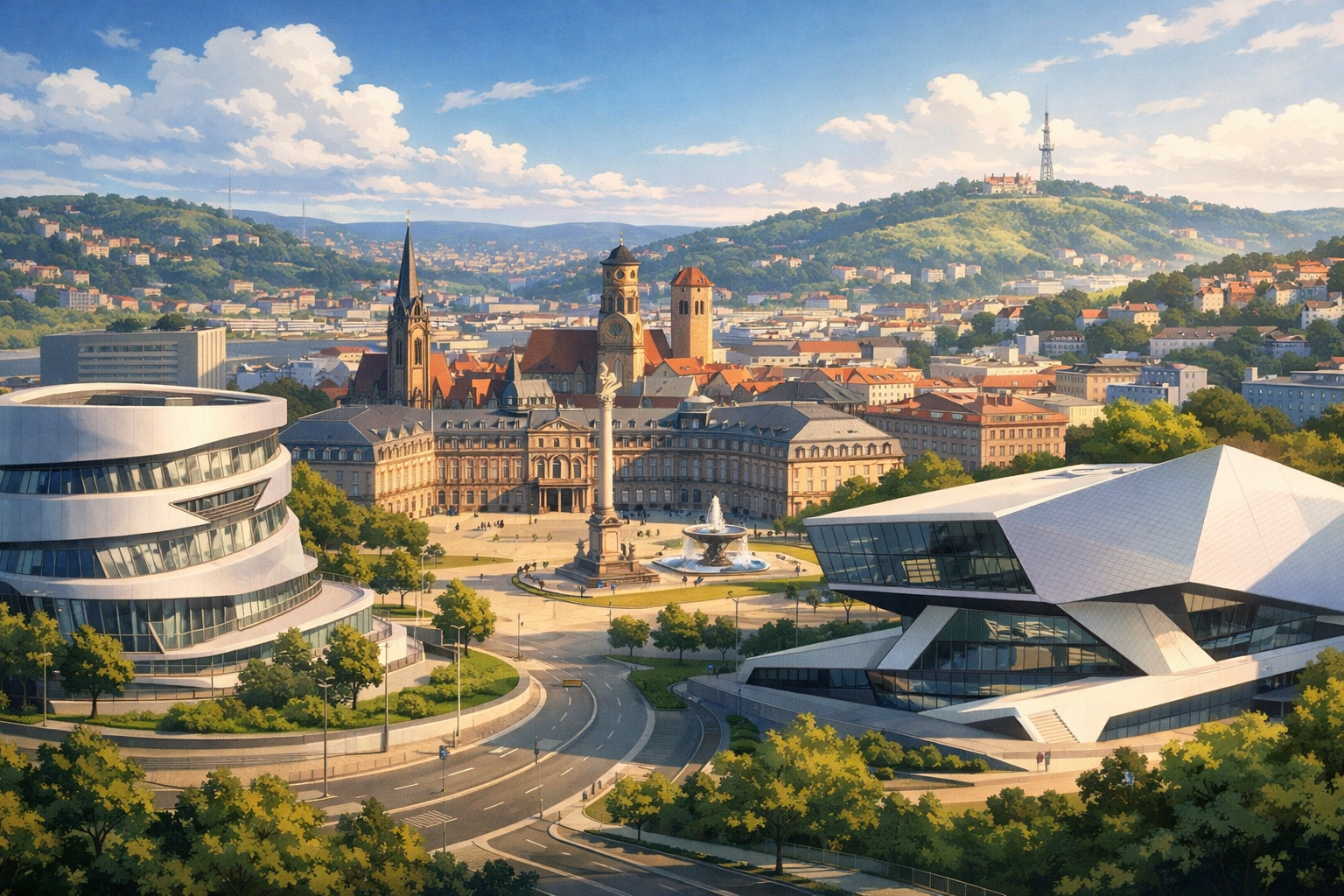
In Baden-Württemberg, Stuttgart is a dream stop for car lovers. Explore the iconic Mercedes-Benz Museum and Porsche Museum, where sleek design, racing legends, and German engineering come vividly to life.

🧭 DAY-BY-DAY ROUTE

Ready-made country and city routes with daily plans, sights, transport and accommodation. Buy PDF guides for independent travel.

🧭 DAY-BY-DAY ROUTE


Day 1 — Stuttgart: city center, Schlossplatz, old town, and evening panorama

  • 🚆 Arrival at Stuttgart Airport and transfer to the city center: taking the S-Bahn S2 or S3 to central Stuttgart usually takes about 25–30 minutes; from the station to a hotel in the center, another 5–15 minutes on foot or a short taxi ride is often enough. This kind of arrival realistically leaves time for check-in, a short rest after the journey, and a relaxed start to the route without overload.

  • 🚶 Start getting to know Stuttgart with the Schlossplatz area — it is not just the central square, but the visual heart of the city, where strict German urban architecture meets wide green spaces, fountains, grand facades, and the gentle rhythm of everyday city life. The character of Stuttgart is felt especially well here: it does not overwhelm with grandeur, but gradually opens up through details — the elegant ensembles of the New Palace, the long perspectives of Königstraße, lively café terraces, neat lawns, and the city crowd in which tourists, students, office workers, and local families mix. During the day this place feels bright and almost resort-like, and toward evening the square becomes especially photogenic: lighting, calm city noise, and open views make the walk very atmospheric.

  • 🚶 Next, it makes sense to move on to the old center — Schillerplatz, Stiftskirche, and the surrounding streets. This is a more intimate, historic Stuttgart: cobbled spaces, old facades, and the contrast between medieval motifs and modern city life. Here the route is easy to build without rushing: pause for coffee, step into a bookstore or gourmet shop, or simply sit in the square and catch the feeling of a city that lives not only around cars, but also around culture, wine, architecture, and a very measured South German way of life.

  • 🚶 After lunch, it is worth setting aside 1.5–2 hours for a calm rest, especially if you had an early flight. In the evening, head to Fernsehturm Stuttgart — the famous TV tower that has long become one of the city’s symbols. Even if the tower itself is not your main goal, this is where Stuttgart’s landscape is read especially clearly: the city lies in a bowl of hills, green slopes literally enter the urban fabric, and neighborhoods spread along the relief, creating a panorama unusual for Germany. At sunset the views become especially expressive: soft light falls on roofs, rails, vineyard slopes, and industrial zones, reminding you that Stuttgart is at once a cultural, engineering, and very lively city.


Day 2 — Stuttgart: Mercedes-Benz Museum + Neckarpark

  • 🚆 The trip to the Mercedes-Benz Museum from the city center usually takes about 20–30 minutes by public transport including access and waiting time, or about 15–20 minutes by taxi in normal traffic. It is better to leave in the morning and allow at least 3–4 hours for the museum itself so the visit does not turn into a race through the halls.

  • 🚶 Mercedes-Benz Museum is one of those places people come to Stuttgart for even if they are far from being car enthusiasts. It is not just a corporate museum, but a very well-staged story of how the automobile changed the 20th and 21st centuries. The building itself, designed in the shape of a complex spiral, already sets the mood: the route unfolds like a journey through time, and the visitor literally rises toward the origins of car manufacturing, then gradually descends through eras, technologies, design, mass culture, and sport. What is especially impressive here is not only the technology, but also the dramaturgy of the presentation: from Karl Benz’s first cars to the gleaming racing Silver Arrows, from executive limousines and rare concepts to buses, trucks, and special vehicles that show how much broader the world of Mercedes was than simply the premium sedan market.

  • 🚶 It is easy to spend half a day inside the museum without getting tired if you move at a comfortable pace and alternate the exhibition with breaks. The space is organized so that even dense technical material feels visually engaging: legendary models, racing history, cars for world leaders, engineering breakthroughs, and the evolution of forms and materials. At the same time, it is a brand museum, an industrial design museum, and a very clear story about European industrial culture. Even those who are usually not interested in cars remember the scale, light, sound, chronology, and the almost cinematic feeling of movement through the decades.

  • 🚶 After the museum, do not rush straight back to the center. The Neckarpark area is suitable for a freer walk and some rest: wide spaces, modern infrastructure, arenas, views of industrial Stuttgart, and the feeling of a large urban complex where sports, events, and automotive history exist side by side. It is convenient to have a late lunch or early dinner here to end the day without extra transfers. For the return trip to the center, again allow about 20–30 minutes.

Day 3 — Stuttgart: Porsche Museum + Zuffenhausen + final walk

  • 🚆 The trip from the center to the Porsche Museum usually takes about 20–25 minutes by S-Bahn to the Neuwirtshaus/Porscheplatz stop, after which the museum is practically right next to it. This makes the day very convenient logistically: no long transfers, a good amount of time for the visit, and enough room for final tasks before a flight or departure.

  • 🚶 Porsche Museum creates a completely different impression than the Mercedes-Benz Museum. If Mercedes tells a broad story of automotive history and the brand’s place in global culture, Porsche focuses on speed, engineering purity, sporting character, and the almost cult status of the marque. The museum architecture looks as if the building is hovering above the square, resting on a minimal number of points; this futuristic image very accurately matches the spirit of the brand. Inside, everything is assembled more compactly and energetically: legendary 356 and 911 models, racing cars, prototypes, engineering solutions, motorsport victories, and the evolution of a shape that has changed over decades carefully and almost like fine jewelry.

  • 🚶 Here it is felt especially strongly that Porsche is not just a car manufacturer, but a brand with an almost emotional, collectible aura. The exhibition is strong precisely because of this combination of aesthetics and mechanics: the cars are presented as objects of desire, as symbols of an era, as the result of precise German engineering, and as part of a great myth of speed. Even if you cannot distinguish generations of the 911 at first glance, the museum still works on an emotional level: light, spatial geometry, polished bodies, racing silhouettes, and a feeling of concentrated energy create a very powerful finale to the whole trip.

  • 🚶 After the museum, leave time for lunch and a short break. If you still have the energy, finish the tour by returning to central Stuttgart for the last 2–3 hours: walk along Königstraße, buy souvenirs, head out once more to Schlossplatz, or sit in a café while calmly gathering your impressions. This ending works especially well for a 3-day route: you manage to see not only the region’s two main automobile museums, but also to feel the city itself — its relief, calm, architecture, and very recognizable South German atmosphere.

Flight tickets

eSIM for travel

Buy PDF guide

Buy PDF guide — 6.43 USD

PDF — 6.43 USD