
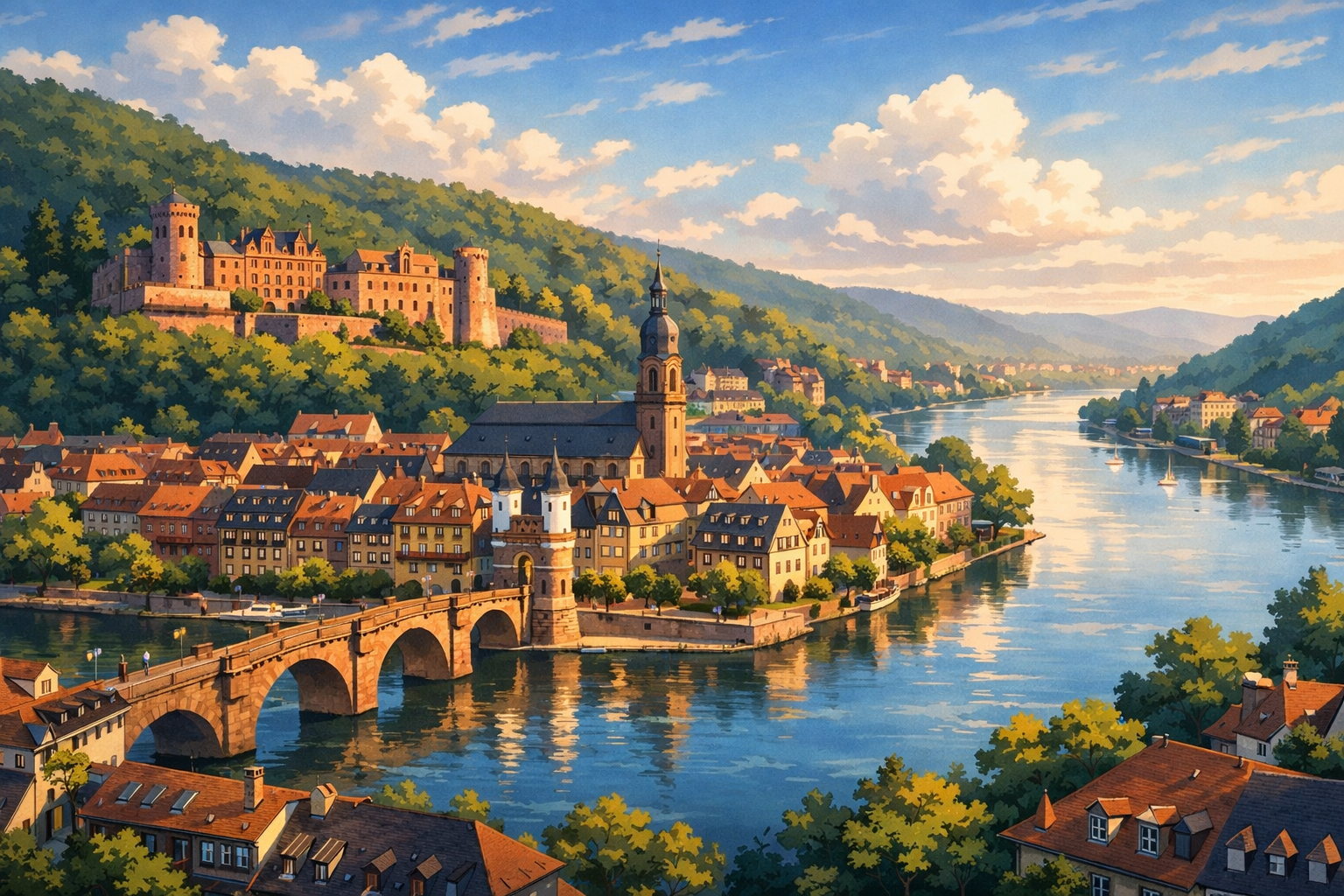
Day 1 — Heidelberg: old town, Market Square, Old Bridge axis, and the castle
🚆 It is convenient to plan your arrival in Heidelberg via Heidelberg Hauptbahnhof. From the main station to Altstadt, people usually get there by bus or a tram-bus combination in about 10–20 minutes, and to the Rathaus/Bergbahn area without long transfers. If traveling from Frankfurt Airport, the most practical option is a train via Mannheim; with good connections, the trip takes about 50–70 minutes, after which another 10–20 minutes usually goes on city transport to the old town.
🚶 Start your route in Altstadt — the historic heart of Heidelberg, stretched along Hauptstraße, one of the longest pedestrian shopping streets in Europe. Here the city does not feel like an open-air museum, but rather like a rare combination of a living university environment, baroque architecture, and a very gentle, almost theatrical romanticism. Facades in warm sandy, pinkish, and ochre tones, narrow side streets, old signs, small wine bars, and cafés create that very atmosphere of “classic Germany” that draws visitors here. Along the way, it is worth stepping out to Marktplatz, where the city’s historic perspective reads especially beautifully: cobblestones, the Hercules fountain, house gables, and the silhouette of Heiliggeistkirche set the scale for the whole walk. This is exactly the place not to rush, but to let the city open up through details — the ringing of bells, the mountain slope with castle ruins above the rooftops, the noise of tourists, students, and locals blending into a very natural urban scene.
🚶 Heiliggeistkirche on the market square is one of the main visual highlights of old Heidelberg. This late Gothic church is perceived not as a stand-alone monument, but as the architectural center of the entire Altstadt: its massive volume, elongated tower, and strict stone form gather the whole historic fabric of the quarter around it. Inside, the space feels calm and composed, while outside the church is especially beautiful in changing light: in the morning it looks строгой и almost northern, and by evening the stone becomes softer and warmer. Nearby, it is convenient to pause for coffee or an early lunch, because this central part of the old town is best suited to an unhurried start without the feeling of racing through sights.
🚶 Then walk to Karl-Theodor-Brücke, better known as Alte Brücke — the Old Bridge across the Neckar. This is not just a convenient crossing, but one of the main panoramic points in the whole city. From the bridge, three layers of Heidelberg are especially striking all at once: the river and sightseeing boats below, the dense baroque buildings of Altstadt in the middle, and the castle hanging above the city on the slope. The stone arches, the gate towers on the old town side, and the view opening onto the opposite bank create an almost perfect postcard. It is worth lingering here for at least 20–30 minutes, especially if the weather is clear: the Neckar adds air, depth, and a sense of movement to the route, and the photos turn out to be among the strongest of the whole trip.
🚶 From the Kornmarkt area or the Rathaus/Bergbahn stop, head up to Heidelberg Castle. It is easy to walk to the lower funicular station in about 10–15 minutes from the central part of Altstadt, and then choose either a short Bergbahn ride or a more atmospheric walk up the slope. Heidelberg Castle is not a “neat German palace,” but a grand set of romantic ruins that became a symbol of the city back in the 19th century. What impresses most here is precisely the combination of greatness and incompleteness: massive walls, Renaissance facades, partially ruined wings, terraces with views over the Neckar valley and the rooftops of the old town. Within the complex, Ottheinrichsbau with its richly decorated facade, the enormous Großes Fass, and the viewpoints from which Altstadt looks like a carefully laid-out historic miniature in the palm of your hand stand out in particular. You should allow at least 2–3 hours for the castle and courtyard, including a rest break and photos.
🏛️ Inside the castle complex, it is definitely worth visiting the Deutsches Apotheken-Museum, located at Schloss Heidelberg, 69117 Heidelberg. This is one of those museum stops that unexpectedly make the route deeper: instead of abstract history, it shows what pharmacies, laboratories, vessels, formulas, and the very culture of healing looked like in Europe over the centuries. The historic pharmacy interiors, cabinets, ceramics, glass, and instruments feel very vivid, and the museum complements the castle well with an intellectual, almost “cabinet-like” layer of impressions. If you do not want to overload the day, 45–60 minutes is a sensible amount of time to give the museum.
💤 It is best to spend the evening back down in the old town: stroll down slowly on foot or by Bergbahn, have dinner in one of the Altstadt restaurants, and walk to the river once more. After the daytime crowds, Heidelberg becomes noticeably softer and more intimate: illuminated facades, the dark silhouette of the castle above the city, reflections in the Neckar, and a calmer street rhythm make the evening here an especially good ending to the first day.