
Buy PDF guide

Buy PDF guide — 12.85 USD

PDF — 12.85 USD

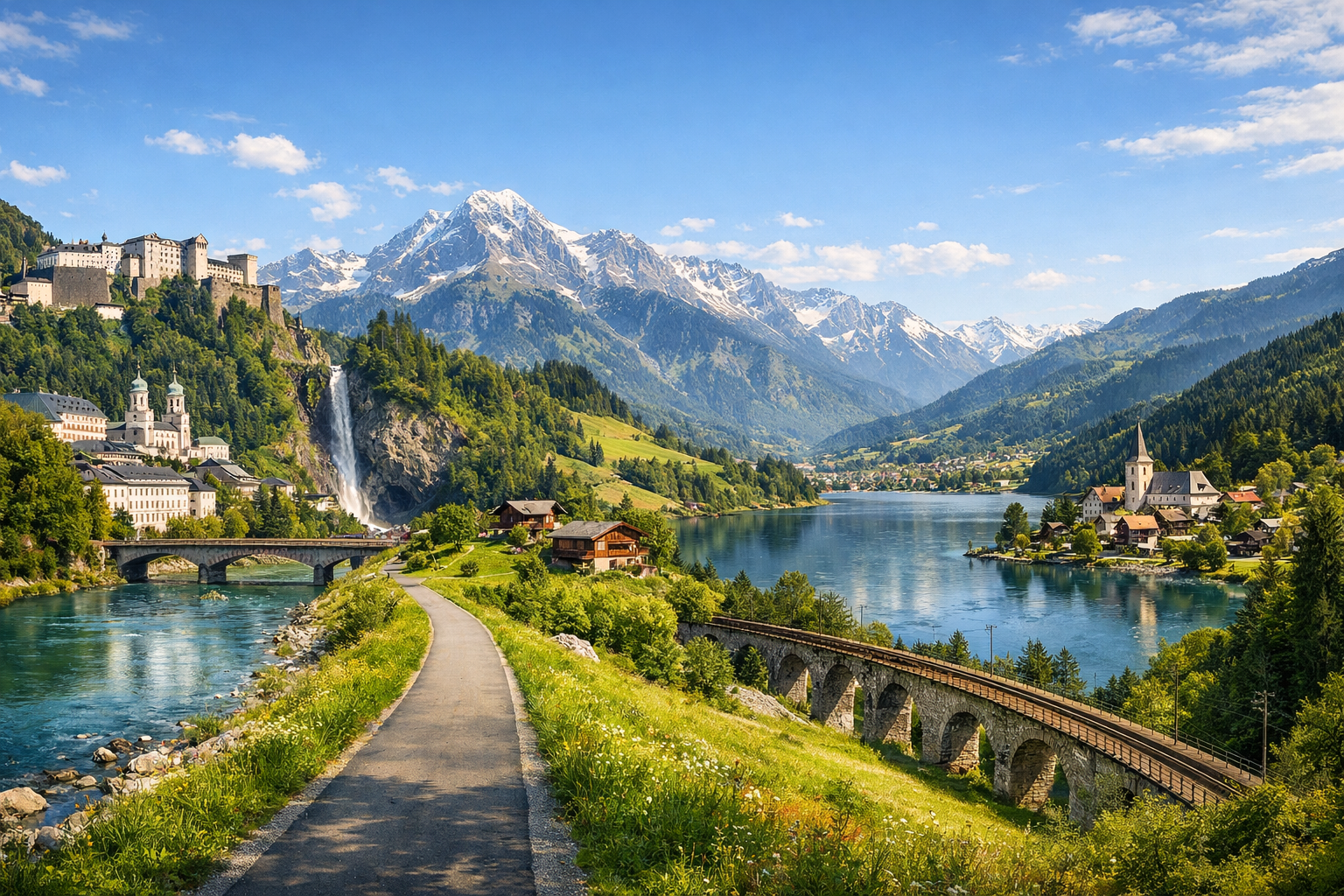
Austria, the states of Salzburg and Carinthia. Cycling tour along the Alpe–Adria route: from Salzburg to Villach. Difficulty: medium. Season: May - September.

Austria, the states of Salzburg and Carinthia. Cycling tour along the Alpe–Adria route: from Salzburg to Villach. Difficulty: medium. Season: May - September.

Cycle from Salzburg to Villach on one of Austria’s most scenic long-distance routes, where baroque towns, river valleys and Alpine panoramas unfold with every stage. Crossing from Salzburg into sunny Carinthia, the medium-difficulty Alpe–Adria trail pairs rewarding climbs with memorable descents, best enjoyed from May to September.

🚲 ROUTE BY DAY

Ready-made country and city routes with daily plans, sights, transport and accommodation. Buy PDF guides for independent travel.

🚲 ROUTE BY DAY


Day 1 — Salzburg → Hallein: a gentle start along the Salzach

  • 🚲 Start in Salzburg and ease into the ride along the embankments and bike paths of the Salzachradweg / Alpe-Adria Radweg toward Hallein. Roughly 22–28 km, with pure riding time of about 1.5–2 hours, minimal elevation gain, and mostly asphalt plus good urban/suburban bike paths. This is the easiest day, ideal for picking up a rental bike and checking your fit, bags, and brakes without overloading yourself. Along the way, it’s convenient to make 1–2 stops: Hellbrunn Palace with its park as a beautiful green departure from the city, and closer to Hallein, the historic center and riverside. Water and food are easy to restock in Salzburg, Hellbrunn, and Hallein; cafés and supermarkets are frequent. It is best to stay overnight in Hallein so the next day remains short and leaves time for Salzwelten or the Keltenmuseum. Road nuances: within Salzburg there are many cyclists and pedestrians, so it’s better not to depart at peak time; strictly keep to bike lanes and do not ride through pedestrian areas of the Altstadt. The day is realistic for an ordinary cycle tourist because it is short, flat, and allows you to adapt to the route without rushing.


Day 2 — Hallein → Golling: salt country, river, and waterfall

  • 🚲 From Hallein along the official Alpe-Adria / Salzachradweg corridor to Golling. Roughly 28–35 km depending on detours to Salzwelten or into the town center, with pure riding time of 2–2.5 hours, little but already noticeable elevation gain, and a gently rolling valley profile. The surface is asphalt bike paths, quiet secondary roads, and short stretches near local traffic. Main stops along the way: Salzwelten Salzburg in Hallein-Dürrnberg as a cultural start to the day, the old center of Kuchl or riverside stretches of the Salzach for a break, and a finishing walk to the Gollinger Wasserfall if you still have the energy. Water is easy to refill in Hallein and Kuchl, and snacks can be found in villages along the valley; in Golling there are hotels, bakeries, and shops. Staying overnight in Golling makes sense because it is a compact and very convenient base on the route. Nuances: on some links the route runs near the B159 road, but the tourist cycling corridor itself usually shifts onto quieter sections; after rain, the natural loop to the waterfall can be slippery, so it is better to leave the bike and walk. The day is realistic thanks to the moderate distance and frequent services along the way.

Day 3 — Golling → Bischofshofen: castle, cliffs, and the Salzach valley

  • 🚲 One of the most beautiful classic days of the Austrian section of the route: from Golling through Werfen to Bischofshofen. About 34–42 km, with pure riding time of 2.5–3.5 hours, moderate elevation gain, and mostly asphalt, with occasional compact gravel on some riverside or rural segments. Main stops: Salzachöfen or a short nature break by the gorge near Golling, then Werfen with a view of Fortress Hohenwerfen, and if desired, a longer excursion option to Eisriesenwelt not by bike but as a separate ascent with extra time set aside. It is best to restock water and food in Golling, Werfen, and Sankt Johann im Pongau or already in Bischofshofen. Staying overnight in Bischofshofen is best: the town sits well on the route, has decent infrastructure, and reduces the load for the next day toward Gastein. Day nuances: keep an eye on Alpe-Adria signage, because there are road branches and bridges in the valley; do not try to ride on fast car links. On a hot day the section is exposed, so sunscreen and an early start are useful. The day is realistic for an ordinary traveler thanks to clear navigation, moderate length, and good infrastructure.

Day 4 — Bischofshofen → Bad Gastein: the most demanding cycling day of the route

  • 🚲 This is the key day with the climb into the Gastein Valley. From Bischofshofen through Sankt Johann, Schwarzach, and then up the valley to Bad Gastein. Roughly 48–58 km, with pure riding time of 4–5.5 hours and elevation gain of approximately 600–900 m depending on the variant and exact overnight point. The surface is mixed: bike paths, secondary asphalt roads, and in places narrower local roads. For an ordinary traveler, the difficulty is moderately hard, and on a regular bike it will already feel close to hard for some riders; on an e-bike it is noticeably more comfortable. Main stops: Schwarzach/St. Veit for a solid lunch and a check-in on how you feel before the climb, then Bad Hofgastein as a logical pause with water and shops, and the finish at the famous Bad Gastein Waterfall. It is best to stay overnight in Bad Gastein so that in the morning you can calmly deal with crossing the Tauern barrier safely. Nuances: this is exactly where it is important not to overestimate your strength — start early, keep a steady pace, do not skimp on water or e-bike battery; in rain, descents and turns in the valley become more slippery. The day is realistic because the distance remains within touring limits, and the elevation gain is distributed along the valley rather than concentrated in one extreme pass.

Day 5 — Bad Gastein → Mallnitz by train through the Tauern, then Mallnitz → Spittal an der Drau by bike

  • 🚲 The most sensible and safest day of the whole tour: from Bad Gastein by train/rail link through the Tauernschleuse to Mallnitz-Obervellach, then back in the saddle and down the Carinthian side to Spittal an der Drau. The cycling part is usually 38–50 km, with pure riding time of 2.5–4 hours, little to moderate elevation gain, and mostly a pleasant descent through the valley. The surface is paved bike paths, quiet rural roads, and occasional compact gravel. Main stops: Mallnitz as the alpine start after the train, Flattach for a coffee or snack break and a possible short walk to Raggaschlucht, then Obervellach or Möllbrücke before the finish in Spittal. Water and food are easy to restock in Mallnitz, Flattach, and Obervellach; services are already less frequent than in the Salzach valley, but still sufficient for a touring route. Staying overnight in Spittal makes sense because of the good infrastructure, railway station, and convenient final push to Villach. Nuances: do not try to look for a car route through closed or unsuitable tunnel links between Gastein and Carinthia — the train here is not a “lazy” option but the safe and standard logistics of the route. The day is realistic because the tough barrier is handled by rail, while the bike section remains pleasant and manageable.

Day 6 — Spittal an der Drau → Villach: a calm Carinthian finish on the Drauradweg

  • 🚲 Final day along the Drau to Villach on a very tourist-friendly and cyclist-friendly corridor of the Drauradweg / Alpe-Adria. About 38–45 km, with pure riding time of 2.5–3.5 hours, little elevation gain, and mostly good asphalt and quality riverside bike paths. Difficulty is moderate leaning toward easy, especially after the previous days. Along the way, it’s convenient to stop around Seeboden or on calm waterside stretches, then take a longer break in Paternion or Feistritz an der Drau and ride leisurely into Villach via the city’s bike-path network. Water and food are easy to find in Spittal, Paternion, and already on the approach to Villach. Overnight stay — in Villach, near the station or old town: convenient for the return train and an evening walk through the center. Nuances: in good weather there can be a headwind on the river section; in high season the popular stretches have many family cyclists, so it is better to ride calmly and not try to maintain a road-bike pace. The day is realistic for an ordinary cycle tourist because after a long journey it provides a beautiful, flat, and logical finish without overload.

Flight tickets

eSIM for travel

Buy PDF guide

Buy PDF guide — 12.85 USD

PDF — 12.85 USD