
Buy PDF guide

Buy PDF guide — 15.00 USD

PDF — 15.00 USD

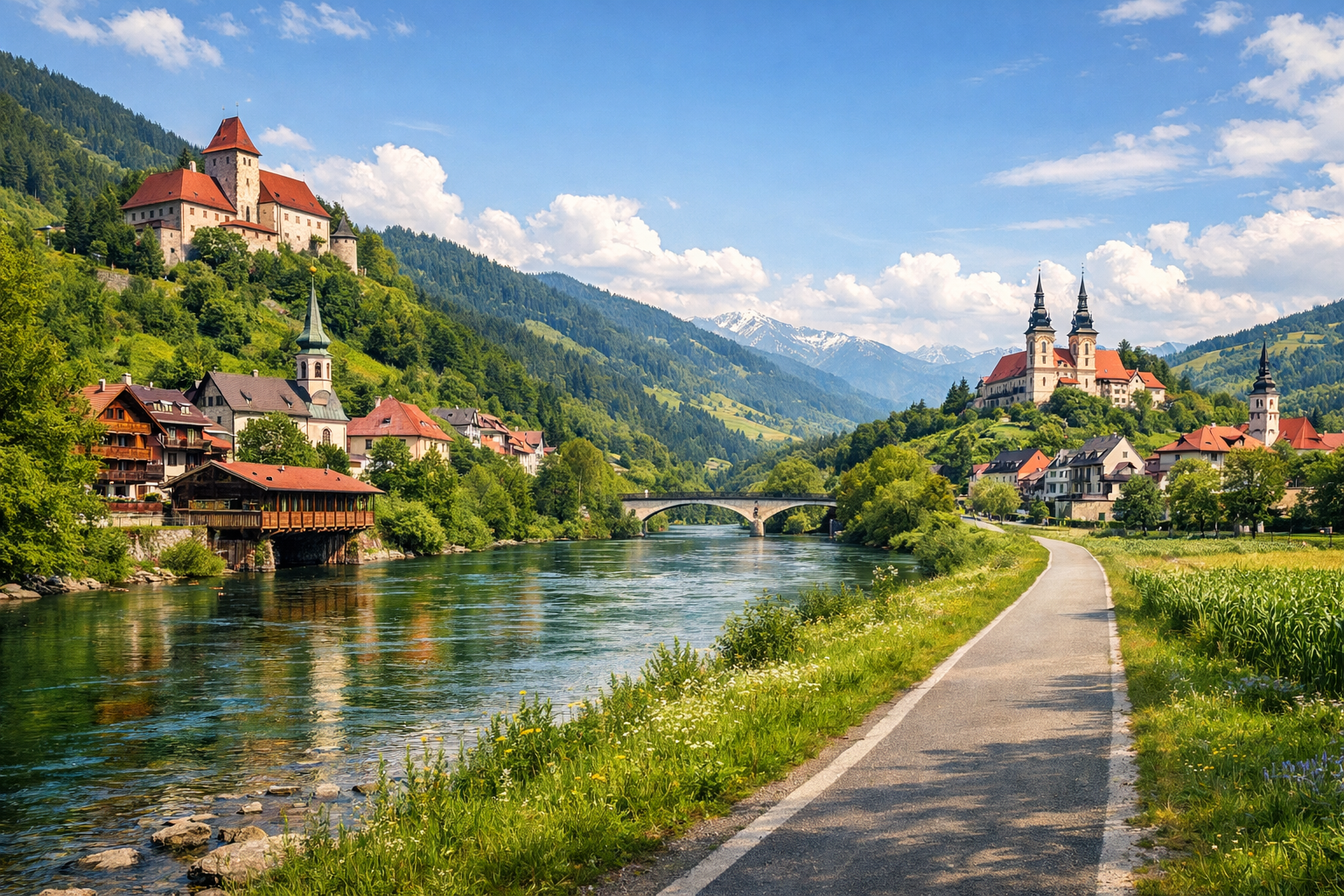
Austria. Cycling tour along the Murradweg: from Murau to Bad Radkersburg. Difficulty: moderate - easy. season: May - September.

Austria. Cycling tour along the Murradweg: from Murau to Bad Radkersburg. Difficulty: moderate - easy. season: May - September.

Cycle through Austria’s green heart on the Murradweg, from the alpine charm of Murau to the sunlit streets of Bad Radkersburg. This moderate to easy route rolls past historic towns like Judenburg, Leoben and Graz, with vineyard country and gentle river landscapes unfolding all the way south.

🚲 ROUTE BY DAY

Ready-made country and city routes with daily plans, sights, transport and accommodation. Buy PDF guides for independent travel.

🚲 ROUTE BY DAY


Day 1 — Murau → Judenburg: entering the Murtal

  • 🚲 Start in Murau, finish in Judenburg. Approximately 50–51 km, pure riding time about 5 hours, elevation gain ≈286 m, descent ≈400 m. Officially, this section of the Murradweg is considered moderate, but for a regular traveler on a trekking bike or e-bike it remains very realistic: the route follows the Mur valley, without Alpine passes, with clear navigation via R2 / Murradweg signs. The surface is mostly comfortable: paved cycle paths, compacted riverside sections, quiet local roads, and short transitions through small settlements. The main stops along the way are Scheifling, the ruins of Frauenburg near Neumarkt/Scheifling, and the mineral spring in the Sauerbrunn/Thalheim area. Water and food are easy to restock in Murau before departure, then in Scheifling and at intermediate village stops; in hot weather it’s better to set out earlier because from May to September the valley can heat up much more during the day than in the morning. It’s best to stay overnight in central Judenburg so you can leave the bike safely and go up to the Sternenturm tower in the evening. Road nuances: this is not a sporty mountain day, but there are sections where the path runs alongside the road, so lights, a bell, and visible clothing are useful even during the day. The day is realistic because the distance fits within a comfortable range, the elevation gain is moderate, and the settlements along the way mean you don’t have to carry too much food.


Day 2 — Judenburg → Leoben: the easiest river stage

  • 🚲 Start in Judenburg, finish in Leoben. Approximately 55 km, pure riding time about 4 hours, elevation gain only ≈68 m, descent ≈248 m. This is one of the friendliest days of the tour: the valley opens up wider, the route goes almost without demanding climbs, and it works well even for those riding light for the first time. The surface is mostly asphalt, cycle paths, quiet country roads, and flat riverside stretches. Along the way it makes sense to take 2–3 stops: Knittelfeld for coffee and a second water refill, the Fohnsdorf area with thermal infrastructure, and also a short break in one of the villages before Leoben. An important current nuance: the official tourist description mentions a temporary closure due to rockfall in the Winkelbauernweg / St. Michael area between the industrial zone and Schladnitz, so before departure it is worth checking the latest status of the local detour and not ignoring temporary signs on site. Leoben is a convenient overnight stop: the city is larger, making it easier to find dinner, bike service, and a spare tube. This day is realistic because with little elevation and good navigation it remains comfortable even with a long lunch stop, sightseeing in central Leoben, and an unhurried pace of 13–16 km/h.

Day 3 — Leoben → Bruck an der Mur: a short day with time for walks

  • 🚲 Start in Leoben, finish in Bruck an der Mur. Approximately 35–40 km, pure riding time 2.5–3 hours, elevation gain insignificant, about 100–150 m total. This day is deliberately kept shorter so the tour doesn’t turn into a race: after two full stages, it’s pleasant to ride the valley calmly, pause by the water, and arrive in Bruck early. The surface is again mostly comfortable — R2 cycle paths, asphalt, river embankments, and quiet roads between villages. The main stops are St. Michael in Obersteiermark, beautiful open sections of the Mur valley, and the historic center of Bruck an der Mur, where the Mur and Mürz rivers meet. Water is easy to get in Leoben and then refill in settlements along the way; lunch is best planned in Bruck itself so there’s no need to rush. Staying overnight in Bruck is convenient both logistically and for recovery: the town stands directly on the route, and around it there are both hotels and a camping option near the Murradweg. Road nuances: after reports of temporary closures in the Leoben/St. Michael area, it makes sense to follow only current detour signs, not an old GPX track without checking. The day is realistic because the short distance offsets any headwind, repair pause, or late start and leaves time for laundry, chain maintenance, and a relaxed dinner.

Day 4 — Bruck an der Mur → Graz: longer, but through an easy-to-follow valley

  • 🚲 Start in Bruck an der Mur, finish in Graz. Approximately 60–63 km, pure riding time 4.5–5.5 hours, elevation gain moderate, usually up to 250–350 m total due to rolling terrain and small in-and-out deviations from the river line. This is already a full-fledged touring day, but still realistic: the route goes through Frohnleiten and further along the Murtal to Graz, without harsh passes, with green views, orchards, farms, and limestone walls above the valley. The surface is mixed but comfortable: cycle paths, some sections on local roads, urban entrances and exits, and short stretches next to cars. The main stops are Frohnleiten with its beautiful old center, one of the riverside breaks between Frohnleiten and Peggau/Deutschfeistritz, and the northern entrance to Graz, where the route already becomes noticeably more urban. Water and food are easy to restock in Bruck, Frohnleiten, and at gas stations/cafés closer to Graz; on a hot day it’s better to take at least two bottles. It makes sense to stay overnight in central Graz or near the Murufer so you can continue the route without unnecessary detours. Road nuances: as you approach Graz, city navigation becomes more intense, intersections appear, and there are shared sections with pedestrians, so it’s better not to arrive too late in the evening during rush hour. The day is realistic because 60+ km here follow a low-mountain river axis rather than switchbacks, and at an average touring speed it is comfortably completed in half a day.

Day 5 — Graz → Leibnitz: the city stays behind, wine Styria begins

  • 🚲 Start in Graz, finish in Leibnitz. Approximately 40–45 km, pure riding time 3–3.5 hours, elevation gain small, about 100–200 m. This is a good transition day: in the morning it’s still the urban Murradweg, and then more and more open fields, meadows, and calm South Styrian landscapes appear. The route stays on the official R2, it is easy to follow, and the terrain is noticeably easier than in the northern part of the region. The surface is mostly excellent: paved cycle paths, embankments, and quiet secondary roads. The main stops are the southern bank of the Mur in Graz, Wildon as a logical coffee break, and then the approach to Leibnitz with entry into the Südsteiermark wine zone. Water and snacks are easy to pick up in Graz, then in Wildon and closer to Leibnitz; there are shops, but between them there are long peaceful stretches without dense urban infrastructure. It’s best to stay overnight in Leibnitz itself so you can walk around the Hauptplatz in the evening and have dinner without extra transfer. Road nuances: leaving Graz through the city requires attention to markings and pedestrians, but after that the day is very friendly. The day is realistic in that after the long stage to Graz it gives the body a chance to recover, while still leaving energy for a side trip to the vineyards if desired, without crazy mileage.

Day 6 — Leibnitz → Mureck: floodplains, fields, and the slow south

  • 🚲 Start in Leibnitz, finish in Mureck. Approximately 30–35 km, pure riding time 2–2.5 hours, elevation gain minimal. We intentionally divide the officially more family-friendly southern section into two days so as not to rush to the finish and to truly feel the river landscape: floodplain forests, rural stretches, the warm light of southern Styria, and the borderland atmosphere. The surface is one of the most comfortable combinations in the tour: riverside cycle paths, calm asphalt, local rural lanes, and in places very pleasant flat sections for e-bikes and leisurely touring. Along the way it is worth taking breaks in small villages and at viewpoints by the Mur; if you don’t want to hurry, you can have a long lunch already in Mureck. Water should be filled in Leibnitz and topped up at the first opportunity in villages, because there are fewer services here than in Graz. Staying overnight in Mureck is convenient both before the final short push to Bad Radkersburg and for those who like to end the tour calmly, with an evening walk around a small town. Road nuances: in the open lowlands you may feel a headwind, and in peak summer there can be heat without much shade on the straight rural sections. The day is realistic because the distance is short, the terrain is almost flat, and the southern section of the Murradweg is considered one of the most accessible for unhurried tourists.

Day 7 — Mureck → Bad Radkersburg: finish by the thermal baths and old town

  • 🚲 Start in Mureck, finish in Bad Radkersburg. Approximately 25–30 km, pure riding time 1.5–2 hours, elevation gain virtually absent. This is an easy and very pleasant final day: the route goes through the flat part of southern Styria, across calm river and rural landscapes, and the finish comes not at a noisy station but in one of the most atmospheric thermal towns in the region. The surface is comfortable cycle paths and local asphalt, with clear navigation on R2. The main stops are short nature breaks in the Mur floodplains, the borderland mood before Bad Radkersburg, and the historic part of the town itself, where you can leave the bike and walk around on foot. Water and a snack are best taken in Mureck, even though the finish is close; in Bad Radkersburg it is already convenient to end the tour with a late lunch, spa, or walk through the old streets. It’s best to stay overnight in a bike-friendly hotel near Parktherme or in the old town. Road nuances: this is a calm day, but in the rain asphalt and cobbles in the old town can be slippery; near the Slovenian border it’s easy to get carried away by extra loops, so it’s better to decide in advance whether you want an additional ride across the bridge. The day is realistic because it is short, almost flat, and allows you to finish the route comfortably even after fatigue, bad weather, or a late morning start.

Flight tickets

eSIM for travel

Buy PDF guide

Buy PDF guide — 15.00 USD

PDF — 15.00 USD