
Buy PDF guide

Buy PDF guide — 10.71 USD

PDF — 10.71 USD

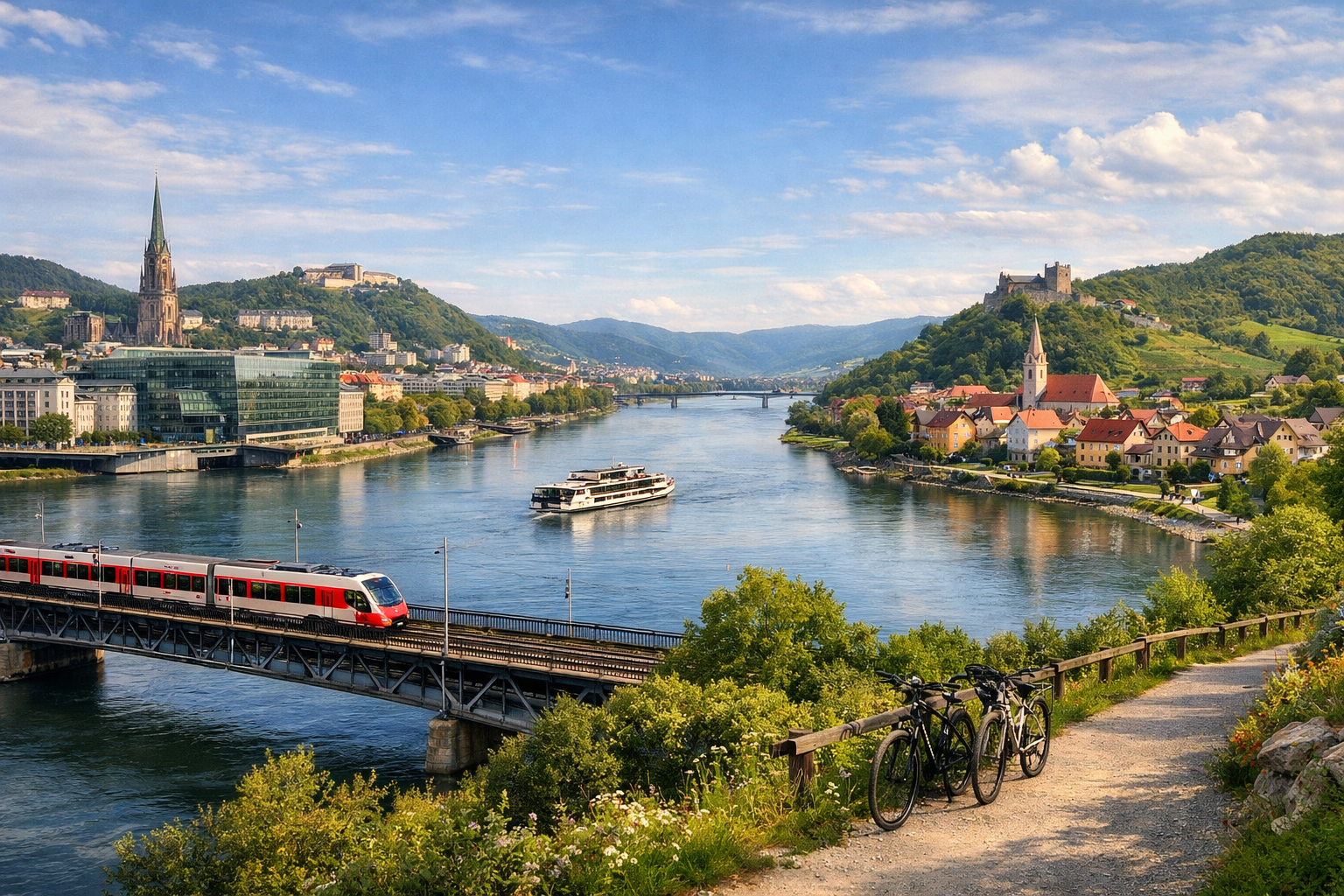
Austria, Linz and the Danube Valley. A budget itinerary through modern Linz and small Danube towns using regional trains and bicycles.

Austria, Linz and the Danube Valley. A budget itinerary through modern Linz and small Danube towns using regional trains and bicycles.

Discover Austria beyond the usual postcard scenes with a budget-friendly journey from creative Linz into the Danube Valley. Regional trains and easy bike rides link riverside towns like Enns, Mauthausen, and Grein, where baroque streets, quiet lanes, and broad water views unfold at an unhurried pace.

🧭 DAY-BY-DAY ITINERARY

Ready-made country and city routes with daily plans, sights, transport and accommodation. Buy PDF guides for independent travel.

🧭 DAY-BY-DAY ITINERARY


Day 1 — Linz: modern center, the Danube, and an affordable city start

  • 🚆 The route base is Linz. For a budget trip, it makes sense to stay all 5 days in one city and take short, light day trips: this saves money on moving around, avoids wasting time on constant check-ins, and keeps flexibility if the weather on the Danube suddenly turns bad. From Linz Airport, the center is easy to reach by bus 601 to Linz Hauptbahnhof in about 22 minutes; it is cheaper than a taxi and realistic even with carry-on luggage.

  • 🚶 It’s best to devote the first day to Linz itself — a city that knows how to combine old Austria with a very modern urban environment. Start at Hauptplatz, one of the country’s largest historic squares: the wide Baroque space does not feel overly grand, but rather sets a calm rhythm. From here it is easy to understand the city’s geography: the southern bank of the Danube, the bridges, the silhouette of the old center, and the tram line that literally ties the route together. For a budget traveler, this is an ideal starting point: there are many bakeries, supermarkets, inexpensive snack spots, and transport stops around.

  • 🚶 Then head down to the Ernst-Koref-Promenade and walk along the Danube to Lentos Kunstmuseum Linz. Even if you don’t go inside, the building itself is worth attention: the elongated glass volume on the riverbank looks like a calm architectural response to the water and the sky. It is especially pleasant to stroll here without rushing: Linz reveals itself not as a “city of must-check sights,” but as a convenient and lively place with long bike paths, broad walkways, and a very legible urban landscape. If the budget is really tight, focus on the walk and keep the museum as a rainy-day option.

  • 🚶 Cross the Nibelungenbrücke to the northern bank, to the area around Ars Electronica Center. This is one of Linz’s most recognizable modern landmarks: the museum of the future and media art shapes the city’s image as a technological and cultural laboratory, not just a transit hub between Vienna and Salzburg. Even from the outside, the place makes a strong impression — especially toward evening, when glass, water, and city lights begin to work as a single stage. For a budget day, you can limit yourself to viewing it from outside, walking along the riverbank, and resting on benches by the river.

  • 🚋 Toward evening, take the Pöstlingbergbahn from Hauptplatz. It is not the cheapest part of the day, but one of the most worthwhile: instead of expensive viewpoints or sightseeing tours, you get a beautiful ride up a local mountain line in about 20 minutes. From the top of Pöstlingberg, Linz looks surprisingly coherent: the Danube stretches like a wide ribbon, the industrial and cultural zones do not clash, and the city feels compact and livable. If you want to save even more, ride only one way, then return on the same tram after a short walk around the viewpoints.

  • 🍽️ For meals on this day, it is best to keep to a simple plan: breakfast from a bakery or supermarket, an inexpensive lunch such as kebab, Asian take-away, or soup/sandwich in the center, and in the evening another simple city option without full restaurant seating. A realistic food budget with this approach is about 18–30 € per day per person.


Day 2 — Linz: a cycling day along the Danube and through modern districts

  • 🚲 The second day is ideal for cycling. Linz has urban bike infrastructure and the public rental system City Bike Linz, and the city itself sits right on the Danube Cycle Path — one of Europe’s most famous cycling routes. This makes it possible to spend a full day with almost no transport costs and see more than on foot, but without extreme effort. For a budget trip, this is one of the best ways to explore the city: you save money, do not depend on transfers, and can easily change your pace.

  • 🚶/🚲 Start with a flat section along the Danube: from the center, move along the embankments and cycle lanes through Urfahr toward the quieter stretches of the riverbank. Linz is great because modernity here is not limited to museums — it can be read in the urban fabric itself: bridges, university districts, public transport lines, river views, and industrial silhouettes on the horizon create the feeling of a “working” city rather than a museum backdrop. A bicycle helps you feel this especially well.

  • 🚲 At midday, make a loop via Ars Electronica Center, the riverside stretches, and back to the historic center, then stop at Nordico Stadtmuseum Linz or simply take a coffee break in the square. The budget logic of such a day is that you alternate free views, relaxing by the water, and short museum options depending on your interests. If it rains, shorten the cycling part and replace it with one museum and a walk through the covered central streets.

  • 🚶 In the second half of the day, you can walk to the outside of Mariendom and through the surrounding quarters. Even without expensive entry programs, this area provides a good contrast to the Danube line: here Linz becomes more vertical, a little quieter, and more ceremonial. Visually, the city keeps changing — from water and glass to stone, church facades, and narrow passages of the old center. For a short trip, this matters: you do not get tired of monotony.

  • 💤 In the evening, return the bike and save your energy for the next outings in the Danube Valley. With a budget pace, it is better not to overload the program with night bars and long late transfers: Linz works best as a calm, practical base. If your accommodation is near Hauptbahnhof, Hauptplatz, or the northern Danube bank, getting back will be simple and safe.

Day 3 — Enns and Mauthausen: a small Danube town and serious historical memory

  • 🚆 Transfer: Linz Hbf → Enns by ÖBB regional train, usually about 15–20 minutes. This is one of the cheapest and most convenient day trips from Linz: a short journey, frequent options, and almost no logistical fatigue.

  • 🚶 Enns is often called Austria’s oldest town, and what you feel here is not touristy pretension but the calm confidence of a small historic center. It is pleasant simply to walk along Hauptplatz, looking at facades, the town’s rhythm, and details without the crowds and bustle of major capitals. This is exactly the kind of Danube town that suits a budget route best: compact, atmospheric, and not dependent on expensive attractions to leave an impression.

  • 🏛️ If you are interested in the region’s Roman history, visit Museum Lauriacum. This is not a giant blockbuster museum, but a local, substantial stop that helps you understand how deeply the Danube corridor is woven into European history. Even a short visit adds depth to the route: you see not just a charming Austrian town, but a place where ancient, medieval, and modern layers intersected.

  • 🚆 After lunch, transfer Enns → Mauthausen or return via Linz with a further segment — depending on the most convenient timetable for your date. The rail part is short, but after that it is important to check local access to the memorial in advance and allow extra time for the climb, waiting for a bus, or a short taxi ride from the station. This day should not be too tightly packed: the memorial calls not for haste, but for an inner pause.

  • 🚶 Mauthausen Memorial is one of the most difficult and important places in the whole region. It is not a “sight” in the entertainment sense, but a space of remembrance where you should behave especially quietly and respectfully. In the context of a route through the beautiful Danube, such a stop is fundamentally important: it restores historical depth and reminds you that European landscapes almost always carry not only beauty, but also tragic experience. Plan at least 2–3 hours for the memorial without rushing.

  • 🚆 Return to Linz in the evening. In terms of money, this day remains quite budget-friendly: short regional segments are usually better value than long-distance trips, and the main value of the route is created not by expensive tickets, but by the strong contrast between the coziness of Enns and the historical weight of Mauthausen.

Day 4 — Grein and Strudengau: a small Danube town, theater, and river scenery

  • 🚆 Transfer: Linz Hbf → Grein on ÖBB regional trains, approximately about 1 hr 10 min–1 hr 30 min depending on connections and the specific service.

  • 🚶 Grein is exactly the kind of small Danube town that makes a compact Upper Austria route worthwhile. It does not try to overwhelm with scale; its strength lies in its proportions, gentle terrain, closeness to the water, and the feeling of old river Europe. When you reach Stadtplatz, everything feels very human in size: the houses, the sloping streets, the view of the Danube, the slow rhythm of local life. It is an ideal place for a traveler who wants not “attractions,” but atmosphere.

  • 🏛️ One of the main highlights is the historic Stadttheater Grein in the old town hall building. Even if you do not catch a performance, the very existence of such a theater in a small town is strikingly beautiful: it feels as though cultural history here is woven directly into everyday life. Nearby, the town becomes especially cinematic — through stairways, facades, the slope, and the water below.

  • 🚶 If you have enough energy, walk up to the outside of Schloss Greinburg and the viewpoints of the Strudengau area. The climb itself adds character to the day: after the flat embankments of Linz, a more dramatic Danube relief appears here. The view from above makes it clear why this stretch of river was considered special for centuries: the Danube is no longer just an urban line, but a powerful natural corridor between hills and historic settlements.

  • 🚲 In good weather, you can add a short bike ride along the flat Danube stretches once you are there, if it is more convenient to take a bicycle from Linz and bring it according to the rules of the specific train, or to rent locally if a rental point is available. But if budget and logistics matter more, do not complicate things: Grein is perfectly sufficient on foot. The value of this day lies precisely in its unhurried pace.

  • 🍽️ To save money, it is better to plan lunch as a combo from a bakery, supermarket, or simple daytime menu, rather than as a long restaurant meal on a scenic terrace. In small towns, this is especially effective: the atmosphere stays the same, while the expenses are noticeably lower.

Day 5 — Linz and a Danube finale: weather buffer, market, museum, or another cycling route

  • 🚶 It is best to keep the last day flexible. For a budget itinerary, this is very practical: if one of the previous days had to be shortened because of rain, heat, fatigue, or timetable changes, you can calmly cover the missed stop without stress. In a region where embankments, bike paths, and local trains matter so much, such a reserve day makes the trip far more realistic.

  • 🚲 In good weather, choose another easy stretch of the Danube Cycle Path within Linz: ride along the city embankments, linking familiar places without rushing this time. A repeat cycling day almost always turns out to be one of the best endings to a short trip: you already know your way around the city, understand where it is pleasant to stop, and see Linz not through the eyes of a first-time tourist, but almost like a temporary local.

  • 🏛️ If the weather is bad, devote the day to one or two museums of your choice: Ars Electronica Center for a modern and interactive experience, Lentos for 20th–21st century art, or Nordico Stadtmuseum for a better understanding of Linz itself. This lets you stay independent of the climate and still have a full final day without extra spending on long-distance transfers.

  • 🚶 For a gentle end to the route, head back to the Danube toward evening. In Linz this is especially beautiful: the city does not try to be postcard-perfect at any cost, but precisely because of that it is easy to remember. Here, modern architecture, transport, the industrial horizon, and the calm river line work together, creating the feeling of an honest, living European city. For a budget trip, this is almost an ideal finale — not expensive, not chaotic, and very coherent.

  • 💶 Approximate budget for a thrifty 5-day scenario without flights: accommodation about 65–110 € per night for a budget private room or 45–80 € for the simplest options when booked early; food about 18–30 € per day; local transport and regional trips about 45–95 € total depending on the ticket mix and the number of museum visits; museums optional. This makes the route relatively affordable for Austria, especially if you book early and do not change your accommodation base.

Flight tickets

eSIM for travel

Buy PDF guide

Buy PDF guide — 10.71 USD

PDF — 10.71 USD