
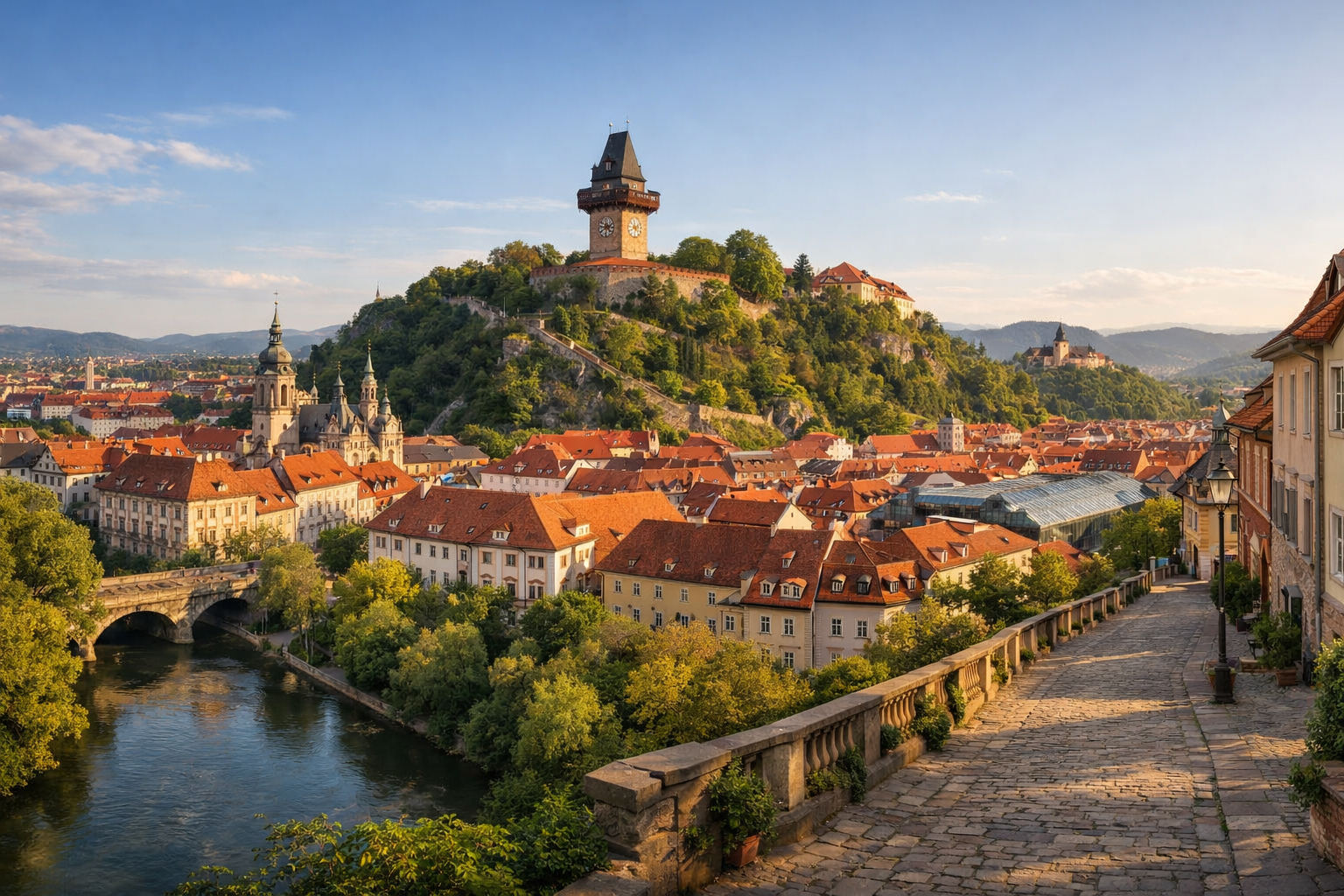
Day 1 — Graz: historic center, Hauptplatz, Murinsel, and Schlossberg
🚶 Start getting to know Graz as a city that knows how to be both grand and very down-to-earth at the same time. Its historic center is included on the UNESCO World Heritage list, yet it never feels like a museum set: trams ring through the narrow streets, small cafés work in the courtyards, and the arcaded façades and inner galleries look as if they were not preserved for tourists, but simply kept being lived in. For a budget itinerary, this is the perfect start: the main impressions here come from walking. Pass through Hauptplatz, look at the town hall, then slowly go deeper into the old streets around Herrengasse, Landhaus, and Sporgasse. Graz has a special urban texture: Renaissance courtyards, Baroque façades, and unexpected passages between houses create the feeling that another layer of the city is hidden behind every arch.
🚶 Then head to Murinsel — the futuristic “island” platform on the Mur River that has become one of the symbols of modern Graz. Against the backdrop of the old center, it looks especially striking: glass, metal, and water create a sharp but very successful contrast with the traditional architecture. It is a good free spot to pause, look at the river, and feel how Graz connects the historic and the modern without forcing it. From here it is convenient to move toward the foot of Schlossberg — the green castle hill rising directly above the center.
🚶 The ascent to Schlossberg can be done as cheaply as possible: skip the funicular or elevator and walk up the stairs and paths instead. This takes about 20–30 minutes at a relaxed pace with stops for photos and rest. At the top, one of the most pleasant city views in Austria awaits you: tiled roofs, church towers, the soft hills of Styria on the horizon, and the famous Uhrturm Clock Tower — Graz’s main symbol. It is especially nice here in the evening, when the city below starts to glow golden and both tourists and locals gather at the viewpoints. If you want to add an inexpensive paid attraction, you can visit Graz Museum Schlossberg; if not, the climb itself, the panoramas, and the walk among the bastions already provide a complete experience.
💡 Budget-friendly and logical: on the first day, almost everything is done on foot. If your energy is limited after the journey, use the tram only to get to the center, then stick to a compact walking loop. For food, it is more economical to focus on inexpensive bakeries, kebab shops, Asian takeaways, and BILLA/SPAR supermarkets in the center. Estimated daily costs without a museum: transport €0–€7, food €15–€28, optional extra admissions €0–€6.