
Buy PDF guide

Buy PDF guide — 6.43 USD

PDF — 6.43 USD

Ancient Plovdiv - theater hills and museums

Ancient Plovdiv - theater hills and museums

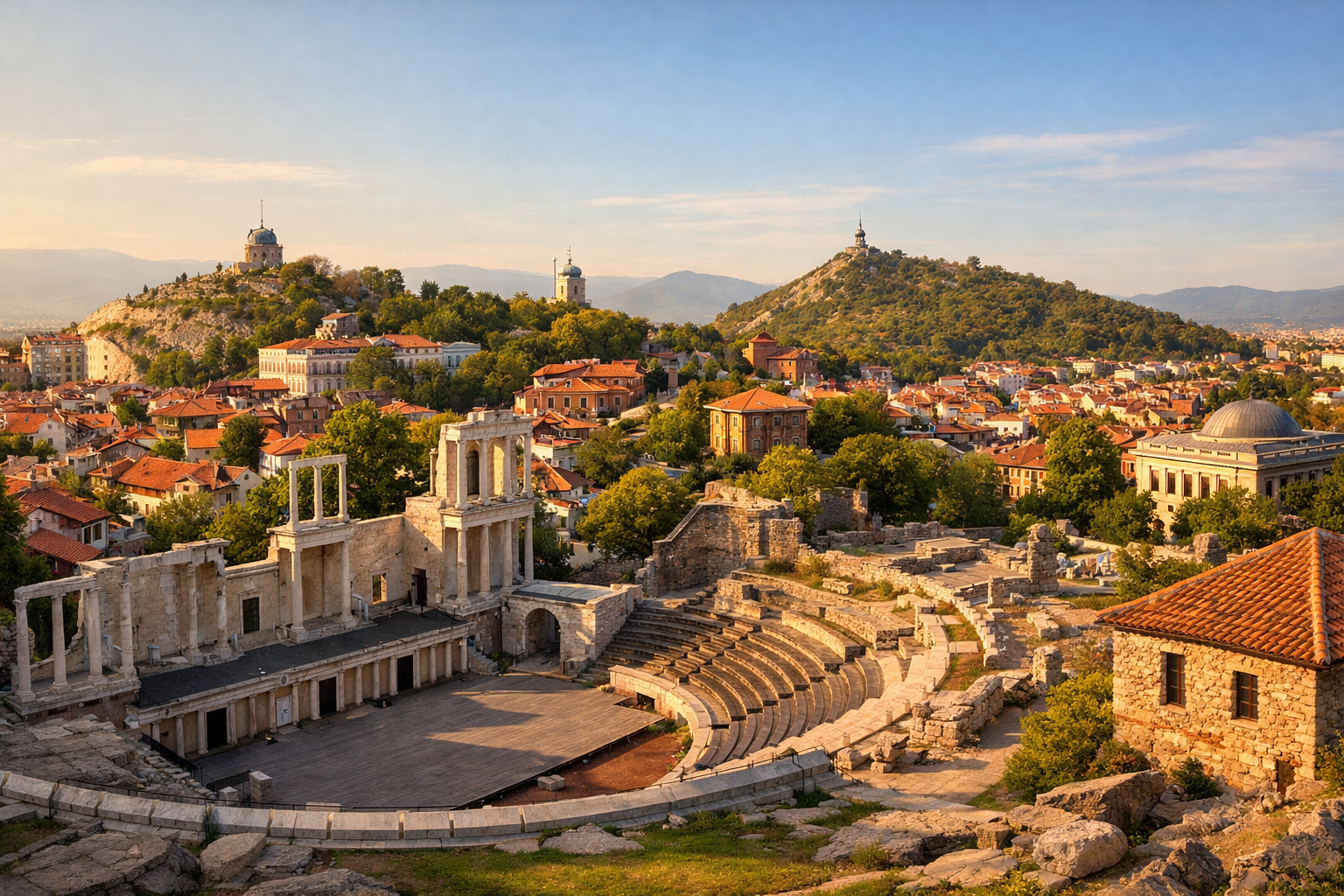
Step into Ancient Plovdiv, where cobbled Old Town streets lead to the grand Roman Theatre and sweeping views from its historic hills. Basilica mosaics, elegant museums, and layers of Thracian, Roman, and Revival heritage make this one of Bulgaria’s most captivating cultural escapes.

🧭 DAY-BY-DAY ROUTE

Ready-made country and city routes with daily plans, sights, transport and accommodation. Buy PDF guides for independent travel.

🧭 DAY-BY-DAY ROUTE


Day 1 — Old Plovdiv: Roman Theatre, Hissar Kapia and cobbled streets

  • 🚶 It is best to devote the first day entirely to the Old Town, so you can get into the rhythm of Plovdiv without rushing. Start with the Ancient Theatre of Plovdiv — one of the city’s most striking and photogenic spots. It is built into the hillside, and here you can especially feel how the ancient heritage is not separated from modern life: this is not just an archaeological site, but a living stage around which the city’s cultural life still continues. Give yourself time not only to look at the rows of stone seats and the panorama, but also simply to stand at stage level and imagine the scale of ancient Philippopolis. Then move on to the labyrinth of streets in the Old Town: houses from the Bulgarian Revival period, stone walls, wooden bay windows, small courtyards, and views that open up unexpectedly around every turn. A logical way to walk is to reach Hissar Kapia and continue along the architectural ensemble of the Old Town without trying to “tick off” every point at once. The atmosphere matters more here: a slow pace, short stops, coffee or lunch with a view, and pauses on the uphill sections. Allow about 3 hours of pure time for the main walk around the district, plus 1–1.5 hours for the theatre and at least another 1 hour for rest, photos, and a relaxed lunch. In the end, the day feels full but realistic: about 5–6 hours without rushing.


Day 2 — Hills and early Christian mosaics: Nebet Tepe, the Roman Stadium and the Basilicas

  • 🚶 Build the second day around the theme of “Plovdiv as a city of layers of time.” In the morning, head up to Nebet Tepe — one of the key hills from which the geography of the city becomes especially clear. This is not a museum hall, but an open space with archaeological meaning and a very strong sense of height: roofs, hills, the modern city, and the ancient relief come together here in a single picture. It is best to go in the morning or closer to evening, when the climb feels easier and the light is softer. After the hill, descend to the central area and the Roman Stadium: today it is woven into the fabric of the lively center, and this contrast makes a powerful impression — antiquity literally emerges onto the main pedestrian street. Then devote the second half of the day to mosaics: first the Bishop’s Basilica of Philippopolis, where the space works almost like a modern museum built over an early Christian monument, and then, if you still have the energy, the Small Early Christian Basilica. This is a good day for alternating a climb, an urban walk, and a museum rhythm. It is realistic to allow about 20–25 minutes on foot from the Old Town to Nebet Tepe including the ascent, about 15–20 minutes for the descent to the center, 1 hour for the Roman Stadium and the central street, 1.5–2 hours for the Bishop’s Basilica, 45–60 minutes for the Small Basilica, and at least another 1 hour for coffee/lunch and a break. Altogether, that again makes a comfortable 5.5–6.5 hours.

Day 3 — Museum Plovdiv: archaeology, ethnography, and a calm finale with views

  • 🚶 The third day is well suited to a more “thoughtful” acquaintance with the city through its museums. Start with the Regional Archaeological Museum: after walking through the theatre, stadium, and hills, it helps gather everything you have seen into one coherent historical line — from ancient Thrace and ancient Philippopolis to later eras. This is one of those cases where the museum does not duplicate the route, but deepens it. Then return to the Old Town and visit the Regional Ethnographic Museum, located in one of the most beautiful houses in the city. Here not only the topic changes, but also the mood: after stone, mosaics, and archaeology, a more “human” layer appears — crafts, everyday life, traditions, and objects of daily use. If you still have time and energy, you can add a short stop at the Trakart Cultural Center or simply leave the finale for a slow walk around the viewpoints of the Old Town. This is a good concluding day: fewer climbs, more contemplation, a clear pace, and a chance to return to a favorite street or viewing terrace. It is reasonable to allow 1.5–2 hours for the archaeological museum, 1–1.5 hours for the ethnographic museum, about 30–35 minutes total for moving between points, at least 1 hour for lunch and breaks, and another 1–1.5 hours for the final walk.

Flight tickets

eSIM for travel

Buy PDF guide

Buy PDF guide — 6.43 USD

PDF — 6.43 USD