
Buy PDF guide

Buy PDF guide — 17.14 USD

PDF — 17.14 USD

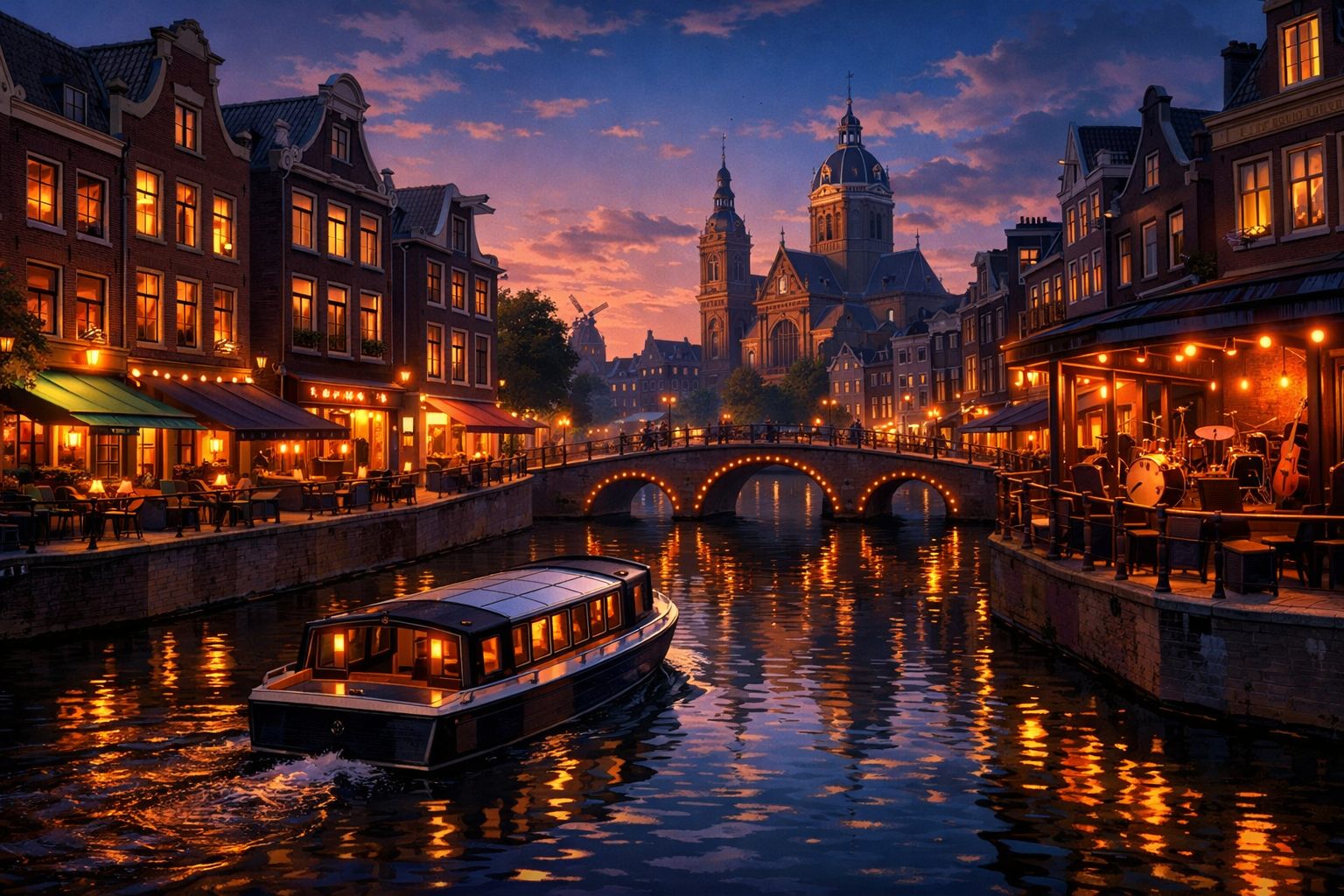
Amsterdam — pubs by the canals, clubs, bars with live music, a boat ride.

Amsterdam — pubs by the canals, clubs, bars with live music, a boat ride.

Amsterdam blends postcard canals and world-class museums with a nightlife scene that shifts effortlessly from cozy canal-side pubs to bars filled with live music and late-night clubs. Drift through the city by boat, then step ashore for a night that feels equal parts laid-back and electric.

🧭 DAY-BY-DAY ROUTE

Ready-made country and city routes with daily plans, sights, transport and accommodation. Buy PDF guides for independent travel.

🧭 DAY-BY-DAY ROUTE


Day 1 — Amsterdam: arrival, Singel Canal, and a first evening by the water

  • 🚆 Transfer from the airport: Schiphol Airport → Amsterdam Centraal by NS train takes about 17 minutes; if your hotel is in the center, it’s convenient to continue by GVB tram or take a short taxi ride. After a flight, it’s better not to overload the day with museums: Amsterdam is especially good in a gentle immersion mode, when first impressions are made up of water, bridges, brick facades, and reflections in the canals.

  • 🚶 Start your introduction with a walk along Singel and then toward Herengracht and Keizersgracht. Amsterdam’s historic center is not just beautiful — it is arranged like a theatrical set, where almost every turn opens a new angle: narrow gabled houses, bicycles by the railings, boats quietly gliding on the water, and small bridges that are especially photogenic in the evening. In this area, the city reveals itself precisely in the details: brass plaques on old facades, flowers in the windows, reflections of light in the dark water, and the feeling that the whole center lives in the rhythm of calm, beautiful everyday life.

  • 🍺 The first essential highlight of the route is a pub by the canal. For a gentle start to the evening, the Jordaan area and 9 Straatjes are ideal: the atmosphere here is more intimate than on the noisy tourist squares, and many venues literally overlook the water or stand just steps from canal bridges. The idea for the evening is simple: don’t rush, get a table by a window or on a terrace, try local beer, and give yourself time to feel the city not as a set of sights, but as a living place with a very beautiful rhythm.

  • 💤 After the journey, keep the evening free of late transfers: a 2–4 km walk, an early return to the hotel, and proper rest. This matters because the coming days will be filled with museums, a boat ride, evening bars with live music, and club nights.


Day 2 — Amsterdam: the museum quarter and an elegant evening by the canals

  • 🚶 Dedicate the morning to Museumplein — one of the most beautiful and logical areas for a thoughtful introduction to the city’s cultural side. Here it’s easy to combine the Rijksmuseum and the Van Gogh Museum, with a break for coffee and a short walk across the square in between. The Rijksmuseum is not just the country’s main museum, but a true visual biography of the Netherlands: the Golden Age, maritime power, urban culture, portraits, craftsmanship, light, textiles, details of everyday life, and famous paintings that many know from reproductions but only truly understand in person. The Van Gogh Museum, by contrast, feels more emotional: here the journey is built around the artist’s inner world, his color, nervous line, personal crises, and incredible power of seeing everyday things.

  • 🌿 After the museums, take a walk through Vondelpark. This park gives the city an important balance: after halls, collections, and queues, there is space, greenery, and a more relaxed breathing rhythm. It’s a good place to slow down a little, sit by the avenues, watch the locals, and simply switch from museum concentration to an easy stroll.

  • 🍷 In the evening, return to the canal area of Prinsengracht or Keizersgracht. The second evening is best made more refined: not a noisy club, but an atmospheric bar or pub by the water where it’s pleasant to spend a couple of hours without rushing. It is in these areas that Amsterdam is especially beautiful after sunset: illuminated bridges, long reflections on the water, and old facades create the feeling of an almost cinematic scene.

  • 🚋 Logistically, the day is very comfortable: from central hotels to Museumplein it is usually 15–25 minutes by tram or about 30–40 minutes on foot at an unhurried pace through the center. In the evening, it’s just as easy to return by tram or on foot if you want to see the canals already lit up for the night.

Day 3 — Amsterdam: Jordaan, Anne Frank House, and live music

  • 🚶 This day is best built around Jordaan — one of Amsterdam’s most charming neighborhoods. Unlike the grand museum quarter, Jordaan enchants with its intimacy: narrow streets, small bridges, quiet canals, independent shops, cafés, and the feeling of an old residential city that has not completely dissolved into tourism. It’s a wonderful place to walk without a rigid plan, allowing yourself small detours from the route.

  • 🏛️ If you bought tickets in advance, include a visit to the Anne Frank House. This is not a museum for a “quick look,” but a place that requires a calm pace and inner quiet. The house on Prinsengracht makes a strong impression precisely because of its concreteness: history stops being abstract and becomes a space you walk through with your own steps. After the visit, don’t plan noisy activities right away — it’s better to allow time for a walk along the neighboring canals.

  • 🍺 In the daytime, continue the essential theme of canal-side pubs: in Jordaan it is especially pleasant to choose a venue not by its famous name, but by its atmosphere — with a view of the water, a bridge, or a quiet street where the canals read as part of the urban scene. It’s easy to spend a long late lunch here, alternating walks and stops without any sense of hurry.

  • 🎷 In the evening — the route’s essential live music block. For a classic Amsterdam evening, Bourbon Street in the Leidseplein area is an excellent choice: it is one of those addresses where live music feels not like a formal program, but like the foundation of the evening’s mood. Blues, rock, soul, a tight room, lively contact with the audience, warm light, and the feeling that you have found not a tourist set, but a real musical tradition of the city. From Jordaan to Leidseplein it takes 10–15 minutes by tram or about 20–30 minutes on foot.

Day 4 — Amsterdam: boat ride, 9 Straatjes, and an evening canal crawl

  • 🛥️ Today is the essential canal boat ride. It’s best scheduled either for late morning or early evening: at these times the light is especially beautiful, and the city feels more three-dimensional than from the street. From the water, Amsterdam opens up differently: the geometry of the canal ring, the rhythm of the bridges, the logic of the old merchant houses, and the reason the city makes such a strong impression precisely through its wholeness all become clear. During the cruise, the stretches along Herengracht, Keizersgracht, and Prinsengracht are especially beautiful, where facades, trees, and boats come together in an almost perfect postcard.

  • 🚶 After the boat, walk through 9 Straatjes. This is an area that pairs conveniently with a water excursion: the small streets seem strung between the canals, and the route naturally flows from shop windows and galleries to bridges and cozy corners. The atmosphere here is more stylish and design-oriented, but without unnecessary formality — a good backdrop for a calm daytime rhythm.

  • 🍻 In the evening, arrange a canal crawl — not aggressive bar-hopping, but a beautiful sequence of 2–3 stops by the canals. The point is not quantity, but changing moods: one waterside pub for an aperitif, a second bar for a longer stop, then a short night walk across the bridges. This is one of Amsterdam’s strongest experiences: after sunset the city does not become chaotic; on the contrary, it becomes even more picturesque and deeper.

  • 🚶 The day’s logistics are convenient because almost everything happens within the historic center. Between cruise piers near Centraal, Damrak, or the central part of the canal belt, the 9 Straatjes area, and evening pubs, you can usually move around on foot, allowing 10–25 minutes for each walk.

Day 5 — Amsterdam: NEMO, Oosterdok, ferry across the IJ, and a jazz evening

  • 🚶 Dedicate the morning to the Oosterdok area and the NEMO Science Museum. Even if you are not usually a fan of science museums, NEMO is worth it for its architecture and waterside setting: the building itself looks like a huge green ship rising out of the harbor. The area around it combines modern Amsterdam with its port past, and that creates a pleasant contrast after the canal center.

  • ⛴️ After that, it’s worth having a short but very characteristic city experience — the free GVB ferry across the IJ from Amsterdam Centraal toward Amsterdam Noord. This is not an excursion or a tourist attraction in the usual sense, but part of the city’s everyday life that also gives an excellent view of the water, the station, and the northern shore. The crossing is short, but very atmospheric.

  • 🌆 On the northern side, you can walk along the waterfront around A'DAM and EYE to see a more modern face of the city: open spaces, industrial scale, broad water, and panoramic lines completely unlike the intimacy of the canal belt. It’s a great day for a change of visual mood, without any feeling that you have left Amsterdam.

  • 🎺 In the evening — the second essential live music block, but now in another genre. For a more refined and musically rich evening, BIMHUIS is an excellent choice — an iconic venue by the water, known for jazz, improvisational, and world music. This is no longer bar energy like at Bourbon Street, but a concert experience with strong acoustics, modern architecture, and a beautiful waterfront view. Returning to the center after the concert usually takes about 10–15 minutes by tram or taxi.

Day 6 — Amsterdam: De Pijp, Heineken Experience, and a club night

  • 🚶 During the day, head to De Pijp — a neighborhood that is livelier, younger, and a little less formal than the canal center. Here you can feel the city’s temperament: markets, cafés, local shops, students, streams of bicycles, and a mix of everyday life with vibrant food culture. It’s a good place to see Amsterdam not only as an open-air museum, but also as a comfortable, lively European city.

  • 🍺 If you like, include the Heineken Experience — not as an obligatory historical shrine, but as an entertaining stop that fits well with the theme of the trip, which already includes pubs, bars, and the evening scene. Afterward, you can take a calm break in one of the neighborhood’s venues and avoid overloading the middle of the day.

  • 🌇 Start the evening without rushing: an early dinner, a short rest at the hotel, and only then head to a club. For a classic Amsterdam music night, Paradiso or Melkweg in the Leidseplein area are great choices — both places are legendary for combining concert history, club culture, and an international program. Paradiso is especially impressive because it is located in a former church building: inside, you can feel a rare combination of monumental space and club energy. Melkweg is more multi-hall and multi-genre, with a program ranging from concerts to electronic nights.

  • 🎧 If you want a more contemporary electronic focus, Shelter in Amsterdam Noord can be an alternative — a club under A'DAM Tower, easily reached by the free ferry from Centraal and a short walk. An evening like this is worth planning with energy in reserve: a club night in Amsterdam can easily run past midnight, so it’s better not to overload the daytime program.

Day 7 — Amsterdam: Rembrandt House, H’ART Museum, the Amstel, and a calm evening bar

  • 🚶 After a busy club night, make this day softer and start later. A good idea is the area around the Amstel River, where the city reveals itself more broadly and majestically than in the tight canals of the center. There are beautiful views of water, bridges, and historic buildings here, and the route itself can easily be adapted to how you feel.

  • 🏛️ Visit Museum Het Rembrandthuis — Rembrandt’s house, where the human scale of history is felt especially well. Unlike huge national museums, what matters here is not grandeur but closeness: the workshop, daily life, the artist’s working space, and the understanding of how great art was created precisely in this city. If you want to add one more cultural stop to the day, H’ART Museum on the Amstel fits naturally into the route nearby.

  • 🚶 Then take a calm walk along the water, without long mandatory checklists. After several active evenings, a day like this is especially valuable: it lets you not simply “collect” sights, but live the city at a more personal pace — with coffee stops, short sits by the water, and unhurried crossings over bridges.

  • 🍷 In the evening, choose a quiet canal-side bar or a stylish hotel bar in a canal house. Let this be an evening not for a loud program, but for a beautiful final taste of Amsterdam: a glass of wine or a cocktail, reflections in the water, one last long route across the bridges, and the feeling that you have truly settled into the city.

Day 8 — Amsterdam: a free morning, final canals, and departure

  • 🌅 Keep the last day as flexible as possible. Depending on your flight time, you can take a short walk along the nearest canal, go for a late breakfast, walk once more through Jordaan, Singel, or Damrak, and calmly gather your final impressions. Amsterdam is wonderful in that even a couple of hours here can easily turn into a full epilogue to the trip.

  • 🛍️ If you want one last urban touch, devote the morning to small purchases: the designer shops of 9 Straatjes, delicacies, local souvenirs, bookshops, and interior stores in the center are much better suited for this than rushed station shops.

  • 🚆 It’s best to plan your airport transfer with time to spare. From the center to Schiphol, the most predictable option is the NS train from Amsterdam Centraal; the journey takes about 17 minutes, but taking into account the trip to the station, finding the platform, and airport procedures, it’s better to allow a solid buffer. If your flight is early or late, or your luggage is heavy, a reasonable alternative is the official Schiphol taxi stand for the return trip, a pre-booked transfer, or a taxi app.

  • 💙 The final idea of the day is not to try to squeeze in one more “must-see” stop. It is much better to finish the route with one beautiful last look at the water, bridges, and canal-house facades: this is usually the image that remains the main memory of Amsterdam.

Flight tickets

eSIM for travel

Buy PDF guide

Buy PDF guide — 17.14 USD

PDF — 17.14 USD