
Buy PDF guide

Buy PDF guide — 10.71 USD

PDF — 10.71 USD

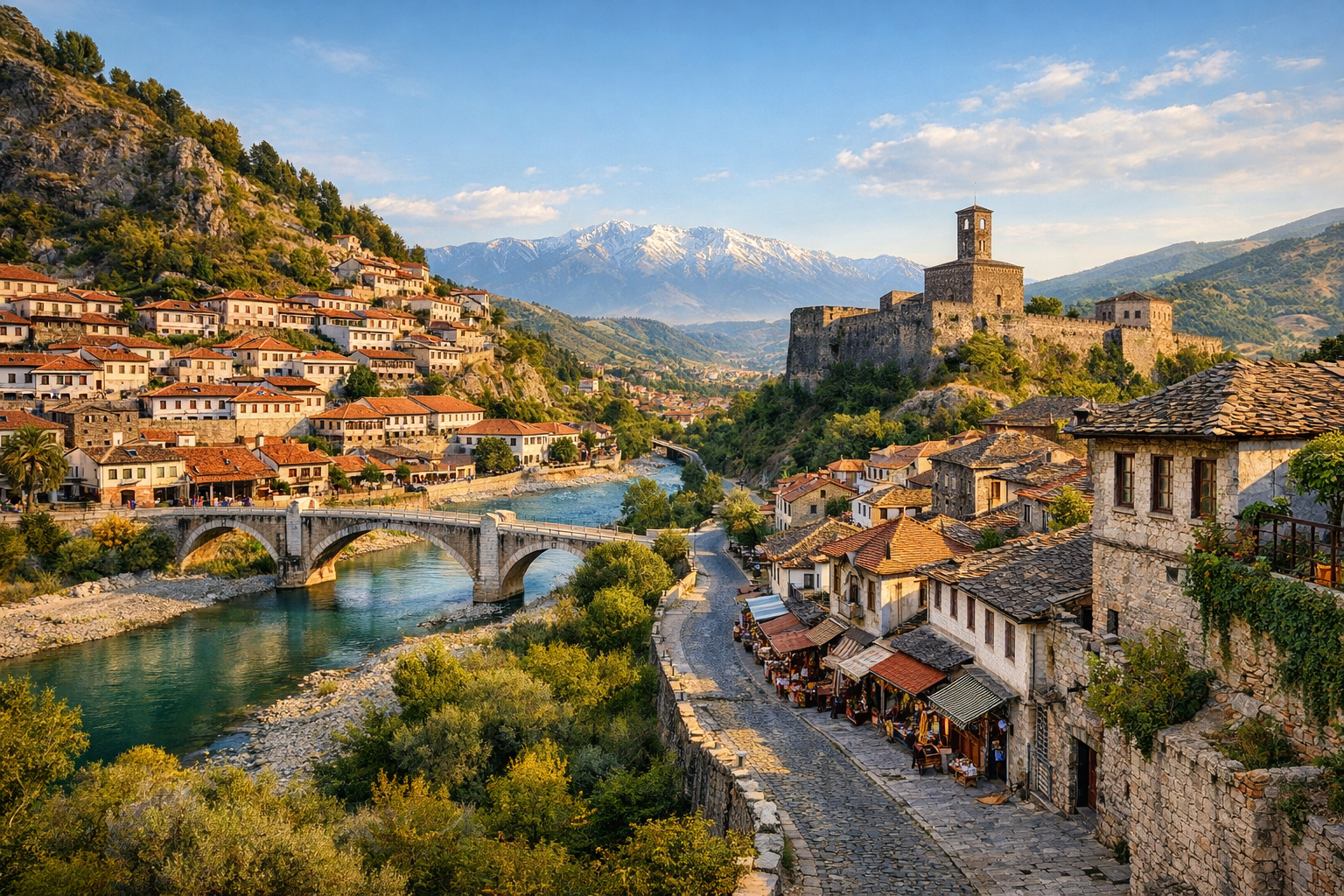
Albania, Berat and Gjirokastër. A journey through ancient stone towns, fortresses, bazaars, and picturesque neighborhoods with bus transfers and overnight stays in family guesthouses. Difficulty: easy. Season: April - June, September - October.

Albania, Berat and Gjirokastër. A journey through ancient stone towns, fortresses, bazaars, and picturesque neighborhoods with bus transfers and overnight stays in family guesthouses. Difficulty: easy. Season: April - June, September - October.

Discover Albania through the timeless stone towns of Berat and Gjirokastër, where hilltop fortresses, old bazaars, and charming historic quarters reveal the country’s rich character. With easy bus transfers and warm family guesthouses along the way, this is a relaxed journey best enjoyed in the soft light of spring or early autumn.

🧭 DAY-BY-DAY ITINERARY

Ready-made country and city routes with daily plans, sights, transport and accommodation. Buy PDF guides for independent travel.

🧭 DAY-BY-DAY ITINERARY


Day 1 — Tirana → Berat: arrival and first impressions of the “city of a thousand windows”

  • 🚖 If you arrive at Tirana International Airport, it is best to use official transport right away: a licensed airport taxi or a prearranged transfer, then make your way calmly to the bus station and head to Berat on a daytime departure. For this itinerary, it is not worth planning late transfers or, even more so, night driving: the road in Albania is beautiful, but it is far more pleasant and relaxing to travel it in daylight, when you can rest properly, get your bearings, and check into your hotel without stress.

  • 🚌 Transfer: Tirana → Berat by intercity bus, usually about 2–2.5 hours. The most practical option is to leave in the first half of the day or after lunch so you arrive before evening and still have time for a walk. In high season, it is wise to check schedules and buy tickets in advance, and to arrive with a small time buffer.

  • 🏘️ Berat is one of the most poetic towns in Albania and a UNESCO World Heritage Site, where Ottoman urban fabric, stone houses, and hillside quarters form an almost theatrical panorama. It is often called the “city of a thousand windows”: white house façades rise in tiers as if one house rests upon another, and by evening the whole scene begins to glow with a soft golden light. After checking in, it is worth taking a stroll through the Mangalem quarter without trying to see everything at once: cobbled lanes, arches, stairways, old walls, and views of the Osum River quickly set the right rhythm for the trip—slow, contemplative, and highly photogenic.

  • 🌉 Closer to sunset, it is a good idea to walk down to the river and look at the city skyline from the opposite bank, toward the Gorica quarter and the old bridge. This is one of those rare towns where the walk itself becomes the main attraction: there is no need to rush from point to point, because the charm of Berat reveals itself precisely in the transitions, turns, stone staircases, and unexpected viewpoints. It is best to end the evening early, with dinner at a family-run guesthouse or in the old town, so you can sleep well before the climb up to the fortress.


Day 2 — Berat: Kala fortress, the Onufri Museum, and the old quarters

  • 🚶 The main day in Berat is best devoted to the Kala fortress—a living citadel that rises above the town and remains not just a ruin, but a real historic quarter with houses, churches, courtyards, and views over the valley. The origins of the fortifications go back deep into antiquity, while the present appearance is largely shaped by medieval and later layers. It is best to start the ascent in the morning, while the soft light falls beautifully on the stone and the heat has not yet made walking difficult. At the top, you feel especially strongly that Berat is not an open-air museum in the usual sense, but a place where history continues to be part of everyday life.

  • 🏛️ Inside the fortress, you should definitely visit the National Iconographic Museum “Onufri,” located in the Cathedral of the Dormition of St. Mary. This is one of the key cultural sites of the entire route: it preserves icons and church objects linked to the outstanding tradition of Albanian icon painting, and the name Onufri has become a symbol of a vivid, richly colored artistic school. Even for those who are usually indifferent to religious art, the museum provides important context: it becomes clearer that Berat is not just a beautiful panorama, but also a city at the crossroads of cultures, faiths, and artistic traditions.

  • 🏠 After the fortress, it is a good idea to head down to the Ethnographic Museum, housed in a characteristic 18th-century home. Unlike large capital-city museums, what impresses here is the intimacy: interiors, utility rooms, household objects, craft motifs, and reconstructions of the old urban way of life let you see what the everyday world of a well-off household in historic Berat looked like. This kind of museum works especially well in combination with a walk through the town itself: what you see inside is then easy to “read” later in the architecture of courtyards, windows, awnings, and everyday details on the streets.

  • 🕌 Spend the rest of the day on a leisurely walk through the Mangalem and Gorica quarters. There is no need to build a rigid checklist of points here—the important thing is to walk slowly, look at the stone staircases, terraces, old façades, and the urban fabric that earned Berat its place on the UNESCO list. If you still have energy, climb up to one of the viewpoints again in the evening: the fortress and quarters look especially expressive in the pre-sunset light. Return to the hotel early, with no night transfers and no attempt to cram in too much.

Day 3 — Berat → Gjirokastër: bus transfer and an evening in the stone town

  • 🚌 Transfer: Berat → Gjirokastër by official intercity bus, on average about 3 hours. This is a realistic and convenient daytime transfer between two UNESCO towns, and it is best planned for the morning or early day. For this itinerary, the bus is the optimal option: there is no need to rent a car, look for parking on steep old streets, or tire yourself out driving on regional roads.

  • ⛰️ On arrival in Gjirokastër, the first impression is almost always very strong: if Berat feels airy and white, Gjirokastër greets you with a more austere, graphic beauty. This is the famous “stone town” of southern Albania, also included on the UNESCO World Heritage list. The roof slopes here are covered in gray stone, the houses look like little fortresses, and the streets climb and run along the hillsides as if the entire town were built from one huge architectural gesture.

  • 🛏️ After checking into a family-run guesthouse, it is better not to overload the day with museums, but to devote the evening to the old bazaar and the Qafa e Pazarit area. This is where the atmosphere of old Gjirokastër is felt especially well: craft shops, stone arches, cafés on terraces, historic houses, and the gentle southern pace of evening life. It is not a noisy bazaar in the eastern sense, but rather a historic urban hub where trade, architecture, and everyday life are woven together.

  • 🌆 In the evening, you can climb to one of the viewpoints to see how the stone roofs and tower-like houses dissolve into dusk above the Drino Valley. It is at this time that Gjirokastër feels especially cinematic and a little severe. Still, it is best to end the route with an early return to the guesthouse: the old streets are steep and slippery in places, so it is wise to limit late walks on unfamiliar climbs, especially if you are tired after the journey.

Day 4 — Gjirokastër: fortress, bazaar, traditional houses, and the ethnographic museum

  • 🏰 The morning is best started at Gjirokastër Fortress—one of the largest and most impressive in Albania. It dominates the entire town and the Drino Valley, so from here it is easy to understand the logic of the local terrain and defenses. The fortress does not look decorative: in its scale you can feel real military history, while the long walls, bastions, and open platforms create an almost epic impression. In good weather, the views alone become a reason to visit: the stone town below seems carved from the hillside, and the mountains on the horizon add a stern depth to the scene.

  • 🏛️ After the fortress, it is convenient to return to the old town and visit the Ethnographic Museum on Rruga Hysen Hoxha. It stands on a site associated with the house of Enver Hoxha, but what really matters is not that; rather, it shows the typical interior and way of life of a traditional 19th-century Gjirokastër house. Inside, it is especially interesting to study the layout of living rooms, reception spaces, utility areas, and decorative elements: this helps explain why local houses are considered an outstanding example of urban Ottoman architecture in the Balkans.

  • 🏠 Then it is worth visiting one of the famous historic houses, above all Zekate House or Skenduli House. These tower-like residential buildings are one of the calling cards of Gjirokastër. From the outside they resemble mini-fortresses with high walls and narrow windows, while inside they open up as complex, status-conscious homes with reception halls, wooden ceilings, built-in cupboards, niches, and a carefully thought-out system of defense and daily life. Houses like these are what make Gjirokastër architecturally unique and distinguish it from many other Ottoman towns in the region.

  • ☕ The second half of the day is best left for a calm pace: a walk through the old bazaar, a little shopping, coffee with a view of the stone roofs, and time without rushing. This is a good moment not only to “tick off” the sights, but also to feel the town as a place to live. Keep an eye on your personal belongings in crowded places and on bazaar streets, keep your documents and money in a convenient bag that closes securely, and do not plan evening trips out into the mountain areas: without preparation and a local guide, such detours are unnecessary on this short route.

Day 5 — Gjirokastër → Tirana: daytime return

  • 🚌 Transfer: Gjirokastër → Tirana by official bus, approximately 4–5 hours depending on the departure and road conditions. For the final day, it is better to choose a daytime departure so you do not arrive late in the evening and depend on nighttime logistics. If your flight is the next day, it is more practical to stay overnight in Tirana; if your flight is in the evening, leave yourself a good time buffer and do not schedule the bus too tightly against the airport.

  • 🌄 In the morning before departure, you can take one more short walk through the bazaar or have coffee overlooking the old stone quarters. It is often in these final hours that the character of the route becomes especially clear: in five days, you have seen two different versions of historic Albania—a lighter, more picturesque Berat and a stricter, almost fortress-like Gjirokastër. Both towns are united by stone, fortresses, Ottoman-era quarters, and a rare sense of historical integrity.

  • ✈️ On arrival in Tirana, it is again best to use official transport for the trip to the airport: a licensed taxi or a pre-booked transfer. Do not agree to random offers by roadsides or bus stations, especially if you are tired after a long transfer. This kind of ending makes the route calm and safe: without unnecessary stress, without night driving, and without trying to squeeze in one more distant location in a single day.

Flight tickets

eSIM for travel

Buy PDF guide

Buy PDF guide — 10.71 USD

PDF — 10.71 USD