
Buy PDF guide

Buy PDF guide — 8.57 USD

PDF — 8.57 USD

Athens - Historical tour: Acropolis, Plaka, Monastiraki, museums, rooftop bars

Athens - Historical tour: Acropolis, Plaka, Monastiraki, museums, rooftop bars

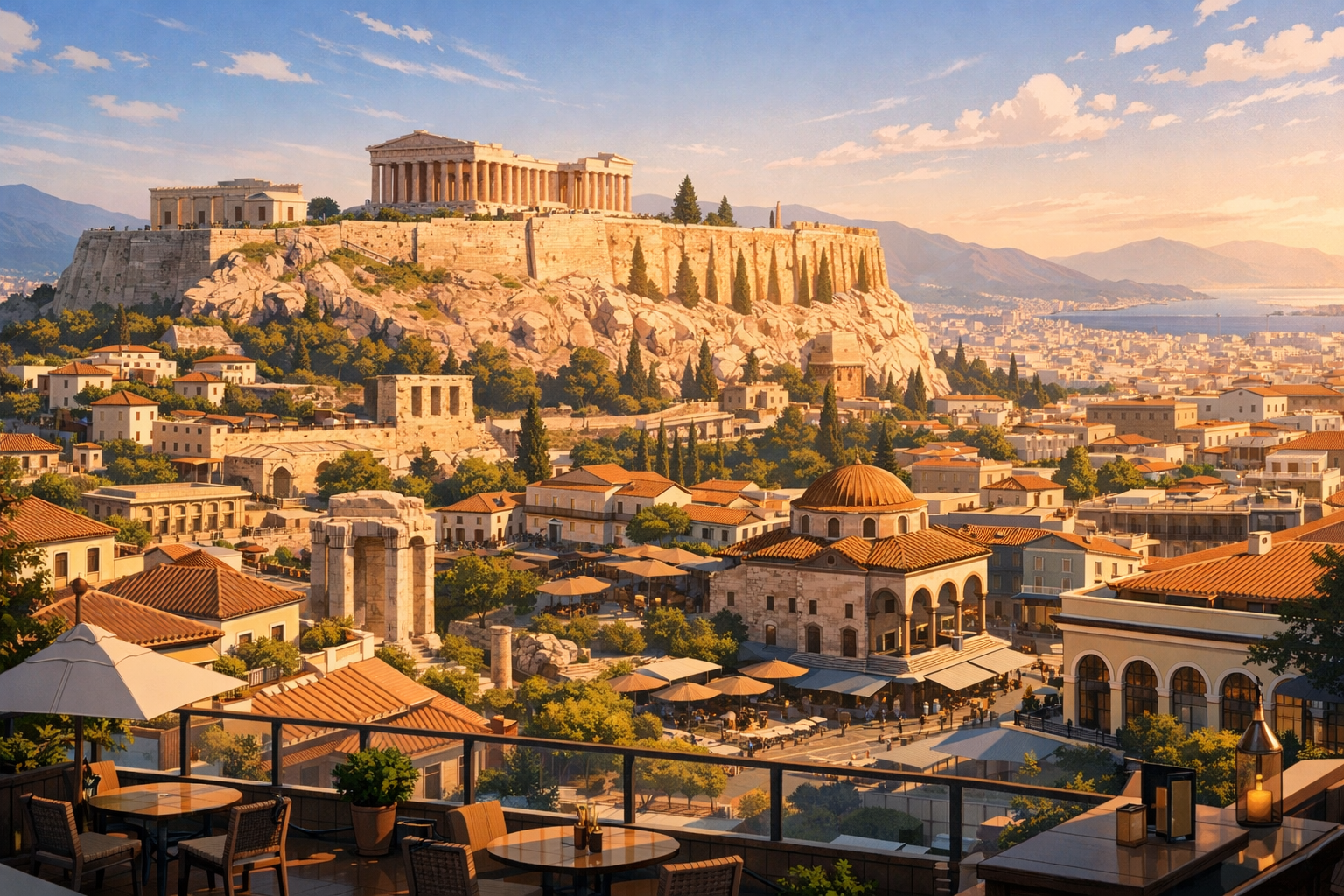
Athens blends ancient grandeur with an easy, lively rhythm. Wander from the Acropolis through the streets of Plaka and Monastiraki, then wind down with world-class museums and rooftop bars overlooking the city’s timeless skyline.

🧭 DAY-BY-DAY ITINERARY

Ready-made country and city routes with daily plans, sights, transport and accommodation. Buy PDF guides for independent travel.

🧭 DAY-BY-DAY ITINERARY


Day 1 — Athens: Acropolis, the south slope, and the Acropolis Museum

  • 🚶 It’s best to devote the first day to the very heart of ancient Athens — the Acropolis. This is not just a hill with ruins, but a symbol of all European civilization, a place where classical Greece quite literally shaped the language of architecture, political thought, and ideas of beauty. It is worth coming up here in the morning, while the soft light lies beautifully on the marble and the heat has not yet made the walk tiring. Along the way, views open up over the Theatre of Dionysus, where ancient Greek drama was born, the Odeon of Herodes Atticus, and the city spreading around the sacred rock like a living historical layer that connects antiquity, Byzantium, the Ottoman past, and the modern capital. At the top, you will find the Parthenon, the Erechtheion with its Caryatids, and a panorama that makes Athens feel not like a chaotic metropolis, but like an open-air museum city.

  • 🚶 After the climb, give yourself a break for rest and water, then head down toward the Acropolis Museum. This is one of Europe’s best archaeological museums, where antiquities are not simply displayed in glass cases but arranged into a carefully thought-out spatial story. Archaeological excavations are visible through the glass floors, and in the upper hall the exhibition is laid out according to the logic of the Parthenon itself — it feels as if you are continuing a conversation with the temple you just saw above. Here the scale of Athenian heritage is felt especially strongly: pediment fragments, archaic korai, reliefs, and details of everyday life in the ancient city turn the abstract word “antiquity” into a very vivid and human experience.

  • ☕ Day logistics: if you are based in the center, the Acropolis area is easy to reach on foot or by metro to Akropoli station. For the climb itself, the main monuments, and photo stops, it is sensible to allow 2.5–3 hours. For the museum, add another 1.5–2.5 hours, depending on your interest in archaeology. Between the hill and the museum, it is convenient to take a break for coffee or a light lunch; a packed schedule without a pause quickly becomes exhausting here, especially in the warm season.

  • 🌇 End the evening gently and beautifully: with a walk along the pedestrian street Dionysiou Areopagitou, where the Acropolis gradually lights up in the evening illumination, followed by going up to a rooftop bar with a view of the Parthenon. For the first evening, terraces in the Makrygianni area or the center are ideal: they give that exact “wow effect” when an ancient temple suddenly becomes not a picture from a textbook, but part of a living night landscape. This is the best moment to feel: you are truly in Athens.


Day 2 — Athens: Plaka, Anafiotika, the Roman Agora, and a rooftop evening

  • 🚶 Dedicate the second day to Plaka — the most atmospheric historic quarter of Athens. This district lies at the foot of the Acropolis, where streets wind between neoclassical facades, shaded stairways, old houses, and tiny squares. Here the city opens up not as an archaeological object, but as the living fabric of everyday history. It is especially pleasant to walk here in the morning, when souvenir shops are only just opening and the alleys still belong to silence. Hidden inside Plaka is the Anafiotika district — almost an island mirage in the center of the capital. White houses, narrow passages, flower pots, and an almost Cycladic sense of space create the unexpected feeling that you have left the city for a moment and been teleported to an Aegean island.

  • 🚶 Then it makes sense to walk to the Roman Agora and the Tower of the Winds. This part of the route shows how Athens changed after the classical era: here you can already see a different cultural layer — later, but no less expressive. Nearby are Hadrian’s Library, old churches, and cozy streets where you can move unhurriedly from monument to monument without the feeling of museum fatigue. Unlike the monumental Acropolis, Plaka and the adjoining ancient areas work more subtly: they do not overwhelm with scale, but draw you into a slow walk and an almost cinematic observation of the city.

  • 🍽️ The day is best planned at a relaxed pace: a walk through Plaka and Anafiotika takes about 2–3 hours with stops for photos and small detours into side streets; the Roman Agora and the surrounding area take another 1–1.5 hours. After lunch, you can take a long siesta or return to the hotel for 1–2 hours of rest: this is exactly the pace that keeps a historical tour from turning into a marathon.

  • 🌃 In the evening, head up again — but this time to another area, for example closer to Monastiraki. Rooftop bars here are especially good because they offer a frontal view of the illuminated Acropolis, the domes of the old city, and the dense urban texture around the square. The evening Athenian light, the clink of glasses, the warm wind, and the silhouette of the Parthenon against the dark blue sky create that very modern version of a historical journey, when antiquity meets urban style without any contradiction at all.

Day 3 — Athens: Monastiraki, the Ancient Agora, Thissio, and a museum focus

  • 🚶 The third day is best started in Monastiraki — one of the most distinctive districts in the center. This is a place where Athens sounds especially loud: market rows, craft shops, street food, antique displays, old facades, and an endless flow of people create a vivid and very urban scene. But the value of Monastiraki is not only in the energy of the present. It is from here that it is convenient to enter a deeper historical layer — the Ancient Agora, one of the key spaces of ancient democracy. If the Acropolis was the sacred and symbolic summit, then the agora was the place of everyday civic life: people traded, argued, made decisions, taught, and learned here. Today, a walk through its grounds helps you better understand how Athens was structured not as a myth, but as a real city.

  • 🚶 Be sure to stop by the Temple of Hephaestus — one of the best-preserved ancient Greek temples. Compared with the Parthenon, it creates a more intimate impression, but sometimes an even stronger one, because it allows you to imagine almost completely the original appearance of an ancient sanctuary. After the archaeological zone, it is very pleasant to walk toward Thissio: this is an area with broad walking paths, views of the hill, and a calmer atmosphere than busy Monastiraki. Here the route naturally slows down, and that rare feeling appears when history is not separated from everyday life, but literally woven into an ordinary city walk.

  • 🏛️ In the second half of the day, add a museum segment according to your interests: either the National Historical Museum for later periods and the formation of the modern Greek state, or the Benaki Museum for a broad cultural panorama from antiquity to modern times. This choice balances the route well: after two days of archaeological sites, you get the historical context that explains how the ancient city turned into the modern capital of Greece.

  • 🌆 For this day, allow about 20–30 minutes on foot between the main points within the historic center, but taking into account the heat and the temptation to stop every few minutes for photos and coffee, the real pace will be slower. After the museum, be sure to take a break at the hotel or in a café. The evening can be finished at a rooftop bar above Monastiraki Square: the view from here is especially beautiful because it captures the city’s relief itself, the Acropolis, and the feeling that Athens is not only the past, but also a very lively capital.

Day 4 — Athens: National Archaeological Museum, Cycladic art, and a final sunset

  • 🚶 Dedicate the final day to museums in greater depth. It is best to start with the National Archaeological Museum — the largest archaeological museum in Greece and one of the most important in the world for understanding ancient Greek art. Here Athens ceases to be only about the Acropolis: before you opens the full scale of Greek civilization — from prehistoric finds to sculpture, bronzes, vase painting, and funerary masks. This is a place where history takes on an almost epic scale. You should really allow no less than 2–3 hours for the visit, and if your interest in antiquity is high, even more.

  • 🏛️ After lunch, move to the Kolonaki district and visit the Museum of Cycladic Art. It gives a completely different type of impression: more concise, bright, and intellectual. The famous Cycladic marble idols seem strikingly modern, almost minimalist, although they are thousands of years old. This is one of the best final accents for a historical tour of Athens, because it shows ancient Greek art not only as archaeology, but also as a source of forms that still influence modern design and visual culture.

  • 🛋️ Between museums, be sure to leave time for a calm lunch and rest. The easiest way to travel between the museums is by metro or taxi; in terms of time this is usually about 15–25 minutes depending on your starting point and traffic. The last day should not be overloaded with additional ruins: it is better to give yourself the chance to calmly absorb what you have seen, buy books or small museum souvenirs, and save your energy for a beautiful finale.

  • 🌇 End the journey on a rooftop terrace with one of the best views of the Acropolis — this could be a panoramic bar in Monastiraki, a hotel bar in the center, or a stylish urban terrace near the cathedral. At sunset, Athens is especially cinematic: the white-beige houses gradually turn golden, the Acropolis hill flares with warm light, and the city looks like a place where several thousand years of history have not disappeared, but simply learned to coexist with modern life. Such a finale perfectly closes a 4-day historical route.

Flight tickets

eSIM for travel

Buy PDF guide

Buy PDF guide — 8.57 USD

PDF — 8.57 USD