
Buy PDF guide

Buy PDF guide — 25.71 USD

PDF — 25.71 USD

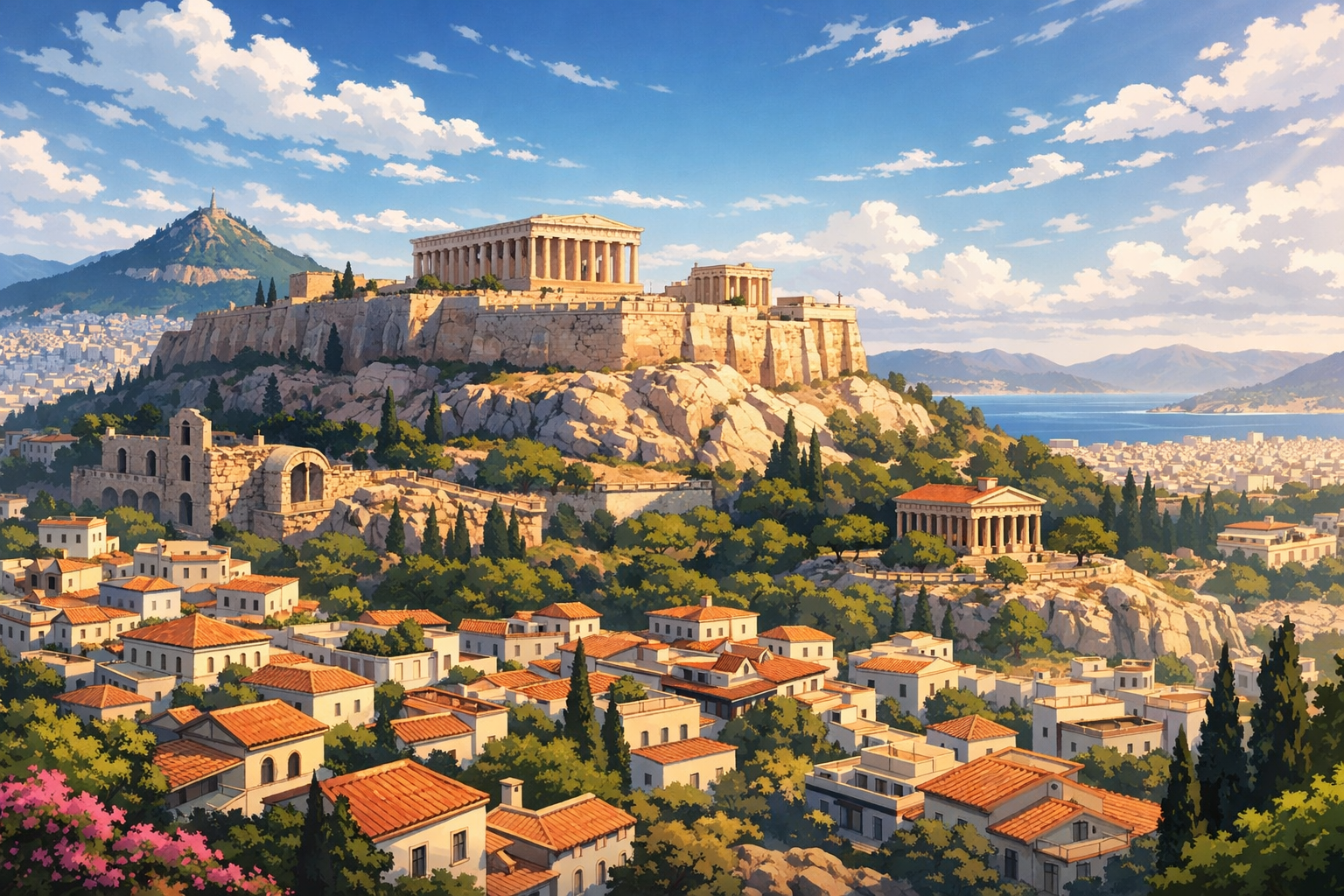
ATHENS

ATHENS

Start in Athens beneath the Acropolis, trace the coast to Sounion’s Temple of Poseidon, then follow sacred roads through Eleusis, Marathon, Brauron and Delphi, climbing Acrocorinth at Corinth before circling back to the city. Greece is sunlit stones and sapphire seas, where every mile hums with myth and modern life.

🧭 DAY-BY-DAY ITINERARY

Ready-made country and city routes with daily plans, sights, transport and accommodation. Buy PDF guides for independent travel.

🧭 DAY-BY-DAY ITINERARY


Day 1 — Athens: first acquaintance (Syntagma → Plaka → National Garden)

  • 🚶 A “tuning your eye” walk: from Syntagma Square via Mitropoleos Street into Plaka—a quarter of narrow lanes, neoclassical facades, and Byzantine parishes. Visually catch the city’s “tiering”: below—markets and squares; above—the Acropolis plateau as the peak of sacred topography. For a finish, a calm loop through the National Garden: ancient fragments, shade, and water for a gentle start after the trip.


Day 2 — The Acropolis and its slopes: Propylaea, Parthenon, Erechtheion

  • 🚶 Enter via the south gate to take the “theater route”: the Theater of Dionysus and the Odeon of Herodes Atticus read as stone amphitheaters attached to the slope. Then—Propylaea (the rhythm of porticoes as a ceremonial “frame” of the entrance), the Parthenon (peripteral temple, optical corrections, and the plasticity of Doric), and the Erechtheion with the Caryatids (a dialogue of the cults of Athena and Poseidon). At the top, catch the panoramas: the Acropolis → Lycabettus → sea axis helps you grasp the ancient “map of winds and roads.”

Day 3 — Acropolis Museum: how to “assemble” the lost ensemble

  • 🚶 The exhibition is arranged “from the bottom up”: the slopes, the Archaic period, then the Parthenon Gallery with the frieze at full scale and a view of the Acropolis itself. Look for traces of polychromy, marble-working techniques, and restoration joints—the museum turns the ruins on the hill into a clear system of forms and meanings.

Day 4 — The Athenian Agoras: Classical and Roman + Hadrian’s Library

  • 🚶 The Ancient Agora is the heart of the polis: the Stoa of Attalos (museum), the Temple of Hephaestus, ruins of the Bouleuterion and residential quarters. Then—the Roman Agora and Hadrian’s Library: how public space changes in the imperial era. Finale—Monastiraki’s monastic and craft milieu: layer histories right in the city’s fabric.

Day 5 — Museums of the “big context”: National Archaeological + Epigraphic

  • 🚶 The National Archaeological Museum is an “encyclopedia,” from the Mycenaean rooms to Classical sculpture and bronzes: look at a Kouros while thinking about proportions, and at the “Antikythera Youth”—how bronze works in space. Nearby is the Epigraphic Museum: inscriptions as living documents of ancient everyday life and law.

Day 6 — Eleusis: the Mysteries of Demeter and the Telesterion (day trip)

  • 🚌 Transfer: Athens → Eleusis (KTEL Attikis; look for departures from Pedion Areos; travel time ≈ 45–60 min depending on traffic).

  • 🚶 Eleusis archaeological site: the processional logic of the route—from the Propylaea to the foundations of the Telesterion, where the Mysteries were held. The “mode of waiting” matters here: large empty planes read as architecture of ritual.

Day 7 — Kerameikos and necropoleis → Cape Sounion (sunset at the Temple of Poseidon)

  • 🚶 In the morning—Kerameikos: the city necropolis, the Themistoclean Wall, and the on-site museum. It’s key to understanding funerary forms and the city boundary.

  • 🚌 In the afternoon/toward sunset—trip to Cape Sounion (KTEL Attikis, route to Cape Sounio from Pedion Areos; ≈ 1.5–2 h along the Attic Riviera). The Temple of Poseidon on the cliff is an ideal place for “archaeology of light”: Doric columns and sea in one frame.

Day 8 — Marathon and Brauron: tumuli, museum, and the Sanctuary of Artemis

  • 🚗/🚌 Trip to northeastern Attica: the Athenian tumulus and the Archaeological Museum of Marathon (context of the battle of 490 BCE, the Vrana/Tsepi necropoleis). Then—Brauron: the Sanctuary of Artemis (stoas by the marsh, “little bears” on votive statues; the museum within walking distance). Daytime travel: 45–60 min to each point with light traffic.

Day 9 — Corinth and Acrocorinth: trade axes and a fortress above the gorges

  • 🚆 Athens → (Proastiakos) → Corinth (≈ 1 h 10–20 min), then taxi/bus 10–15 min to Ancient Corinth. On site—the Temple of Apollo, the museum, and street paving slabs with cart ruts. Climb to Acrocorinth (a fortress on a cliff)—panoramas of the Isthmus and the shadow of ancient “logistics” between the Aegean and Ionian seas.

Day 10 — Delphi: the Sanctuary of Apollo and the museum (day trip)

  • 🚌 Athens → Delphi (KTEL of Phocis; look for morning departures, one-way travel time ≈ 3 h).

  • 🚶 The Sacred Way, treasuries, Temple of Apollo, theater, and stadium; then—the Delphi Archaeological Museum with the Charioteer, the Sphinx of Naxos, and treasury friezes. The space reads as the “amphitheater of Parnassus”—architecture embedded in the mountain.

Day 11 — Byzantium and the modern era: Museum of Byzantine and Christian Culture + Benaki

  • 🚶 Transition from antiquity to the Middle Ages: marble, icons, fragments of mosaics and carving—how the language of form changes after the ancient canons. Then—Benaki (Greek culture from antiquity to the 20th century): a good “bridge” to contemporary Athens.

Day 12 — Buffer for pace/shopping + final panorama from Philopappou

  • 🚶 Free morning: revisit a favorite museum/neighborhood, bookshops on Panepistimiou, ceramics and replicas in museum shops. Closer to sunset—Philopappou Hill: the Acropolis in warm light and the complete line of the journey—Archaic → Classical → Hellenistic → Rome → Byzantium → modernity.

Flight tickets

eSIM for travel

Buy PDF guide

Buy PDF guide — 25.71 USD

PDF — 25.71 USD