
Buy PDF guide

Buy PDF guide — 25.71 USD

PDF — 25.71 USD

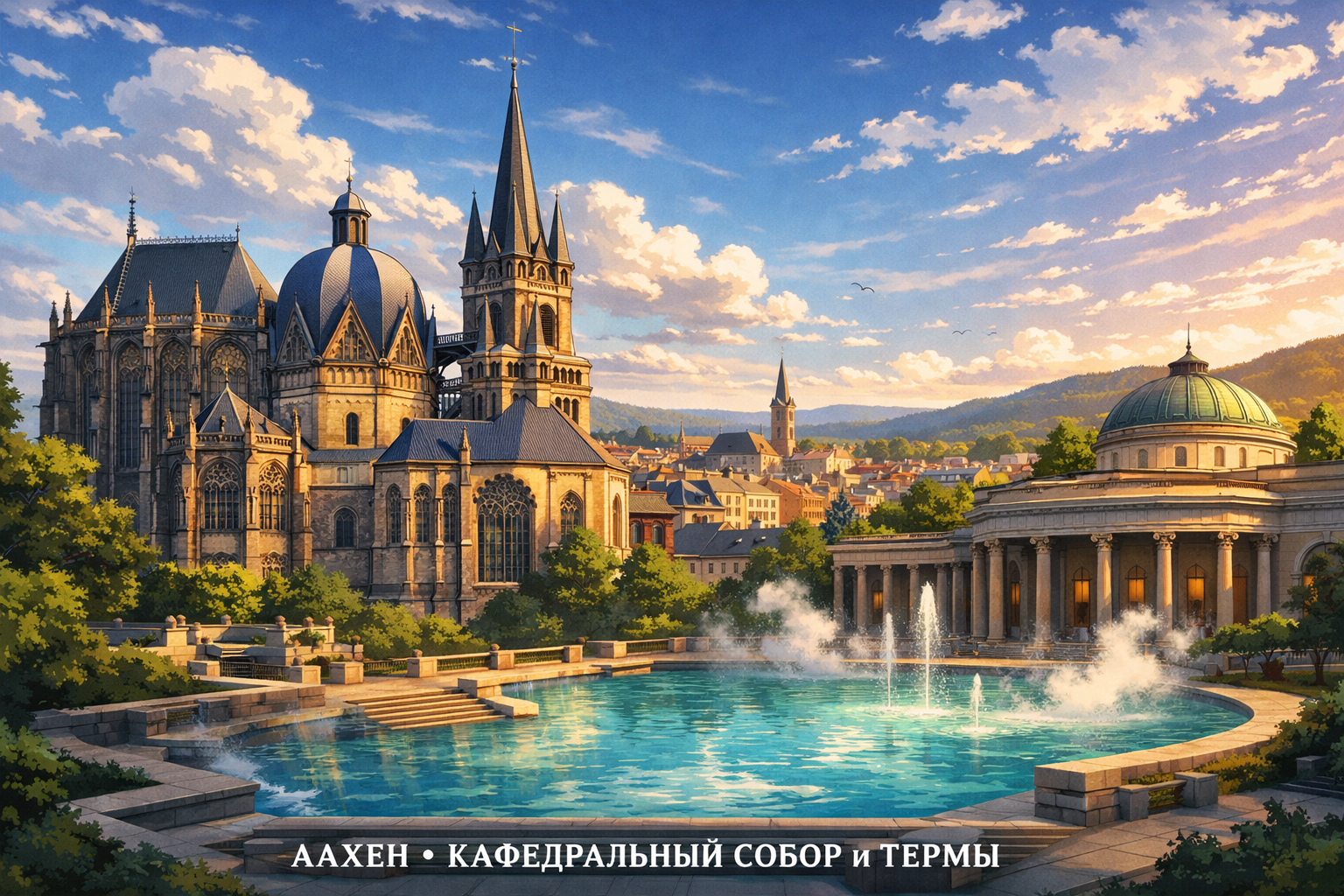
Aachen Cathedral and Thermal Baths

Aachen Cathedral and Thermal Baths

Trace Germany’s Roman heartbeat along the Rhine and Moselle, from Aachen’s cathedral and thermal springs to Cologne’s Colonia Agrippina, Zülpich’s baths, Xanten’s Archaeological Park, Bonn’s LVR museum, and Trier’s vast Roman baths and museums. A compact loop of ancient stones, warm waters, and lively river towns.

🧭 DAY-BY-DAY ITINERARY

Ready-made country and city routes with daily plans, sights, transport and accommodation. Buy PDF guides for independent travel.

🧭 DAY-BY-DAY ITINERARY


Day 1 — Aachen: arrival, Elisenbrunnen and “archaeology under glass”

  • 🚆 Arrive in Aachen (Aachen Hbf). Check in and take an easy walk through the historic center: the neoclassical Elisenbrunnen pavilion with its hot springs sets the theme for the whole trip—Romans bathed here too. Go down to the Archaeological Window in Elisen garden park: beneath a glass pavilion, the city’s earliest layers are exposed—remains of ancient and medieval development, fragments of Roman structures and utilities. In the evening, take a short loop around the Cathedral Quarter to pick out viewpoints of the cathedral for the next day.


Day 2 — Aachen: Aachen Cathedral (Charlemagne’s Palatine Chapel) and the treasury

  • 🚶 Aachen Cathedral is Germany’s first UNESCO World Heritage site: the Carolingian Palatine Chapel (octagon) builds on the ancient engineering tradition and elevates it to a new height of medieval symbolism. Outside is a rare “fusion of eras” (Carolingian, Gothic, Baroque); inside—strict octagonal geometry, columns of ancient marble, stacked arcades, gilded mosaics. Be sure to visit the Domschatzkammer (treasury): reliquaries, coronation objects, and unique ivory works tie architecture to ritual. Focus on the “drama of verticals” and on how different building campaigns “stitched” new meanings onto Charlemagne’s core.

Day 3 — Aachen: City Hall, Centre Charlemagne, and the Couven House Museum

  • 🚶 Morning—City Hall on Marktplatz: a Gothic shell with the imperial coronation hall and later additions—an illustrative textbook on the life of “Charlemagne’s capital.” Nearby is Centre Charlemagne on Katschhof: an interactive narrative about Aachen from antiquity to the 20th century that helps you “re-read” yesterday’s cathedral. Afterward—Couven Museum: urban domestic architecture and 18th–19th-century interiors in the “Monheim House”—how people lived in the old center and what the urban nodes around the market looked like.

Day 4 — Aachen: thermal tradition — Burtscheid, Elisabethhalle, and Carolus Thermen

  • 🚶 Daytime—Burtscheid quarter: the region’s hottest springs emerge here, linked to balneological practices since Roman times. Step into the historic Elisabethhalle (early-20th-century interior) and stroll through the Kurpark. Evening—Carolus Thermen, a modern spa complex: not a museum, but an excellent “translation” of the ancient idea of the thermae into today’s language (bathing halls, steam rooms, Roman and Mediterranean motifs). A cultural pause amid dense architecture.

Day 5 — Cologne: Roman Colonia Agrippina — museum and praetorium

  • 🚆 Aachen → Cologne (≈ 40–55 min by ICE/RE). Start with the Romano-Germanic Museum (temporary location in Belgisches Haus on Cäcilienstraße)—mosaics, glass, everyday items from CCAA. Then the City Hall Square area: beneath it lies the praetorium (palace of the Roman governor) and the routes of the future MiQua; today, routes around the construction site and MiQua:forum provide an excellent “map” of late-antique topography. For dessert—see Cologne Cathedral’s Gothic as the “neighbor” of the city’s ancient layer. Return to Aachen.

Day 6 — Zülpich: Römerthermen — Museum of Bathing Culture

  • 🚆 Aachen → (Cologne/Gorsdorf via the branch line) → Zülpich (total ≈ 1.5–2.0 h). Römerthermen Zülpich is an exceptionally rare north-of-the-Alps example of a Roman urban bath preserved in situ. The exhibition runs from ancient hypocausts and cosmetics to medieval bathhouse keepers and the spa phenomenon of the modern era—perfect context for Aachen. Return to Aachen.

Day 7 — Xanten: LVR Archaeological Park Xanten (APX) and the Great Baths

  • 🚆 Aachen → Xanten (≈ 2.5–3.0 h, with transfers). APX is Germany’s largest archaeological park on the site of Colonia Ulpia Traiana: streets, walls, gates, amphitheater, reconstructed quarters. A key point is the protective pavilion over the Great Baths and the LVR RömerMuseum, which stands directly on the foundations of the bath basilica. You can clearly see how the baths are “stitched” into the Roman city fabric. Return to Aachen.

Day 8 — Bonn: LVR LandesMuseum and the basilica (late antiquity and the Rhine)

  • 🚆 Aachen → Bonn (≈ 1 h 20–1 h 40 min). At the LVR LandesMuseum Bonn there’s a strong Rhine archaeology section: Roman burials, everyday objects, glass. A short walk to Bonn Minster: an early-medieval layer and the city’s connection to the Roman camp. Return to Aachen.

Day 9 — Transfer to Trier: a “Roman capital” on the Moselle

  • 🚆 Aachen → Trier (usually via Cologne/Koblenz; ≈ 3–4 h depending on the connection). Evening orientation: Porta Nigra, the axes of the old town, views of the cathedral. Overnight in Trier.

Day 10 — Trier: Imperial Baths, Barbara Baths, and the Landesmuseum

  • 🚶 A full “Roman day”: the Kaiserthermen—a giant late-imperial bathing machine with service passages and buttresses; the Barbara Baths—the other pole of urban infrastructure on a scale of almost “six football fields”; the Rheinisches Landesmuseum Trier brings together the city, the province, and the logistics of an imperial center on the Rhine/Moselle. In the evening—a panorama from the bridge over the Moselle. Overnight in Trier.

Day 11 — Return to Aachen + optional: Heerlen (Netherlands), Thermenmuseum

  • 🚆 Trier → Aachen (via Koblenz/Cologne; ≈ 3–4 h). After check-in—a short trip to Heerlen (Netherlands, ≈ 25–35 min by train via Herzogenrath): Thermenmuseum—the best-preserved Roman baths in the Netherlands under a modern pavilion. This makes a clear “Euroregional” ring of Roman baths around Aachen. Return and a final dinner in the old town.

Day 12 — Aachen: buffer/rest and departure

  • 🚶 Morning — free time: favorite angles of the cathedral, Domschatzkammer display cases, coffee by the Katschhof. Transfer to the main train station and then on to Cologne/Bonn Airport (CGN) or Düsseldorf (DUS).

Flight tickets

eSIM for travel

Buy PDF guide

Buy PDF guide — 25.71 USD

PDF — 25.71 USD